
Starving in Silence: The Case for an African Commission Resolution on Conflict-Induced Starvation in Africa
Posted: 10 June, 2026 Filed under: Harry Mwesigwa, Maram Mahdi, Sohna Jawara | Tags: 2025 Global Report on Food Crises, African Commission on Human and Peoples’ Rights, African regional human rights system, armed groups, basic food needs, basic rights to dignity, conflict, crop fields, destruction of crops, Ethiopia, farms, food security, food stocks, human rights, humanitarian issue, hunger, irrigation systems, legal problem, Nigeria, regional instruments, South Sudan, Starvation, Sudan, the Democratic Republic of the Congo, weapon of war Leave a commentAn advocacy piece
|
|
|
|
|
|
Maram Mahdi |
Harry Mwesigwa |
Sohna Jawara |
|



1 Introduction
Starvation is no longer reducible to drought, market failure or developmental lag in Africa. In conflict settings, hunger has been engineered as a weapon of war. Civilians are deprived of the means of survival not by accident but by design, through siege, the obstruction of relief convoys, the deliberate destruction of crops, and the targeting of marketplaces. The implications are stark, violating the most basic rights to dignity, health and life. In 2025, approximately 147 million people globally experienced acute food insecurity as a result of conflict.
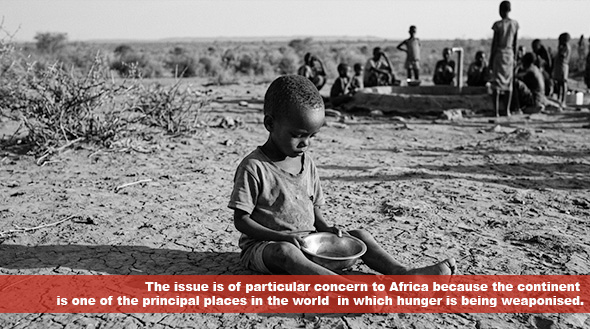
The issue is of particular concern to Africa because the continent is one of the principal places in the world in which hunger is being weaponised. The 2025 Global Report on Food Crises records more than 295 million people facing acute food insecurity across 53 countries and territories in 2024, with conflict remaining a central driver of the crisis. Several of the largest food crises are in African conflict settings, including Sudan, the Democratic Republic of the Congo, Nigeria, Ethiopia and South Sudan. In these contexts, starvation is not just a humanitarian issue but also a legal problem requiring a regional response from the African human rights system.
The African regional human rights system, ordinarily robust in its articulation of human rights, has not yet translated this lived reality into an express normative framework. Although regional instruments protect life, dignity, health, food security and humanitarian access, they address conflict-induced starvation only by inference. This piece calls on the African Commission on Human and Peoples’ Rights (African Commission) to adopt a dedicated resolution on conflict-induced starvation in Africa, acting under its promotional and protective mandate in Article 45 of the African Charter on Human and Peoples’ Rights (African Charter). Such a resolution should expressly prohibit starvation as a method of warfare, clarify the human rights obligations of states and non-state actors, and create a basis for coordinated regional monitoring, reporting and accountability.
2 The weaponisation of hunger in Africa
The African continent is host to the world’s largest concentration of acute food insecurity. Five African states – Nigeria, Sudan, the Democratic Republic of the Congo (DRC), Ethiopia and South Sudan – account for nearly two-thirds of those facing crisis-level hunger globally. Sudan, in particular, has become the paradigmatic site of weaponised hunger. For approximately 18 months, the Rapid Support Forces employed siege tactics around El Fasher, denying humanitarian convoys and advancing military offensives to coincide with the harvest season. The war in Sudan has left more than 30 million people in need of humanitarian assistance with many of them being children.
In the DRC, armed groups in North Kivu and Ituri exercise gatekeeper control over food markets, dictating who eats and who does not. The humanitarian situation in the DRC has thus worsened with the World Food Program reporting that over 26 million people – nearly one in every four Congolese – are struggling to meet their basic food needs and face worsening levels of hunger. Of these, over 4 million children under 5 years suffer severe acute malnutrition and 1.5 million pregnant and breastfeeding women are projected to be acutely malnourished. In northern Ethiopia, the Tigray conflict of 2020 to 2022 resulted in the large-scale destruction and looting of social and economic infrastructures such as industries, farms, irrigation systems, food stocks, crop fields, and businesses. The occupying forces also prevented farmers from tilling and planting on their land leading to the starvation of about 6 million people.
In Somalia and the central Sahel, jihadist actors deliberately target agricultural producers to consolidate their territorial authority and this has exposed 6.5 million people to crisis levels of hunger with 1.8 million children projected to suffer from acute malnutrition in 2026. The warring parties in the civil war in South Sudan have also used starvation as a tool of war, exposing 7.8 million people to high levels of hunger with over 2.2 million children and 1.2 million pregnant and breastfeeding women acutely malnourished. The escalating insurgent attacks in Northeastern Nigeria, particularly in Borno, Adamawa and Yobe states have fueled an unprecedented hunger crisis with nearly 5.8 million people facing food insecurity and catastrophic hunger.
What unites all these contexts is intentionality. The categorical distinction between famine as misfortune and starvation as a crime has recently become evident in conflict settings. The UN Fact-Finding Mission on Sudan has documented, in painstaking detail, conduct meeting the conventional threshold of starvation as a war crime: obstruction of impartial relief, destruction of bakeries and water installations, and the looting of granaries. These examples show that starvation in armed conflict is often not a natural or accidental phenomenon, but a political one, attributable to identifiable actors and requires an effective response from the African regional system through a comprehensive normative and accountability framework.
3 The legal framework and its lacunae
3.1 General International Law
Globally, starvation in armed conflicts rests at the intersection of different branches of international law such as international humanitarian law, international human rights law and international criminal law.
Under international humanitarian law, starvation is prohibited as a method of warfare. As most conflicts in Africa such as in Sudan, Ethiopia, Nigeria, Somalia and South Sudan are non international armed conflicts, they are at a minimum regulated by Common Article 3 and where the threshold is met, by Additional Protocol II to the Geneva Conventions.
Article 14 of Additional Protocol II prohibits the starvation of civilians as a method of warfare and this includes destruction of foodstuffs, agricultural areas, water supplies and other objectives indispensable for survival. Similarly, Rule 53 of the ICRC Customary Law Study shows that this norm has acquired the status of customary international law and is thus binding on all states and non-state actors. Rules 54 and 56 are corollary to norm and prohibit the attacking of objects indispensable to human survival and the denial of humanitarian relief.
Furthermore, Geneva Convention IV (GC IV) provides in Article 23 for the protection of civilians, and mandates belligerent states to permit the passage of consignments of medical supplies, food and clothing for civilians. Article 59 of the GC IV also places a duty on occupying powers to provide relief including ‘foodstuffs, medical supplies and clothing’ either directly or indirectly by allowing other states and humanitarian organisations to provide relief. This obligation is unconditional and also forms part of customary international law. An occupying power has limited discretion and may only restrict the passage of relief if the organisation or state providing it is not impartial in the armed conflict, or if it is going to be diverted for the war effort. But even in these circumstances, it still has the obligation to ensure alternative relief is provided to the population. The International Court of Justice (ICJ) has in its UNRWA Advisory Opinion held that the obligation to provide relief is not only limited to foodstuffs, medical supplies and clothing but also extends to other items that have the character of relief supplies such as ‘water, bedding and shelter, …[and] adequate supplies of fuel, which are essential for cooking, heating and transportation’( para 96). In addition, the ICJ has clarified that the state obligation to allow humanitarian relief does not ‘displace its basic obligations to ensure the availability of food and medical supplies essential to the survival of the local population’ (para 98). This means that states remain with the obligation under article 23 of GC IV to ensure that the local population is adequately supplied with humanitarian relief.
Under international criminal law, the Rome Statute in Article 8(2) provides that starvation amounts to a war crime when it is committed as part of a plan or policy and in an armed conflict. Thus, using starvation as a means of warfare and intentionally depriving civilians of ‘objects indispensable to their survival, including wilfully impeding relief supplies as provided for under the Geneva Conventions’ amounts to a war crime. According to the ICC Elements of Crimes, to prove the war crime of starvation under Article 8(2), it must be shown that the perpetrator deprived civilians of objects indispensable for their survival, intended to starve them as a method of warfare, and the conduct took place in an armed conflict. Starvation may also constitute a crime against humanity if it is widespread or systematic and may also amount to genocide where it is committed with the intent to destroy a protected group either in whole or in part.
While the above mentioned treaties generally deal with starvation in armed conflicts, it is important to note that it is now settled that international human rights treaties are also applicable in cases of armed conflict. The ICJ, in its Wall Advisory Opinion, held that human rights continue to apply both in peacetime and wartime and that any conflict between human rights and international humanitarian law is reconciled by the principle of lex specialis (para 106). On this basis, Article 11 of the International Covenant on Economic, Social and Cultural Rights is instructive as it guarantees the right to adequate food including the freedom from hunger. In its General Comment 12, the Committee on Economic, Social and Cultural Rights has stated that this right is indivisibly linked to human dignity, and denotes that food must be adequate, sustainable, available, accessible and of good quality (paras 7-13). In addition, states have an obligation to respect and not destroy access to food, to protect and prevent third parties such as non-state actors from destroying or hindering access to food and to fulfil which includes the positive obligation to facilitate and provide food. While this right is subject to progressive realisation, its minimum core which is that all individuals should be free from hunger attracts immediate obligations (para 17).
3.2 The African Human Rights System
Unlike the global framework which is quite comprehensive, the law on starvation in armed conflicts at the regional level remains somewhat underdeveloped. The African Charter does not contain an explicit provision on the right to food. However, the African Commission in Social and Economic Rights Action Centre (SERAC) and Another v Nigeria has interpreted the right to food as inseparably linked to the right to life, dignity of human beings and is therefore essential for the enjoyment and fulfillment of such other rights as health, education, work, and political participation. In addition, in its Guidelines and Principles on Economic, Social and Cultural Rights, the African Commission has stated that the right to food attracts certain minimum core obligations such as guaranteeing that everyone is free from hunger even in times of emergency, protecting against the destruction of food sources and refraining from using ‘access to food as a political tool to reward supporters, punish opponents or recruit militias.’ This latter obligation is important because it closely reflects the prohibition on using food deprivation as a tool of war. Furthermore, in DRC v Burundi, Rwanda and Uganda, the African Commission held that it may use Articles 60 and 61 of the African Charter to draw inspiration from the provisions of international humanitarian law (IHL) and reinforce the system of protection in Africa. This is an important finding as the Commission may invoke the elaborate IHL provisions already discussed above in its framing of a Resolution against starvation.
Similarly, three thematic resolutions adopted by the African Commission – Resolutions 374 (2017), 431 (2019) and 514 (2022) – progressively elaborate the right to food, with Resolution 374 going furthest by calling on non-state actors to permit unhindered humanitarian access. Complementary protection is afforded to women, under articles 11 and 15 of the Maputo Protocol, which respectively address the protection of women in armed conflict and guarantee a stand-alone right to food security. Articles 14 and 22 of the African Children’s Charter, which require provision of nutritious food and the observance of IHL in conflicts affecting children, provide additional protection in respect of children. The African Committee of Experts on the Rights and Welfare of the Child has further elaborated on these obligations in its 2020 General Comment on Article 22 and has stated that children in armed conflicts are entitled to adequate food and nutrition. Given the child-specific impact of starvation in armed conflict, the African Commission could coordinate with the African Committee of Experts in developing any future resolution on the issue. This would ensure that the regional response captures the distinct harms suffered by children, including malnutrition, displacement, family separation and heightened exposure to disease, while strengthening coherence between the African Charter and the African Children’s Charter.
These instruments are important, but they do not specifically name starvation as a method of warfare, nor do they provide a conflict-specific framework on sieges, humanitarian access, attacks on objects indispensable to survival, accountability for starvation crimes, or coordination with peace and security institutions. A standalone resolution is therefore necessary to define states’ obligations in conflict settings and to link the human rights dimensions of starvation with the African Union’s peace and security architecture. At a technical and policy level, this would help align the Commission’s instruments with relevant decisions and communiqués of the African Union Peace and Security Council, while creating a more coordinated regional response to starvation in armed conflict.
The Commission’s current special mechanisms also reveal the gap. None of the existing working groups expressly addresses starvation in armed conflict. The Working Group on Economic, Social and Cultural Rights is the most natural institutional home for this issue because starvation directly implicates the rights to food, health, life and dignity. The Working Group on Extractive Industries, Environment and Human Rights Violations may also be relevant where conflict, land dispossession, environmental destruction and food insecurity intersect. However, neither mechanism presently has a mandate focused on conflict induced starvation. The proposed resolution could therefore expand the mandate of the Working Group on Economic, Social and Cultural Rights to monitor the issue systematically.
This case for a standalone resolution is in no way intended to be an indictment on the work of the African Commission or other regional actors. The Commission, non-governmental organizations and other regional bodies are reacting to the starvation crisis on the African continent. For instance, recently, the February 2026 statement of the African Commission condemned the ‘food aid trap’ in South Sudan. The Commission’s Fact-Finding Mission Report in Sudan similarly highlighted the issue of starvation; however, it remained silent on the possible avenues for management and accountability. These interventions show that the Commission is attentive to the issue, but still lacks a standing framework for addressing it systematically.
4 Reforms and the case for a dedicated resolution
We propose that the African Commission should adopt, at its next ordinary session, a dedicated resolution on the prohibition of starvation as a method of warfare in Africa. Such a resolution should perform four distinct normative functions:
- First, it should provide definitional clarity. The resolution should define starvation as a method of warfare by drawing on Common Article 3, Article 14 of Additional Protocol II and Articles 8(2)(b)(xxv) and 8(2)(e)(xix) of the Rome Statute. It should expressly identify conduct now visible in African conflicts, including siege, denial of humanitarian access, destruction of agricultural infrastructure, attacks on markets and water systems, manipulation of food aid, and the use of food as a tool of political coercion. This definitional precision prevents engineered famine from being mischaracterised as drought, administrative failure or ordinary humanitarian misfortune.
- Second, it should articulate state obligations. The resolution should require states to refrain from starvation practices, to ensure rapid and unimpeded humanitarian access, to avoid arbitrary bureaucratic impediments to humanitarian action, and to protect objects indispensable to civilian survival. It should also clarify due diligence obligations in relation to non-state actors, including the duty to prevent, investigate and punish starvation-related crimes committed on territory under a state’s jurisdiction or control. This would give regional human rights expression to the logic of UN Security Council Resolution 2417, but in a form calibrated to African conflicts and African institutions.
- Third, it should create an institutional architecture. The resolution should consider extending the mandate of the Working Group on Economic, Social and Cultural Rights to include an explicit focus on starvation. In addition, Commissioners dealing with countries undergoing armed conflict such as Sudan, DRC, and other Sahelian countries could undertake country missions, issue urgent appeals, and table thematic reports on starvation, particularly on the magnitude and responsible actors. Where starvation has a direct impact on children, the resolution could also provide for cooperation with the African Committee of Experts on the Rights and Welfare of the Child.
- Fourth, it should strengthen accountability and remedies. The resolution should make clear that starvation-related violations may be raised through communications before the Commission where they implicate Charter rights, including the rights to life, dignity, health, property, development and the protection of the family. It should encourage states to investigate and prosecute starvation crimes domestically, cooperate with regional and international accountability mechanisms, and provide remedies to affected communities. Reparations should not be limited to compensation. They should include the restoration of livelihoods, agricultural land, livestock, water systems, markets and other conditions necessary for communities to regain food autonomy.
5 Conclusion
Hunger weaponised in armed conflict is a violation of human dignity in its starkest form. Beyond institutional reform, we are also advancing this advocacy through public awareness and civil society mobilisation. We have launched an online petition to build public support for a regional response, including the adoption of a resolution on ending weaponised starvation in Africa. We are also raising awareness through the Global Campus Starvation Tool, which helps educate stakeholders on the legal characterisation of starvation, the protection of civilians, and the accountability implications of using starvation as a weapon of war.
The African regional system already has the legal basis to respond through an authoritative regional statement that names starvation as a method of warfare, identifies the duties of states and non-state actors, and equips the Commission with institutional means for prevention, monitoring and accountability. A dedicated African Commission resolution would close the normative gap and give the African human rights system a clearer basis to confront one of the most brutal features of contemporary armed conflict on the continent.
About the Authors
Maram Mahdi has a background in peace and security and vast experience in governance, conflict prevention and management, and transitional justice. She holds a BPolSci and MA Security Studies from her alma matter, the University of Pretoria. Maram has worked with the Institute for Security Studies in their respective Addis Ababa and Pretoria offices. A published researcher and policy enthusiast, she is passionate about expanding and connecting the African human rights system and peace architecture.
Harry Mwesigwa is an LLM Candidate in Human Rights and Democratisation in Africa at the Centre for Human Rights, University of Pretoria, and a Researcher at the Human Rights and Peace Centre (HURIPEC), Makerere University. He holds a Bachelor of Laws (LL.B) and a Postgraduate Diploma in Legal Practice, with interests in public international law and international human rights law.
Sohna Jawara’s legal experience includes legal practice in conventional and Sharia courts. Ms Jawara is currently a State Counsel at the Attorney General’s Chambers & Ministry of Justice, specialising in criminal and civil litigation, government advisory work, and human rights advocacy. She prosecutes cases with strategic litigation expertise, drafts legal instruments, and contributes to law reform and national development initiatives on behalf of the Government of The Gambia. Trained in both conventional and Sharia law systems, she possesses strong courtroom advocacy and legal research skills. She holds an LL. B (Cum Laude) and a Barrister-at-Law (Merit) qualification, with additional training in human rights, democracy, intellectual property and criminal justice. Ms Jawara is justice-oriented and navigates the law with a unique approach to achieve justice. Her academic interest include Human Rights, Migration Law, Religion and Cultural Education, Democracy, Access to Justice and Litigation Strategies.

