
What the Constitution of Zimbabwe Amendment Number 3 Bill means for democracy
Posted: 19 June, 2026 Filed under: Nqobani Nyathi | Tags: 2008 elections, Amendment Number 3 Bill, changing term limits, Constitution of Zimbabwe, Constitution of Zimbabwe Amendment Number 3 Bill, democracy, five years, gender equality, good governance, Government of National Unity, human rights, human rights violations, rule of law, transparency, violence, ZANU-PF, Zimbabwe Leave a comment Author: Nqobani Nyathi
Lawyer
Introduction
In 2013, Zimbabweans voted overwhelmingly for a new Constitution. Drafted during the Government of National Unity after the violence and massive human rights violations that followed the 2008 elections, it marked a national attempt to break from the past.
The Constitution of Zimbabwe is anchored in clear values. These include the rule of law, human rights, gender equality, transparency and good governance. Above all, it affirms that authority to govern derives from the people of Zimbabwe. For the third time, that founding vision is under threat.
Another regressive turn
On 16 February 2026, Constitution of Zimbabwe Amendment Number 3 Bill (Bill) was gazetted. The governing party, ZANU-PF, has long signalled its intention to amend the Constitution to extend Mnangagwa’s term of office by two years. Like its predecessors, this amendment is not people driven. Each amendment has slowly weakened the democratic safeguards painstakingly negotiated in 2013.
The Bill is even more regressive. In some respects, it is plainly unconstitutional.
Extending Presidential and Parliamentary terms
The most striking proposal is the extension of presidential and parliamentary terms from five to seven years. Section 143(1) of the Constitution states that “Parliament is elected for a five-year term,” and section 95(2)(b) provides that the President’s term of office is “five years and coterminous with the life of Parliament.” The justification offered for this change is that this will reduce “election mode toxicity” and promote “stability.”
That argument is hollow. Stability comes from credible elections and strong institutions, not a longer electoral cycle. In reality, this proposal aligns with ZANU (PF)’s political objective to extend Mnangagwa’s term of office to 2030. Yet section 328(7) of the Constitution expressly provides that “an amendment to a term-limit provision, the effect of which is to extend the length of time that a person may hold or occupy any public office, does not apply in relation to any person who held or occupied that office.” This safeguard exists to prevent incumbents from rewriting the rules for their own benefit.
The Bill attempts to bypass this protection through wordplay, stating that, notwithstanding the safeguard, the proposed change of term “shall apply to the continuation in office of the President.” In other words, it seeks to make the longer term apply to the current President. This also appears to be an attempt to avoid the two referendums required by the Constitution for changing term limits. However it is framed, the effect is the same. This provision was crafted as a shield against personalised rule. Ignoring it would be illegal and unconstitutional and would, in effect, amount to an unconstitutional change of government.
There is nothing inherently wrong with a five-year electoral cycle. It is one of the most common cycles in democratic states. Zimbabweans chose it. Changing it without meaningful public consultation, particularly for the benefit of an individual, disregards the people’s will.
To be clear, most of the so-called “toxicity” surrounding elections has stemmed from violence, partisan and weak institutions, resulting from the conduct of state agents or operatives of the ruling party ZANU-PF. It is a self-inflicted wound which would only be addressed by change of conduct of those in power, not by merely tinkering with the length of presidential or parliamentary terms. Extending terms without addressing electoral credibility does nothing to reduce this “toxicity.” It merely postpones it.
Removing the people from Presidential elections
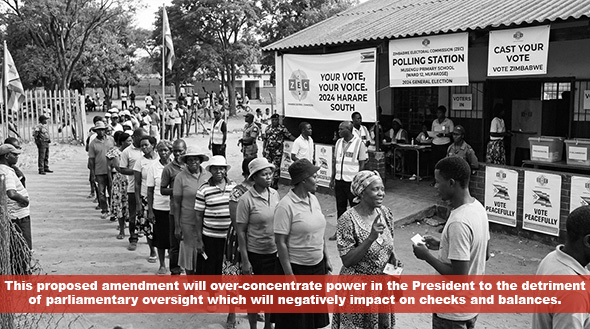
The Bill proposes to remove the direct election of the President and replace it with election by Parliament. No public demand has driven this change, and yet it is being rushed through without consultation.
At the same time, the amendment will empower the President to appoint ten senators. A President elected by Parliament, while influencing its composition, creates a troubling accountability paradox. This proposed amendment will over-concentrate power in the President to the detriment of parliamentary oversight which will negatively impact on checks and balances.
Weakening electoral integrity
Electoral safeguards are also being weakened. The Zimbabwe Electoral Commission (ZEC) is constitutionally mandated to run free and fair elections. The Bill seeks to remove voter registration and compilation of the voters’ roll from ZEC and transfer it to the Registrar-General, a civil servant under the control and direction of the executive and lacking constitutional independence. This is the same office whose previous mismanagement led to the 2013 constitutional reform, vesting the function exclusively in ZEC.
Rather than strengthening ZEC, the amendments reverse hard-won reforms. The efficiency justification is unconvincing and ignores the historical reasons for removing voter registration from executive control.
The Bill further proposes a Zimbabwe Electoral Delimitation Commission to take over boundary delimitation. Unlike ZEC, this body would lack strong independence safeguards. Instead of resolving disputes, it risks generating new ones.
Undermining judicial independence
The 2013 Constitution introduced public interviews for judicial appointments to enhance transparency and rebuild trust in the courts. Previous amendments weakened this safeguard. In 2017, the first amendment removed public interviews for the Chief Justice, the Deputy Chief Justice and Judge President of the High Court. In 2021, the second amendment allowed the promotion of sitting Judges to higher courts without public interviews and enabled the President to extend the tenure the Chief Justice, Deputy Chief Justice and other senior Judges beyond the retirement age. This Bill now removes public interviews for all judges entirely, without any justification.
Public interviews are a deliberate reform to curb executive dominance and opaque judicial appointments. Removing them concentrates more power in the executive and undermines judicial independence, a cornerstone of constitutional democracy.
Rolling back on gender equality
The Bill proposes abolishing the Zimbabwe Gender Commission (ZGC) and transferring its functions to the Zimbabwe Human Rights Commission (ZHRC).
Gender equality is a founding value embedded in the Constitution’s Declaration of Rights and in its Chapter 12’s architecture of independent commissions. The ZGC was deliberately established as a stand-alone body because systemic gender inequality requires focused monitoring, investigation, research and remedial action. Its mandate is detailed and proactive. Folding it into an already overstretched ZHRC, which carries the dual burden of promoting human rights and addressing maladministration will inevitably dilutes attention and expertise on gender equality.
The proposal is also inconsistent with Zimbabwe’s regional obligations. It comes less than a year after the African Commission on Human and Peoples’ Rights specifically urged Zimbabwe to “continue providing support to the mandate and resources of the Zimbabwe Gender Commission”, in its Concluding Observations. Abolishing the ZGC soon after this recommendation is not only regression but also an act of bad faith. It undermines both domestic constitutional commitments and Zimbabwe’s standing within the African human rights system.Top of FormBottom of Form
Politicising traditional leadership
The 2013 Constitution prohibited traditional leaders from engaging in partisan politics. They were barred from being members of political parties, acting in a partisan manner, or furthering any political cause. This safeguard was introduced because traditional leaders had previously been used for partisan mobilisation and, at times, to facilitate human rights violations. The Bill seeks to remove this safeguard entirely, risking community cohesion and electoral fairness.
A betrayal of the 2013 promise
Taken together, these amendments do not “reinforce constitutional governance,” as claimed in the Bill’s Memorandum. They concentrate power in the President, reduce transparency and erode checks and balances. The 2013 Constitution sought to ensure that power would never again be personalised and unchecked. This Bill undermines that vision and weakens the democratic project Zimbabweans endorsed in 2013.
About the Author:
Nqobani Nyathi is a Zimbabwean lawyer

