
From commitments to concrete action: Ending femicide in South Africa
Posted: 20 July, 2026 Filed under: Derara Roba, Keziah Mwashigadi, Noah Yesuf, Rumbidzai Musonza | Tags: accountability, femicide, gender-based violence, human dignity, intimate partner violence, live free from violence, National Council on Gender-Based Violence and Femicide Act 9 of 2024, national disaster, National Strategy on the Prevention of Femicide, South Africa, woman's rights, women’s dignity Leave a commentThe Authors are enrolled in the LL.M in Human Rights and Democratisation in Africa (HRDA) at the Centre for Human Rights, University of Pretoria.
|
|
|
|
|
|
Noah Yesuf |
Rumbidzai Musonza |
Derara Roba |
Keziah Mwashigadi |



Femicide in South Africa: The staggering realities
Femicide represents the most extreme manifestation of gender-based violence against women and girls. The numbers are frightening as reports have repeatedly shown that South Africa has one of the highest femicide rates in the world. Recent records indicate that the rate of intimate partner violence in South Africa is five times higher than the global average, and approximately 15 women are killed every day.
Yet, the response remains sluggish, unable to effectively tackle the pervasive ongoing femicide crisis that poses a daily threat to women’s lives and deprive their constitutional right to live free from violence with dignity, equality, and freedom.
Femicide as a national disaster
Femicide, an affront to human dignity, does not have a universally accepted definition. Working definitions refer to it as the intentional killing of women or girls based on their gender. In South Africa, the National Council on Gender-Based Violence and Femicide Act 9 of 2024 defines femicide as “the killing of a female person or a person on the basis of gender identity as a female, whether committed by a person within a domestic relationship, interpersonal relationship, or by any other person.” Among the many legislative and policy measures adopted by South Africa to address this pressing crisis are the adoption of the National Strategy on the Prevention of Femicide and setting up reporting systems, and the decision to classify femicide as a national disaster by the government of South Africa in November 2025, which marked another major move to ensure the rights of women in South Africa. However, despite decades of progress through legislative and policy initiatives, there remains a pressing need for concrete action and effective implementation to ensure women’s safety in the country.
Stripping women of dignity, equality, and freedom
Undoubtedly, women who endure violence such as choking, shooting, and stabbing, and whose lives ultimately become tragic, are stripped of the core democratic values of human dignity, equality, and freedom that underpin the post-1994 constitutional order. Women such as Marilize, who was shot; Marchein, whose throat was cut; and Thembisa, who was stabbed, were robbed of these ideals, which form the foundation of the Bill of Rights under the Constitution and which the state is obliged to respect, protect, promote, and fulfil.
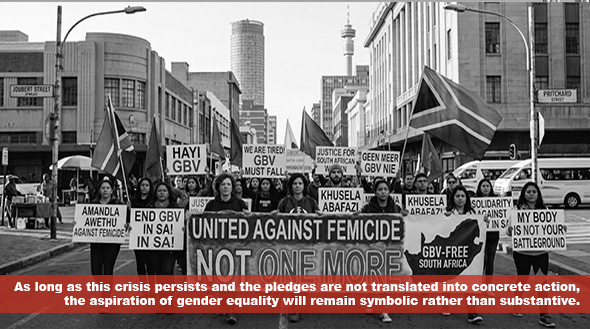
As long as this crisis persists and the pledges are not translated into concrete action, the aspiration of gender equality will remain symbolic rather than substantive. Femicide happens every single day, and with each instance, women’s dignity is eroded. This highlights the imperative for the nation to prioritise and act decisively to combat femicide to protect women who make up 51% of South Africa’s population.
Turning commitments into concrete action
Studies show that femicide is preventable through collective, transformative, and targeted measures. Declaring femicide as a national disaster is a step in the right direction. While acknowledgement and commitments are important, it is actions that truly save lives. Addressing femicide requires concerted action from the state and other stakeholders, including civil society. Some of these measures are briefly highlighted in the following paragraphs.
Prevention and root-cause identification: As a country, the medication to cure femicide is moving from reaction to prevention through addressing the root causes and following prevention measures. A declaration of femicide as a national disaster should be accompanied by a stand-alone budget that can be invested in prevention measures, including education, training, setting up femicide surveillance and early warning systems, and risk identification mechanisms. Strengthening school-based gender education and systems to track repeat offenders is also essential.
Inter and multisectoral coordination: A 2025 study identified a cross-sectoral coordination gap in GBVF responses. Scaling up coordination efforts across different departments and tiers of government, CSO, the media, service providers, and international actors should be harnessed to respond to the crises collectively. Enhancing collaboration among the police, courts, and social services is crucial for ensuring accountability, protecting those at risk and supporting survivors.
Societal approach: A 2022 study highlighted the obvious reality that males are the primary perpetrators of femicide, and patriarchal norms and structures have contributed to the causes. As a society, we must understand that a boy who is not nurtured today has a high chance of becoming a perpetrator tomorrow. Families need to start to educate their children, and societies need to transform the deeply ingrained patriarchal social norms and structures that subordinates women and fuels femicide.
Further, a social fracture cannot be healed by legal measures alone; Ubuntu calls on us to embrace our collective responsibility to fight this serious social evil. Each individual and organ of society has a role to play. Let us end this tragedy and not wait for another victim’s blood to call for justice.
About the Authors
Noah Yesuf is a human rights practitioner from Ethiopia with over five years of experience working on human rights issues, particularly in civic space, the protection of human rights defenders, human rights education and training, and research. Noah has worked as a Protection and Research Manager at the Ethiopian Human Rights Defenders Center (EHRDC), with other human rights experience. His areas of interest span human rights advocacy and research, civic space, rule of law, and democracy. Noah is currently enrolled in the LLM in Human Rights and Democratisation in Africa (HRDA) program at the Centre for Human Rights, University of Pretoria.
Rumbidzai Musonza is a feminist human rights advocate currently enrolled in the LLM in Human Rights and Democratization in Africa (HRDA) at the Centre for Human Rights, University of Pretoria. Her work is grounded in advancing youth development, gender justice, human rights, and climate action across the African continent. She is the founder of Raising Our Roar, a feminist newsletter dedicated to healing, storytelling, and truth-telling as tools for social transformation. Her research interests focus on women’s rights, sexual and gender-based violence, and the protection of vulnerable and marginalized communities.
Derara Roba is the Co-Founder and Executive Director of HALE: Human Rights and Inclusion Network, a youth-led civil society organisation established in Ethiopia and has served as a Lecturer at Dilla University and Madda Walabu University, Ethiopia. He holds an LL. B from Hawassa University and an MPhil from UiT The Arctic University of Norway. He is currently enrolled in the LL.M in Human Rights and Democratisation in Africa (HRDA) at the Centre for Human Rights, University of Pretoria. His research interests include transitional justice, legal pluralism, and indigenous peoples and minority rights, approached from a multidisciplinary perspective.
Keziah Mwashigadi is a lawyer, certified professional mediator, and human rights advocate currently enrolled in the LLM in Human Rights and Democratisation in Africa (HRDA) at the Centre for Human Rights, University of Pretoria. Her work focuses on gender justice, human rights, and access to justice in Africa. She is the founder of Employee & Legal Solutions Kenya (ELSK), a consultancy providing legal and regulatory compliance services. Her research interests include women’s rights, gender-based violence, disability rights, and the protection of vulnerable and marginalised communities.
 AfricLaw