
Between coordination and enforcement: What the GBVF disaster declaration actually delivers
Posted: 8 June, 2026 Filed under: Rethabile Mosese | Tags: accountability, ActionSA, criminal justice system, Disaster Management Act, Domestic Violence Act, femicide, GBVF, gender-based violence, legal advocacy organisations, national disaster, National Disaster Management Centre, National Prosecuting Authority, National Shelter Movement of South Africa, political decision, Public Finance Management Act, Rape Crisis Cape Town Trust, sexual offences, Sexual Offences Act, Victims of Crime Survey, Women for Change Leave a comment Author: Rethabile Mosese
Centre for Human Rights, University of Pretoria
A political victory, a legal question
On 21 November 2025, thousands of women lay on the ground for fifteen minutes at the Union Buildings, in shopping centres, on pavements and office floors, honouring the women killed every day in South Africa. I joined them knowing that these numbers are not abstract. Though exact figures fluctuate with reporting cycles, research by the South African Medical Research Council and Gender and Firearms Studies Africa estimates that around fifteen women are murdered daily. Hours after this collective act of mourning, government declared gender-based violence and femicide a national disaster under the Disaster Management Act. For many, the declaration felt like long-awaited recognition. But the legal instrument government chose matters as much as the declaration itself. Having spent over a decade inside the systems meant to protect survivors, I understand how much turns on that choice.
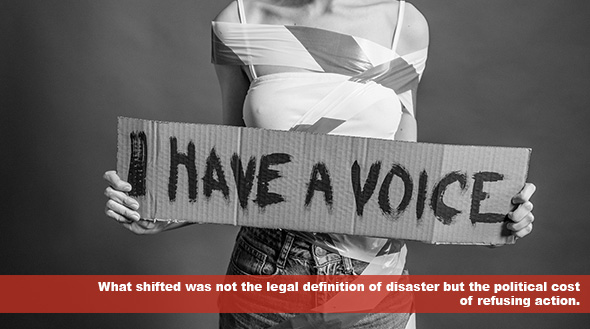
Government’s reversal was political before it was legal. Two weeks earlier, the National Disaster Management Centre had rejected classification, insisting that GBVF “cannot reasonably and rationally be regarded as a disaster.” What shifted was not the legal definition of disaster but the political cost of refusing action. Women for Change had secured over 1.1 million signatures. The national shutdown during the G20 Summit withdrew women’s labour and forced international attention onto a crisis government has long normalised. Once the state capitulated, it faced the more consequential decision: which legal authority to use.
The Disaster Management Act offers two pathways. Section 23 creates a coordination mandate, instructing the executive to manage the crisis within existing legislation, budgets, and systems. Section 27 creates emergency powers, enabling Cabinet to gazette binding regulations with the force of law, override existing systems through emergency procurement, and rapidly deploy resources. Government opted for Section 23. The distinction is not merely academic: when COVID-19 was declared a state of disaster in March 2020, Cabinet gazetted extensive regulations within 72 hours. When the KwaZulu-Natal floods struck in 2022, a Section 27 declaration enabled immediate SANDF deployment and emergency housing measures that would have been legally unavailable under Section 23. Section 23 unlocks coordination; Section 27 unlocks capacity.
The deeper distinction is that Section 27 changes the default. Under Section 23, every intervention requires a fresh political decision to act; inaction carries no legal consequence. Under Section 27, regulations must be gazetted, their content is subject to constitutional scrutiny, and Parliament retains oversight of their exercise. When an instrument creates obligations and a legal record, accountability is at least possible. When it creates neither, as Section 23 does not, the political cost of inaction approaches zero.
Coordination without capacity
We therefore face a national disaster governed by the weakest legal mechanism available, and those mechanisms must operate within systems that are already failing. The GBVF response is a pipeline in which resources consistently evaporate before reaching survivors. Provincial departments receive allocations that pass to district offices, which contract implementing partners such as shelters and legal advocacy organisations. At each tier, a portion is retained for programme management; the funds eventually reaching frontline organisations are a fraction of what Parliament intended. According to the National Shelter Movement of South Africa, Gauteng alone returned hundreds of millions of rands in unspent GBVF allocations in recent financial years, not because the need had gone, but because procurement law blocked the money from reaching the organisations capable of spending it. Shelters operated at or beyond capacity while the funds sat unspent. Survivors were told no beds were available, handed a list of numbers, and instructed to try again.
The Public Finance Management Act requires competitive tender processes for contracts above certain thresholds. Smaller community organisations, those most trusted by survivors, are systematically unable to meet the compliance requirements, not because they are inefficient, but because they operate in a feminised care economy the state has chronically undervalued. The compliance burden falls hardest on organisations doing the most necessary work precisely because that work has never been treated as infrastructure. Section 23 cannot override procurement requirements, create emergency funding streams, or shift unspent allocations mid-year. It asks existing systems to coordinate their way out of structural failure.
The criminal justice system reflects the same measurement problem. Statistics South Africa’s Victims of Crime Survey consistently shows that the majority of sexual offences are never reported to the police. Of the cases that are reported, research by the Rape Crisis Cape Town Trust shows that fewer than one in ten ends in conviction. The National Prosecuting Authority reports conviction rates of roughly 75% for cases that reach verdict. The gap between those figures is not a rounding error; it is a measurement design problem. The system counts success only after attrition has eliminated the vast majority of cases. The GBVF response architecture, across its funding flows, its statistics, and its coordination structures, is designed to measure its own activity rather than survivor outcomes. What no coordination mandate can do is reorient those systems toward the question they have never been required to answer: are survivors safer?
An unfilled legal gap that continues to expose women to danger
Government may argue that Section 27 is inappropriate for GBVF because it is not an acute disaster with a clear beginning and end but a chronic structural condition. Section 27 was designed for sudden events where emergency powers are needed and the Constitution requires that those powers be time-limited. This argument has legal merit, but it proves too much. Accepting it does not lead to Section 23; it exposes a genuine gap in the legal framework. South Africa has no adequate instrument for chronic crises that have crossed an emergency threshold. Section 23 is too weak to compel the institutional change the crisis demands; Section 27 is constitutionally constrained in ways that make permanent deployment legally untenable. That gap is itself a legislative failure. What the government’s choice of Section 23 achieves is not a solution to this gap but a deferral of it, channelling political pressure into a coordination apparatus rather than converting it into demand for legislative reform.
This is not a new pattern. The National Strategic Plan on GBVF (2020–2030), developed after the 2018 Total Shutdown marches, made comparable promises of systemic transformation through coordinated multi-sectoral implementation. Five years on, its own monitoring data shows implementation gaps across every pillar. What the NSP parallel reveals is not that all instruments fail equally, but that instruments without binding obligations and enforcement mechanisms fail predictably. The NSP had no legal force. Section 23 has no emergency powers. Both asked existing systems to coordinate their way toward outcomes those systems were not designed or resourced to deliver. Section 23 repeats that structure.
Powers unused, promises unkept
Section 23’s limitations do not mean ministers are powerless. Existing legislation already gives them regulatory authority they have not used. Section 19(1) of the Domestic Violence Act empowers the Minister of Justice to make regulations on protection order procedures, training requirements, and service standards. Section 73 of the Sexual Offences Act permits regulations on evidence handling, forensic turnaround times, and victim-witness support. A search of the Government Gazette reveals that no regulations have been issued under either provision since both Acts came into force. The Public Finance Management Act also permits virement between programmes and emergency expenditure for unforeseen needs, mechanisms used extensively during COVID-19. If GBVF is truly a national crisis, there is no principled reason they cannot be deployed now.
When this article was first written, three benchmarks were proposed: new regulations under the Domestic Violence Act or Sexual Offences Act in the Government Gazette; budget reprioritisation through virement or emergency expenditure; and consolidated quarterly reporting on prosecution outcomes, shelter capacity, and service accessibility, all of which are permissible under the referenced legislation. Four months after the declaration, none has been initiated.
In December 2025, responding to a written parliamentary question by ActionSA MP Dereleen James, President Ramaphosa confirmed that no temporary powers had been assigned to ministers, no regulations had been issued, and no additional resources had been allocated. The February 2026 National Budget allocated a general contingency reserve for disasters but contained no dedicated GBVF line item. In the State of the Nation Address, the President devoted 72 seconds of a 100-minute speech to a declared national disaster. The National Council on Gender-Based Violence and Femicide Act of 2024, proclaimed in November 2025 and designed as the central accountability body, has still not been established. Section 23 delivered exactly what its legal architecture permitted: a coordination mandate without enforcement, recognition without resources, and declaration without transformation.
The record of inaction under Section 23 is precisely the evidence for the need for a specific legal tool to address chronic problems such as GBVF with clear legal powers to address the ‘disaster’ similar to other emergencies, with oversight and consequences for inaction. Under Section 23, inaction carries no legal consequence; under Section 27, the obligation to act is inscribed in the instrument, and political inertia must work harder to produce the same outcome. An instrument to address chronic problems like GBVF is necessary and imminent.
What the declaration deferred
What Women for Change achieved is significant. Over eighteen months, they built a coalition that forced government to acknowledge that the scale of violence in South Africa is intolerable. Acknowledgement, however, is not transformation. Civil society secured the declaration; civil society did not secure the instrument. Survivors navigating broken systems need beds in shelters, evidence collected properly, cases that reach trial, and budgets that reach the organisations doing the work. Those outcomes require law, resources, and political will, in that order.
The deeper lesson concerns what the entire GBVF response architecture was built to do. Systems that measure their own activity rather than survivor outcomes will optimise for the former. A legal instrument that adds coordination reporting to those systems does not transform them; it extends them. What South Africa requires is not a better coordination mandate but a legislative framework that makes survivor outcomes the enforceable measure of institutional performance, with binding obligations, independent monitoring, and consequences for failure. Building that framework is the work the declaration, for all its hard-won significance, has deferred.
About the Author:
Rethabile Mosese is an admitted attorney who has led survivor-centred legal services and gender-based violence programmes for over a decade. She previously served as Deputy Director at Lawyers Against Abuse and is currently pursuing her LLD at the University of Pretoria.

