
Does the ACHPR Really Get It?! Human Rights Defenders, African Values, and the Dangerous Drift Toward Normative Regression
Posted: 31 May, 2026 Filed under: Mai Aman | Tags: ACHPR, ACHPR’s Draft Declaration, African Commission on Human and Peoples’ Rights, African values, anti-terror legislation, apartheid, authoritarianism, civic space, civil society actors, colonialism, community primacy, culture, digital surveillance frameworks, freedom of expression, Guidelines on Freedom of Association and Assembly in Africa, hostile environments, human rights defenders, LGBTQ defenders, moral health of society, official panel discussion, protest rights, public-order laws, respect for institutions, restrictive NGO regulations, Sovereignty, state security, women human rights defenders Leave a comment Author: Mai Aman
Centre for Human Rights, University of Pretoria
Civil society organisations (CSOs) participating at the 87th Ordinary Session of the African Commission on Human and Peoples’ Rights (ACHPR/ the Commission), held in Banjul, the Gambia from 12 to 20 May 2026, were alarmed when discussions began emerging around a Draft Declaration on the Promotion of the Role of Human And Peoples’ Rights Defenders And their Protection In Africa. For many CSOs working directly on civic space, freedom of expression, protest rights and defender protection across the continent, this was the first time they had become aware that such a process was already underway within the Commission.
The concern was not simply procedural, although the limited consultation surrounding a Declaration of such potential normative significance immediately raised questions. Rather, alarm quickly grew once civil society actors were able to review the text itself. As the Draft Declaration began circulating during the session, organisations realised that, in its current form, the Declaration risked doing the exact opposite of what a Declaration on human rights defenders should do; instead of strengthening protections for defenders operating in increasingly hostile environments, the Draft Declaration appeared capable of legitimising the very frameworks already being used to repress them.
The issue rapidly became a subject of discussion both within formal and informal spaces of the session. CSOs with observer status before the Commission raised concerns through oral statements, warning about the dangers posed by several provisions of the Draft. The Commission itself dedicated an official panel discussion during the session to the proposed Declaration,at which, CSOs pushed back. Simultaneously, CSOs began mobilising collective responses and submissions to be shared with the Commission on the Draft Declaration.
The Reality: Human Rights Defenders in Africa Are Under Siege
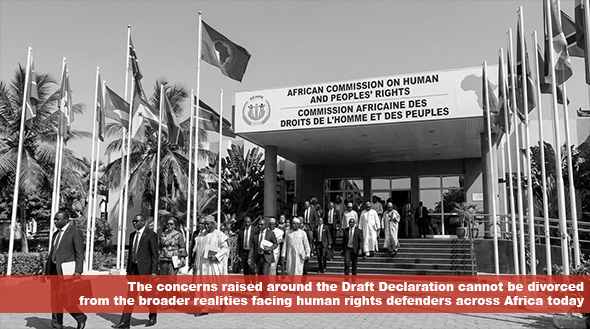
The concerns raised around the Draft Declaration cannot be divorced from the broader realities facing human rights defenders across Africa today. Across the continent, defenders increasingly operate in environments defined not by protection, but by repression. Journalists are arrested under cybercrime and anti-terror laws. Protest organisers are prosecuted as threats to national security. Feminist activists are accused of undermining “African values.” Environmental defenders exposing abuses linked to extractive industries are harassed, surveilled and, in some instances, killed. Human rights advocacy itself is increasingly framed as destabilisation, foreign interference, or opposition to culture, morality and sovereignty.
This shrinking of civic space is not incidental. It reflects a broader continental and global trend toward the securitisation of dissent. Governments increasingly rely on anti-terror legislation, digital surveillance frameworks, restrictive NGO regulations, public-order laws and morality rhetoric to discipline political opposition and civic mobilisation. In many contexts, the language of sovereignty, culture and national stability has become intertwined with efforts to suppress criticism and delegitimise independent civil society.
It is precisely within this context that the ACHPR’s Draft Declaration becomes so significant. Africa urgently needs stronger regional protections for human rights defenders. Yet, ironcily, the current Draft Declaration risk reflecting a deeper and more troubling shift within the African human rights system; a shift away from protecting dissent and toward regulating, disciplining and securitising it.
The ACHPR’s Legacy and Why This Draft Matters
The concern surrounding the Draft Declaration stems not only from its content, but also from the historical role the ACHPR itself has played within the African human rights system. Over the last three decades, the Commission has positioned itself as one of the continent’s most important normative actors in relation to civic space, freedom of expression, freedom of assembly and the protection of vulnerable groups.
Through resolutions, concluding observations, soft law instruments and jurisprudence, the ACHPR has repeatedly affirmed that dissent forms a legitimate and necessary part of democratic society. The Commission’s Guidelines on Freedom of Association and Assembly in Africa recognised the centrality of protest and public participation. Its resolutions on women human rights defenders acknowledged the gendered nature of attacks against feminist activists. Resolution 275 recognised violence and violations committed against persons based on sexual orientation and gender identity and, by implication, the legitimacy of defenders working on these issues despite increasing hostility across the continent.
Historically, the Commission has therefore functioned as an institution capable of challenging state excesses and affirming the legitimacy of unpopular or politically vulnerable forms of advocacy. This is particularly significant within a regional context where many domestic institutions often fail to protect human rights defenders.
It is precisely because of this institutional legacy that the current Draft Declaration has generated such concern among CSOs. The issue is not merely that the Draft contains problematic wording or conceptual inconsistencies. Rather, several aspects of the Draft Declaration appear fundamentally inconsistent with the Commission’s own jurisprudence and the broader logic underpinning the protection of human rights defenders under international and regional law.
The Fundamental Conceptual Problem: Who Exactly Is a Human Rights Defender?
At the heart of the Draft Declaration lies a profound conceptual problem, it fundamentally misunderstands the structural role of human rights defenders within the African human rights system.
Principle 4 of the Draft Declaration classifies the executive, judiciary, police, military and state administrations as “human rights defenders.” While this may initially appear inclusive or holistic, the implications are far more serious. The provision collapses the distinction between the state as duty-bearer and defenders as accountability actors.
This distinction is not technical or symbolic. It forms the foundation of the human rights defenders framework itself.
Human rights defenders are protected precisely because they challenge abuses of power. They, among other things, expose violations, document state violence, mobilise communities, pursue strategic litigation, organise protests, monitor detention centres, advocate for marginalised groups and hold public institutions accountable. Defenders often operate in direct opposition to state conduct, particularly in contexts where institutions are authoritarian, corrupt or abusive.
States, by contrast, are duty-bearers under regional and international human rights law. Under Article 1 of the African Charter, states are obligated to recognise rights, protect them and adopt measures giving effect to them. The logic underpinning both the UN Declaration on Human Rights Defenders and the ACHPR’s own jurisprudence therefore depends on preserving the distinction between those exercising power and those monitoring its abuse. The Draft Declaration destabilises this distinction.
If the executive, military and police become categorised as human rights defenders, then the Declaration effectively transforms the state from the object of scrutiny into a co-beneficiary of protection. This creates a dangerous conceptual conflation between institutions exercising coercive authority and individuals or groups challenging abuses committed by those very institutions.
The practical implications are deeply troubling. Across Africa, some of the gravest violations against defenders are committed by state security institutions themselves. Arbitrary arrests, enforced disappearances, digital surveillance, intimidation, torture and violent crackdowns on protest movements are frequently carried out precisely by the police, intelligence services and military structures the Declaration now seeks to classify as defenders.
If these institutions are themselves defenders, then who exactly are defenders being protected from?
The problem extends even further. By blurring the distinction between independent civil society actors and state institutions, the Declaration risks legitimising state-aligned organisations or government-organised NGOs as equivalent to independent defenders. This undermines the very rationale for special protection frameworks, which emerged because defenders occupy structurally vulnerable positions vis-à-vis state power.
And let us not forget, human rights defenders are not simply people who support human rights in the abstract. They are accountability actors operating within unequal power relations. The Draft Declaration’s failure to recognise this significantly weakens its protective logic.
“African Values” and the Politics of Moral Regulation
Perhaps the most politically concerning aspect of the Draft Declaration is its repeated reliance on broad and undefined notions of “African values,” “moral health of society,” “community primacy,” “respect for institutions,” and “state security.”
The issue here is not African values themselves. African societies possess rich traditions of solidarity, dignity, resistance, collective responsibility and communal care that have historically informed struggles against colonialism, apartheid and authoritarianism. The problem is not culture or values. The problem is who gets to define them, who enforces them, and against whom are they deployed.
Across the continent, vague invocations of culture, morality and tradition are already routinely weaponised to suppress dissent. Feminist activists are accused of undermining family values. LGBTQ defenders are framed as promoting foreign agendas inconsistent with African identity. Protest organisers are accused of destabilising society. Journalists investigating corruption are portrayed as threats to sovereignty and national security.
In authoritarian contexts, broad moral language rarely protects defenders. More often, it is used to repress and discipline them.
The Draft Declaration repeatedly treats African values as singular, static and universally agreed upon across the continent. Yet African societies are politically contested, plural and constantly evolving. There is no singular African moral consensus from which dissenters automatically fall outside. Many of the continent’s most important struggles for liberation and justice emerged precisely through contestation against dominant political, social and cultural norms.
The Draft Declaration’s framing risks transforming rights protection into conditional protection. Defenders become legitimate only insofar as they operate within state-approved understandings of morality, culture and public order.
This danger becomes particularly visible in relation to defenders working on gender, sexuality and minority rights. The Draft’s extensive references to “traditional values” and “moral health” exist within a continental context where anti-rights actors increasingly mobilise notions of African authenticity to delegitimise feminist and queer advocacy. Without clear safeguards, the Declaration risks reinforcing precisely the frameworks already being used to justify violence, criminalisation and exclusion.
The danger is therefore not merely interpretive. It is operational. The Declaration creates normative language that can easily be appropriated by states seeking to restrict civic space while simultaneously claiming fidelity to African values and traditions.
The Securitisation of Human Rights Defenders
The Draft Declaration’s securitised logic becomes even clearer in Principle 38, which imposes extensive duties on human rights defenders themselves.
Under the Draft, defenders are instructed:
- Not to interfere in state affairs;
- Not to destabilise institutions;
- Not to mix their activities with politics;
- To respect legislation relating to terrorism, illicit financial flows and national resources;
- To protect national institutions from external interference;
- And to refrain from “manipulation of opinions or data.”
These formulations are deeply concerning because they mirror the precise narratives already used across Africa to criminalise defenders and shrink civic space.
Across the continent, protest movements are routinely accused of destabilising society. Civil society organisations are labelled foreign agents or proxies of external interests. Human rights advocacy is increasingly framed as a threat to sovereignty or national stability. Anti-terror legislation is used to prosecute journalists, activists and political opponents. Digital laws criminalise dissent under the language of misinformation or cyber-security.
In this context, the Declaration increasingly reads less like a protection instrument and more like a behavioural framework for acceptable dissent. The underlying assumption appears to be that defenders must remain within carefully regulated boundaries of acceptable activism. Yet human rights work is inherently political, even when it is not partisan.
Defenders challenge entrenched inequalities, expose abuses and confront systems of power. A human rights defender who never challenges state authority is unlikely to require protection in the first place.
The Draft Declaration therefore risks transforming defenders from independent watchdogs into regulated stakeholders whose legitimacy depends on state approval.
This reflects a broader trend within contemporary governance; the securitisation of civic space. Dissent is no longer merely opposed through overt repression. Increasingly, it is managed through legal frameworks that redefine acceptable participation while criminalising or delegitimising forms of advocacy considered disruptive, radical or politically inconvenient.
The danger of the Draft Declaration lies precisely in its capacity to normalise this shift within the African human rights system itself.
Normative Regression in the African Human Rights System
Another concern is that the Draft Declaration reflects a broader pattern of normative regression emerging globally and within the African human rights system.
Around the world, civic space is shrinking through digital authoritarianism, securitisation, sovereignty rhetoric and moral nationalism. Rights are not always rejected outright. More often, they are subjected to reinterpretation, qualification and conditional recognition.
This is what makes the Draft Declaration at hand particularly dangerous. The Declaration does not abolish rights protections. Instead, it reframes them around notions of acceptable behaviour, acceptable politics and acceptable morality. Protection becomes contingent upon conformity.
This shift is subtle, but profoundly consequential.
Increasingly, human rights defenders are expected not simply to respect the law, but to align themselves with state-centric understandings of order, morality and national interest. Advocacy that fundamentally challenges power structures risks being reframed as destabilisation rather than democratic participation.
This reflects a growing discomfort with adversarial forms of civic engagement. Rather than recognising defenders as actors who may legitimately confront state institutions, the Draft Declaration increasingly imagines them as partners operating within regulated frameworks of acceptable dissent.
Historically, the ACHPR represented one of the few continental spaces where defenders could seek normative protection against authoritarian excesses. If the Commission itself begins reproducing the language of securitisation, moral conformity and state sensitivity, the implications extend far beyond this Declaration alone. They signal a potentially broader ideological shift within the African human rights system regarding the meaning of dissent, civic participation and defender legitimacy.
Conclusion: Africa Needs a Declaration on Defenders – Just Not This Version
Africa unquestionably needs a regional Declaration on human rights defenders. Defenders across the continent urgently require stronger protections against reprisals, surveillance, criminalisation and violence. They need safeguards against digital authoritarianism, shrinking civic space and increasingly sophisticated forms of repression.
But such a Declaration must centre the lived realities of defenders themselves. It must preserve the distinction between defenders and duty-bearers. It must constrain power rather than legitimise it. Most importantly, it must recognise that dissent is not a threat to democracy, it is one of its essential conditions.
The current Draft Declaration risks moving in the opposite direction. Rather than strengthening protections for defenders, it introduces frameworks capable of disciplining, regulating and delegitimising them. In doing so, it reflects a broader and deeply troubling trend toward the securitisation of dissent within contemporary governance.
Yet there is still time for the African Commission to reconsider its approach. The Commission can still withdraw the current Draft, meaningfully engage with and consult human rights defenders across the continent, and develop a Declaration that genuinely responds to the lived realities of shrinking civic space, reprisals and repression in Africa.
Human rights defenders in Africa do not need a Declaration that teaches them obedience and “African Values”. They need one that protects them from power.
About the Author:
Mai Aman is a Sudanese human rights lawyer, Legal researcher and women’s rights advocate. Mai holds an LLB from the University of Khartoum and an LLM in Human Rights and Democratisation in Africa from the Centre for Human Rights, University of Pretoria, She is currently pursuing an LLD in Human Rights at the same institution. She serves as Collaborations Manager at the Initiative for Strategic Litigation in Africa (ISLA), where she works on strengthening African accountability mechanisms, strategic partnerships and civil society engagement.

