
Ethiopia: A National Dialogue in the Shadow of War
Posted: 3 September, 2026 Filed under: Derara Roba | Tags: armed conflicts, civilian abductions, constitutional estrangement, ENDC, Ethiopian National Dialogue Commission, frustration, human rights violations, Human Rights Watch, Oromo Liberation Army, political willingness, Tigray People's Liberation Front, Tigray war Leave a comment Author: Derara Roba
Centre for Human Rights, University of Pretoria
1 Introduction
After a long wait, the Ethiopian National Dialogue Commission (ENDC) launched a national conference in Addis Ababa on 15 July 2026. Aimed at moving towards consensus after years of war, human rights violations and constitutional estrangement, it was framed as a historic move.[1] Yet, the conference is unfolding while the sound of the guns has not been silenced. The paradox of “national” dialogue, which is supposed to be nationally engaging, convened amidst the war and the urge to start war, is what this piece problematises. It attempts to question whether the dialogue is an instrumental means of establishing legitimacy rather than a genuine forum for representation. In this piece, it is underlined that the continuation of the national dialogue, while the guns are not falling silent and there are indications of Ethiopia moving into large-scale war, should not be considered a mere backdrop to the dialogue; rather, it implies a framing of who should be represented.
2 A dialogue born and continued amidst war
The ENDC was established under Proclamation 1265/2021, in the immediate aftermath of the Tigray war. The objective was to foster consensus and reconciliation through inclusive and representative consultation.[2] While these objectives appear laudable, they are yet to be met. Over the past four years, the entire process has been fractured by ensuing disputes in Amhara and Oromia regions. The conflict between Fano militias and the Federal government in the Amhara region has continued into 2026.[3] Similarly, the clash between the Oromo Liberation Army (OLA) and the Federal government has persisted despite a partial peace deal between splinter faction of the OLA referred by authorities as Shane and the Oromia regional state in the Oromia region.[4]
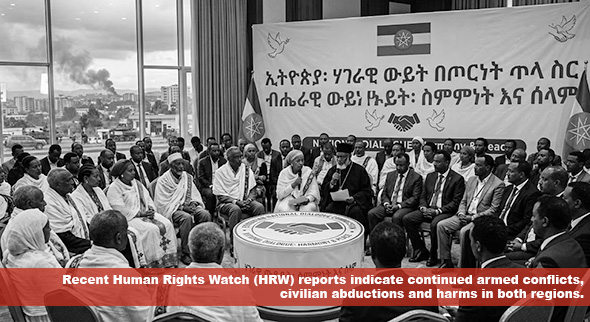
Recent Human Rights Watch (HRW) reports indicate continued armed conflicts, civilian abductions and harms in both regions.[5] Meanwhile, tension in the northern regions are growing following renewed confrontations between Tigray People’s Liberation Front (TPLF) and federal forces, coupled with a fragile relationship with Eritrea.[6] Inspite of these tensions, the national dialogue continues.
3 Whose voice counts?
Inclusion and active participation through fair representation are determinantal success factors for the national dialogue alongside political willingness.[7] Experience show that the absence of balanced inclusion compromises the legitimacy of dialogue process.[8] Importantly, within the inclusion (diverse groups), fair representation is a critical theme serving as a cursor weighing the decision-making power.[9] The outcome of inadequate representation is in two folds: (1) frustration and dissatisfaction, and (2) increases the possibility of the dominant party which will erase any semblance of genuine inclusive representation.[10]
Tigray has largely remained absent from the ENDC process. Although the Commission has attempted to hold meetings in Mekelle, the region’s political administration has not been substantively included.[11] In October 2024, the Ogaden National Liberation Front suspended its participation, contending with the participants’ selection process.[12] As Ethiopian Insights and Security Studies (EISS) have noted, several major political actors and armed groups were left out of the dialogue.[13]There are also concerns about the Commission’s independence, given that the dominance of the Prosperity Party in Parliament, which oversees the process.[14] Thus, a national dialogue that excluded political actors and armed groups either by design or by circumstance risks what Blunk described as a dominant party-driven process.[15] Those who hold the power maintain their preferences while the genuine multitude interests of Ethiopian society are compromised.
4 Genuine dialogue: Beyond instrumentalist motive
Viewed from its nature, a national dialogue presupposes the need for a major political and socio-economic reforms to sustain national coexistence. It sets a stage for all to engage in discussion and decision-making process, including those at the political, economic and social peripheries. It therefore requires careful planning, composition, and transparent decision-making rules and willingness to enforce agreements from its commencement to implementations. In the country where multitude of rifts are deepening and where war has continued on a high-scale in Amhara, Oromia, Tigray and other regions, the objectives of the ENDC will be defeated as current conditions make the national dialogue processes vulnerable to be manipulated for instrumentalist motives.
5 Conclusion and recommendations
As Haider noted, the political context in which the national dialogue is carried out determines the likelihood of success and failure.[16] Inclusiveness, fair representation, public buy-in and national ownership form the political context[17] should be underlined during the preparation, process and implementation phases. The success of the national dialogue is not automatic. Efforts must therefore be made to ensure that the dialogue is representative of concerned parties. Such political willingness, includes suspending national dialogue for security reasons and boycotting by concerned parties.[18]
Current conditions clearly point in the direction of very limited success (if any at all) should the national dialogue continue in its current form. Accordingly, the following recommendation are forwarded:
- The national dialogue should be suspended until conflict affected regions, armed groups and political constituencies to safely participate.
- Publication of transparent delegates selection criteria that incorporates unrepresented parties.
- Revision of the Commission’s oversight mechanism, as the dominance of the Prosperity Party in Parliament makes parliament oversight susceptible to instrumentalization by the dominant party.
[1] Modern Diplomacy (2026) https://moderndiplomacy.eu/2026/06/18/ethiopias-national-dialogue-reaches-final-phase-without-first-trust/.
[2] Institute for Security Studies (ISS) Africa (2025) https://issafrica.org/iss-today/ethiopia-s-national-dialogue-needs-time-and-an-interim-report.
[3] Al Jezeera (2026) https://www.ethiopia-insight.com/2026/07/18/ethiopias-national-dialogue-could-unravel-the-federal-bargain/ ; Amhra America (2026) https://www.amharaamerica.org/post/war-updates-from-amhara-region-ethiopia-june-22nd-to-28th-2026 .
[4] The Africa Report (2024) https://www.theafricareport.com/370346/ethiopia-signs-peace-deal-with-oromo-liberation-army-splinter-group/
[5] Human Rights Watch (HRW) (2026) https://www.hrw.org/world-report/2026/country-chapters/ethiopia.
[6] Council on Foreign Relations (CFR) (2026) Conflict in Ethiopia https://www.cfr.org/global-conflict-tracker/conflict/conflict-ethiopia (2026).
[7] H Haider “National Dialogue: Lessons Learned and Success Factors” Knowledge, evidence and learning for development (2019) 9.
[8] M Blunck L Vimalarajah O Wils C von Burg D Lanz & M Mubashir National Dialogue Handbook: A Guide for Practitioners (2017) 29.
[9] Haider (n 7) 11.
[10] Blunck (n 8) 83.
[11] ISS Africa (n 2).
[12] Ethiopia Insight ‘Ethiopia’s National Dialogue Could Unravel the Federal Bargain (2026) accessed 6 August 2026)https://www.ethiopia-insight.com/2026/07/18/ethiopias-national-dialogue-could-unravel-the-federal-bargain/.
[13] As above
[14] As above.
[15] Blunck (n 8) 92.
[16] Haider (n 7) 5.
[17] As above.
[18] J Halder ‘Supporting a National Dialogue: Dilemmas and Options for Third Parties. Mediation practice series (2016) https://www.hdcentre.org/wp-content/uploads/2016/12/Harlander_MPS_Supporting-a-National-Dialogue-1.pdf accessed 06 August (2026) 8.
About the Authors:
Derara Roba is the Co-Founder and Executive Director of HALE: Human Rights and Inclusion Network, a youth-led civil society organisation established in Ethiopia and has served as a Lecturer at Madda Walabu University and Dilla University, Ethiopia. He holds an LL. B from Hawassa University and an MPhil from UiT The Arctic University of Norway.
He is currently enrolled in the LL.M in Human Rights and Democratisation in Africa (HRDA) at the Centre for Human Rights, University of Pretoria. His research interests include transitional justice, legal pluralism, and indigenous peoples and minority rights, approached from a multidisciplinary perspective.

