
The unclear relation between Angola and its Muslim citizens and migrants: Is Angola discriminating against them?
Posted: 6 October, 2017 Filed under: Cristiano d'Orsi | Tags: Angola, Angolan Constitution, Angolan Muslims, discrimination, freedom of religion, human rights, illegal immigration, ISIS, Islamic, Islamic Community of Angola, Islamic State terror group, John Locke, Law on Religion, Manuel Fernando, religion, Rosa Cruz da Silva 2 Comments Author: Cristiano d’Orsi
Research Fellow and Lecturer at the South African Research Chair in International Law (SARCIL), University of Johannesburg
Angola is a country where the traditional Islamic relation between Muhajirun (‘immigrants’) and Ansar (‘helpers’: locals)[1] seems not to find a fertile ground. Islam in Angola represents a minority religion, with an estimate number of proselytes amounting to approximately 1%[2] of the entire population.[3] These are mostly Sunnis who arrived in Angola from West Africa,[4] Somalia[5] and from families of Lebanese descent[6] following the end of the Angolan Civil War in 2002.
Historically, as many of these immigrants entered Angola illegally, which created the misperception of associating Islam with illegal immigration and crime (almost predominantly counterfeiting of money and money laundering), although barely any evidence of this has been proved.[7] This was affirmed by the UN Special Rapporteur on Freedom of Religion or Belief on her visit to the country in 2007.[8]
South Africa: Expulsion of pregnant students violated constitutional rights
Posted: 3 October, 2017 Filed under: Uncategorized Leave a comment
Many thanks to Godfrey Kangaude, LL.M. (UFS), LL.M. (UCLA), an LL.D. candidate at the University of Pretoria and Executive Director of Nyale Institute for Sexual and Reproductive Health Governance in Malawi, for summarizing this decision with Y. Kakhobwe in Legal Grounds III: Reproductive and Sexual Rights in Sub-Saharan African Courts, published by Pretoria University Law Press (PULP) in 2017. 228-pages online Flyer with Table of Contents. New online edition with links to decisions and analyses.
Head of Department, Department of Education, Free State Province v. Welkom High School & another; Head of Department, Department of Education, Free State Province v. Harmony High School & another (CCT 103/12) [2013] ZACC 25, 2013 (9) BCLR 989(CC); 2014 (2) SA 228 (CC) (10 July 2013) Constitutional Court of South Africa Decision online. Case summary by G. Kangaude and Y. Kakhobwe.
View original post 486 more words
Kidnappings in Nigeria as a class act: Implications for the criminal justice system
Posted: 18 September, 2017 Filed under: Akinola Akintayo | Tags: abductors, ‘Evans’, Chukwudubem George Onwuamadike, class act, criminal justice system, inequality, kidnapping, Nigeria, personal enrichment, ransom, targeting of the rich 3 Comments Author: Dr Akinola Akintayo
Lecturer and researcher in the Department of Public Law, Faculty of Law, University of Lagos, Nigeria
Nigeria is a country steeped in inequality. Reports indicate that a minimum of 86 of the 140 or so million Nigerians live in extreme poverty. The country’s richest individuals are also said to earn 8,000 times each day what their poor counterparts spends on basic necessaries in a year. To further underscore the severe level of inequality, studies also indicate that the combined wealth of the top five richest Nigerians can end extreme poverty in the country. That is how bad the income and wealth gap in Nigeria is.
However, this kind of inequality underpinned by exploitative and oppressive capitalist mode of production tends to weaken what some scholars have referred to as the ‘social instinct’ and breeds discontent, opposition and conflicts between society’s classes. In this kind of clime, the less privileged and deprived members of the society may well feel entitled, either within or without the law, to demand what they considered their own fair share of the commonwealth from the more opulent part of the society. The main purpose of this short piece is to interrogate emerging evidence which suggests that recent dimensions of kidnappings in Nigeria is a class act where the deprived class may be demanding what they perceived as their fair share from the more opulent class and examine the omens that this bids for the criminal justice system.
Kenya: High Court halts HIV+ data collection, upholding dignity & privacy
Posted: 31 May, 2017 Filed under: Uncategorized 1 CommentMany thanks to Professor Ebenezer Durojaye of the Dullah Omar Institute for Constitutional Law, Governance and Human Rights at the University of the Western Cape, for abstracting this significant judgment for REPROHEALTHLAW subscribers. Prof. Durojaye can be reached at ebenezerdurojaye19 at gmail.com
Kenya Legal and Ethical Network on HIV & AIDS (KELIN) & 3 others v Cabinet Secretary Ministry of Health & 4 others [2016] eKLR Petition 250 of 2015. (High Court at Nairobi) Decision online.
This case centres on a directive issued by Kenyan President Kenyatta requesting that the names of school-going HIV positive children, their guardians and HIV-positive pregnant women and their addresses be compiled for the purpose of assisting the government to respond and provide appropriate service and support to the children living with HIV/AIDS. The said information should include the number of children infected with HIV, number of guardians or caregivers infected with HIV, number…
View original post 451 more words
Nigeria: Accountability for maternal healthcare services
Posted: 31 May, 2017 Filed under: Uncategorized Leave a commentMany thanks to to Onyema Afulukwe-Eruchalu for writing this useful new article in the Ethical and Legal Issues section of the International Journal of Gynecology and Obstetrics. She currently serves as Senior Legal Adviser for Africa at the Center for Reproductive Rights.
Afulukwe-Eruchalu, O. (2017), Accountability for maternal healthcare services in Nigeria. International Journal of Gynecology and Obstetrics137.2 (May 2017); 137: 220–226. DOI:10.1002/ijgo.12108 PDF online for 12 months. Submitted text online.
High maternal mortality ratios (MMRs) serve as objective indicators of the poor condition of women’s health in any country and point to violations of human rights that are entrenched in national, regional, and global laws. For more than a decade, Nigeria has consistently been one of the top five listed countries with the highest MMRs in the world; in 2015, its MMR was estimated at 814 deaths per 100 000 live births, accounting for 19% of…
View original post 254 more words
Double trouble: Consulting for a fair retrenchment
Posted: 3 April, 2017 Filed under: Rochelle le Roux | Tags: bumping, case law, consultation, employee, employer, employment, fairness, labour law, legislation, legislative developments, operation requirements, procedural, retrenchment, retrenchment law, Sputh Africa, substantive, unemployment, unfiar dismissal Leave a comment Author: Prof Rochelle le Roux
Director of the Institute of Development and Labour Law; Professor in the Faculty of Law, University of Cape Town (UCT)
Most employers and employees have a broad understanding that the fairness of a dismissal rests on both a substantive and a procedural leg.
On the one hand, substantive unfairness, in broad strokes, suggests that an employee who should not have been dismissed, had been dismissed.
The legislature had chosen to express substantive fairness with reference to the employee’s misconduct or incapacity and the operational requirements of the employer. A dismissal for the latter reason is often referred to as retrenchment.
On the other hand, procedural unfairness implies that the employee had not been given an opportunity to be heard by the employer before the dismissal was affected. There is at least one practical reason for distinguishing between procedural and substantive fairness: when a dismissal is unfair only because the employer did not follow a fair procedure, the competent remedy is generally only payment of compensation and not reinstatement as would be the case when the dismissal is either substantively, or both substantively and procedurally, unfair.
South African rulings uphold rights of HIV+ employees
Posted: 30 March, 2017 Filed under: Uncategorized Leave a commentMany thanks to Godfrey Kangaude, LL.M. (UFS), LL.M. (UCLA), now an LL.D. candidate with the University of Pretoria and Executive Director of Nyale Institute for Sexual and Reproductive Health Governance in Malawi, for composing and/or editing summaries of 54 recent African court decisions for Legal Grounds III: Reproductive and Sexual Rights in Sub-Saharan African Courts, published in 2017 by Pretoria University Law Press (PULP). All three volumes in the series are freely available in print or electronic form.
Two of the court decisions summarized in Legal Grounds III clearly upheld the rights of HIV-positive persons against discrimination, including unjust dismissal, and exclusion from certain job opportunities.
Gary Shane Allpass v Mooikloof Estates (Pty) Ltd. [2011], Case No. JS178/09, a Labour Court of South Africa upheld the rights to equality and non-discrimination of HIV-positive persons in the workplace. The Court ruled that a horse-riding instructor’s dismissal from employment for HIV-positivity was…
View original post 349 more words
94 mental health patients in Gauteng: A lesson for State parties to the CRPD – A classic case of a poor deinstitutionalisation process
Posted: 28 March, 2017 Filed under: Patricia Mwanyisa | Tags: 94 mental health patients, adequate standards of living including adequate food, Centre for Human Rights, clothing and housing, Convention on the Rights of Persons with Disabilities, CRPD, deinstitutionalisation, disability rights, freedom from torture or cruel, Gauteng, Health Ombud, human rights, human rights-based approach, ICESCR, inhumane or degrading treatment, mental disability, Mental Health Care Act, NGO, provincial government, psychosocial, right to highest attainable health, right to independent living and inclusion in society, right to life, South Africa Leave a comment Author: Patricia Mwanyisa
Consultant – Human Rights and Access to Justice
As South Africa took time to celebrate its annual human rights day on March 21, this year (2017) the deaths of the 94 patients in Gauteng Province in a space of under a year should not be forgotten. The provincial government of Gauteng took the decision to remove persons with psychosocial and intellectual disabilities from government health institutions to reduce spending on their healthcare. The implementation process was poorly planned, rapidly executed and chaotic. The move had fatal and disastrous consequences as it not only contravened national and international law, but also proved cruel and inhumane. The record shows 94 lives were lost, families have been severely traumatised and a healthcare support system regardless of whether it was the most ideal or not was shaken to its knees.
Apart from violating domestic law – the National Health Act 61 (2003) and the Mental Health Care Act 17 (2002)) – as a State party to the UN Convention on the Rights of Persons with Disabilities (CRPD) and the International Covenant on Economic, Social and Cultural Rights (ICESCR), among other international instruments, there are several frameworks that were contravened by South Africa. This case provides an opportunity for some serious learning for South Africa (SA) as well as other African States. Learning from previous mistakes is vital for progress. Focus should be directed on how to avoid making similar mistakes in the future. It is probably more important to provide guidance to State parties or governments when they have made mistakes as opposed to the naming and shaming – particularly after the fact. To be productive, however requires the state or those in power to accept responsibility, acknowledge their mistakes and be receptive to the guidance. Ultimately, objectively and substantively unpacking the critical aspects or points at which things went wrong in the Gauteng saga from an international human rights perspective would be beneficial for the planning and implementation of these types of projects or programmes in the future.
Stripped of Dignity: The Struggle for LGBT Rights in Tanzania
Posted: 17 March, 2017 Filed under: Daniel Marari | Tags: consensual sex, constitution, discrimination, equality, gender identity, hate crimes, HIV/Aids, homosexuality, imprisonment, LGBT, LGBTI, Penal Code, prosecution, sexual minorities, Sexual Offences Special Provisions Act, sexual orientation, Tanzania, unnatural offence, violence 7 Comments Author: Daniel Marari
LLM, International Human Rights Law, Lund University, Sweden
Although the Tanzanian Constitution (1977) guarantees the right to equality and prohibits discrimination based on gender and sex, lesbian, gay, bisexual and transgender (LGBT) people still face deeply rooted hostility, prejudice and widespread discrimination in the Tanzanian society. Threats of criminal penalty, social exclusion, harassment and violence make it particularly unsafe for one to come out as an LGBT person.
At present, certain homosexual acts between consenting adult males are criminalized under the Penal Code (Chapter 16 of the laws). Under section 154 of the Penal Code, committing or attempting to commit “unnatural offences” are crimes punishable with a maximum sentence of life imprisonment and twenty years’ imprisonment, respectively. “Unnatural offence” is defined as (1) sexual intercourse with any person “against the order of nature” as well as (2) consensual sexual intercourse between a man and man or woman “against the order of nature”. The words “against the order of nature” are not statutorily defined. Also, under section 157 of the Penal Code, it is an offence punishable with a maximum of five years imprisonment for any male person, whether in public or private, to commit an act of gross indecency with another male person. By section 3 of the Sexual Offences Special Provisions Act, “gross indecency” is defined as “any sexual act that is more than ordinary but falls short of actual intercourse and may include masturbation and indecent physical contact or indecent behavior without any physical contact”. Consent is no defense to any of these offences and no distinction regarding age is made in the text of the law. As the consequence of the existence of these laws criminalizing private consensual homosexual acts, LGBT people in Tanzania live in psychological stress and unceasing fear of prosecution and imprisonment.
Read the rest of this entry »
AFRICA: Legal Grounds III: Reproductive and Sexual Rights in Sub-Saharan African Courts – 54 case summaries
Posted: 15 February, 2017 Filed under: Uncategorized Leave a comment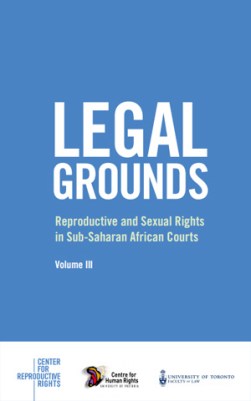
by: Godfrey Kangaude, Onyema Afulukwe, Guy-Fleury Ntwari, et al.
Foreword by Prof. Charles G. Ngwena
PULP (Pretoria University Law Press) 2017
228 page book online. Previous volumes.
Printable flyer with Table of Contents
Reproductive and sexual rights, which are guaranteed in constitutions and in international and regional human rights treaties, have no impact if they are not recognized and enforced by national-level courts. Legal Grounds: Sexual and Reproductive Rights in Sub-Saharan African Courts Volume III continues to provide much-needed information about whether and how national courts of African countries apply constitutional and human rights to protect reproductive and sexual rights. The case summaries, significance sections, and thematic highlights serve as useful resources for those seeking to further develop litigation, advocacy, and capacity- building strategies.
Like its predecessors, Legal Grounds: Reproductive and Sexual Rights in Sub-Saharan African Courts – Volume III is a tool for organizations, individuals, and institutions…
View original post 302 more words
 AfricLaw