
Mozambique’s struggle for the freedom of peaceful assembly: A complex reality that reaps lives
Posted: 18 September, 2024 Filed under: Denise Ivone Mboana | Tags: Amnesty International, Azagaia, civil war, economic development, excessive force, Excessive Use of Force, freedom of expression, freedom of peaceful assembly, human rights, International Covenant on Civil and Political Rights, Intimidation of victims, lack of transparency, Mozambican National Resistance, Mozambique, multiparty system, peaceful assembly, peaceful protests, police suppression, Regional and International Human Rights Instruments, Restrictive Legal Framework, street protests, The Civicus Monitor, Universal Declaration on Human Rights, unrest, violence 8 Comments Author: Denise Ivone Mboana
LLM Student, University of Sussex
Introduction
This article aims to provide a brief analysis of the freedom of peaceful assembly in Mozambique. Nestled along Africa’s southeastern coast, Mozambique has a vibrant cultural history. Nevertheless, the nation has confronted substantial challenges rooted in its colonial past and internal conflicts, notably the “16 years’ war” involving the ruling Frelimo party (in power since independence) and the main opposition Mozambican National Resistance (Renamo) party. Following the 1994 peace agreement that concluded the civil war, Mozambique transitioned to a multiparty system, enabling other political parties to participate in elections; after this period of turbulence, the country has made significant progress in recent years towards political stability and economic development.[1] However, in terms of civil participation and freedoms, The Civicus Monitor, a reputable global civil society alliance, ranks Mozambique’s status as “oppressed”[2] and recent events and the current pre-election scenario confirm this assessment. The restrictions on civil liberties, limited freedom of expression, and suppression of dissent are indicative of the challenges faced by Mozambican citizens in exercising their democratic rights.
Context
On October 11, 2023, Municipal elections took place in Mozambique, and following the announcement of results on October 26, the primary opposition party, Renamo, urged its supporters to mobilise for street protests, seeking to contest the election results citing irregularities.[3] Reports indicate that security forces responded with excessive force during these peaceful protests, employing live ammunition, rubber bullets, and tear gas, resulting in at least three fatalities.[4]
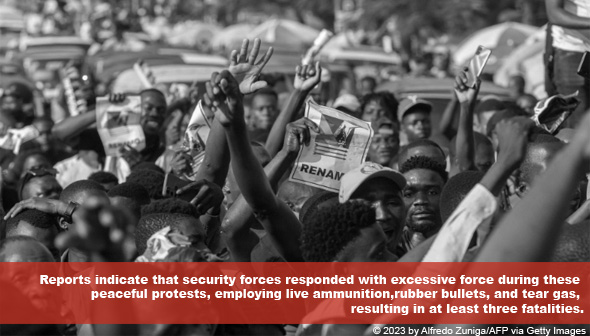
This incident, as highlighted by Amnesty International, is not a singular occurrence but part of a broader pattern of police suppression of peaceful protests in 2023 and previous years in Mozambique [5] Notably, at least three instances of peaceful demonstrations were met with force by the police throughout the year.[6] For example, in March 2023, during peaceful protests to pay tribute to the death of rapper and political activist Azagaia, the police responded with violence, leading to the detention of at least seven protesters.[7]
As the national elections in Mozambique approach, there is growing fear about future events due to the ongoing disregard for human rights. This lack of respect for civil liberties could lead to serious consequences soon. The suppression of freedoms and political rights may increase tensions and unrest, further weakening democratic values. This situation highlights the urgent need to protect the rights and freedoms of Mozambican citizens during this crucial time.
Mozambican State’ Allegation
The Mozambican state, acting through the Police of the Republic of Mozambique (PRM), has persistently employed the justification of “violent protests” as a pretext to obstruct the realisation of the Freedom of Peaceful Assembly, raising concerns about the authorities’ commitment to safeguarding and facilitating citizens’ constitutionally protected freedoms. In an interview with DW, the spokesperson of PRM said— “…noting the existence of strong “signs” of transition from a peaceful to violent demonstration, the police decided to take preventive police measures… urging the demonstrators not to carry out the marches”[8] (translated and emphasis added).
This situation highlights the ongoing tension between security concerns and the protection of civil liberties. As discussions around the freedom of peaceful assembly continue, there is a critical imperative for constructive dialogue between law enforcement, civil society, and government authorities to ensure a balanced approach that respects both public order and the fundamental rights of citizens.
Applicable Regional and International Human Rights Instruments to the Freedom of Assembly
Freedom of assembly is guaranteed in several international and regional human rights instruments, including the Universal Declaration on Human Rights (UDHR, Art. 20)[9] and International Covenant on Civil and Political Rights (ICCPR, Art. 21)[10] and African Charter on Human and Peoples’ Rights (Art. 11)[11]. This fundamental right provides individuals and groups with the ability to gather and express their opinions and is also a critical avenue to protect and achieve other rights.[12] The recognition and safeguarding of the right to peaceful assembly play a pivotal role in nurturing a robust democratic culture, [13] where citizens can freely express their views, participate in decision-making processes, and contribute to the pluralistic fabric of a just and equitable society.[14]
In fulfilment of its obligations to protect and promote human rights, which demand states to ‘adopt legislative or other measures to secure rights’[15], Mozambique has integrated provisions safeguarding the internationally recognised freedom of peaceful assembly into its domestic legal structures. This commitment is explicitly articulated in article 51 of the Constitution (2004, updated in 2018)[16], reflecting Mozambique’s dedication to upholding the right to peaceful assembly and ensuring a robust framework for protecting various other civil rights. Further, Mozambique has enacted national legislation such as the Law on Public Meetings and Demonstrations (Law No. 9/93), which governs the conduct of public gatherings.[17]
Mozambique’s ratification of the African Charter means that after domestic remedies have been exhausted, individuals or NGOs may bring complaints to the African Commission concerning violations of the freedom of peaceful assembly. Mozambique has not ratified the Protocol that establishes the African Court on Human and Peoples’ Rights, significantly curtailing the options available for individuals seeking justice, limiting their ability to file complaints directly with the African Court, which poses a challenge to the comprehensive protection and enforcement of human rights.
Challenges to the Freedom of Peaceful Assembly in Mozambique
Restrictive Legal Framework
While Mozambique has established a legal framework governing public assemblies, concerns persist regarding the restrictive nature of specific provisions. The Law on Public Meetings and Demonstrations (Law No. 9/93) grants authorities the power to regulate, restrict, or prohibit assemblies based on subjective criteria, raising questions about the law’s compatibility with international standards.
For example, under article 10 of Law 9/93, persons or entities wishing to hold meetings or demonstrations in public or public places must notify the civil and police authorities in the area proposed for the rally in writing at least four working days in advance. This notice must be signed by ten promoters indicating their name, profession and address or, in the case of legal persons, by their respective governing bodies, containing the indication of the time, place and object of the meeting and even indicating the route to follow.
According to the African Commission’s guideline, states must prioritise facilitating the enjoyment of this fundamental right in formulating laws related to freedom of assembly.[18] However, the existing requirements seem to deviate from this central objective, posing challenges to effectively realising and enjoying the freedom of assembly.
The Human Rights Committee, which oversees the ICCPR, has consistently emphasised that restrictions on the right of peaceful assembly must meet the criteria of legality, necessity, and proportionality.[19] Any limitations must pursue a legitimate aim and not undermine the essence of the right.[20] The African Commission, tasked with overseeing the African Charter[21], reached the same interpretation.
The absence of constitutional provisions explicitly permitting legal restrictions can be addressed by invoking the Universal Declaration of Human Rights. Article 29 of the Declaration allows legislators to set limits on fundamental rights, ensuring the acknowledgement and adherence to the values articulated therein, such as the rights and freedoms of others[22] and the demands of morality, order, and general welfare in a democratic society.[23]
Excessive Use of Force
Reports indicate instances where security forces in Mozambique have employed excessive force to disperse peaceful assemblies.[24] This situation raises significant human rights concerns, as the use of force should adhere to principles of necessity and proportionality.
Indeed, the freedom of assembly must be peaceful and non-violent to benefit from protection.[25] General Comment No. 37 (2020) on the Freedom of Peaceful Assembly explains that “Violence” encompasses the damage to others (aggression or death) and to property;[26] Pushing, shoving, or disrupting activities isn’t considered to be violence.[27] Thus, the explanation of PRM that they saw ‘sighs’ of transition from a peaceful to violent demonstration’ is not adequately illustrated. In addition, the African Commission’s Guidelines on Freedom of Association and Assembly in Africa provide a broad interpretation of what “peaceful” means under Article 11 of the African Charter. This interpretation encompasses behaviours that may cause offense, actions that temporarily obstruct the activities of third parties.[28]
Furthermore, PRM’s tactics in repressing peaceful demonstrations involve the use of firearms and live bullets, raising concerns about the proportionality and potential harm inflicted during these interventions. According to the United Nations Basic Principles on the Use of Force and Firearms by Law Enforcement Officials, security forces of the state are mandated to employ the minimum necessary force.[29] When dispersing assemblies, the use of firearms is permissible only when no other less harmful means are feasible.[30] However, even in such cases, security forces are obligated to restrict the use of firearms to the minimum extent necessary.[31] Lethal use of firearms by law enforcement officers is only permissible when strictly unavoidable to protect life.[32]
Access to African Court
The absence of Mozambique’s ratification of the Protocol establishing the African Court on Human and Peoples’ Rights limits avenues for individuals to seek legal remedies at the continental level under the ACHPR. This significantly constrains the avenues for individuals seeking justice and undermines the comprehensive protection and enforcement of human rights. Though complaints can be submitted to the African Commission, reports have found that that despite the relatively limited number of cases, the African Commission frequently takes many years to decide cases on the merits. For example, there are cases where the complaint was received by the Commission in 2007 and only decided in 2020.[33] Given that the Commission remains as the only option for individuals from states that haven’t ratified the protocol to access the African Court, the extended timeframe for case resolutions can be a notable challenge, potentially exceeding what would be considered a reasonable duration in ordinary circumstances.
Lack of transparency and impartiality in domestic courts
The state’s role in protecting and fulfilling internationally guaranteed human rights is the fundamental starting point of international human rights law.[34] Subsequently, Mozambique’s national judicial system serves as the primary venue for individuals to seek redress for human rights violations. Filing a case in domestic courts allows for the examination of claims within the country’s legal framework that guarantees the freedom of assembly. However, there is a notable challenge in addressing violations of this right at the domestic level due to concerns regarding the integrity and impartiality of the courts.[35]
Due to this fact, the efficacy of legal mechanisms may be compromised. When there are doubts about the fairness and unbiased nature of the judicial system, it raises critical questions about the effectiveness of the legal avenues available for addressing infringements on the right to peaceful assembly in Mozambique. Given that the state perpetrates these violations, the courts, despite their legal independence, fall short of upholding the principles of transparency and the separation of powers. In 2010, Gabriela Knaul, the UN Special Rapporteur on the independence of judges and lawyers, said— ‘the major challenge for the independence of the judiciary in Mozambique is to be fully operational and depoliticised so that judicial decisions be based on facts and in accordance with the law, without undue influences, inducements, pressures, threats or interferences, whether direct or indirect’.[36]
Intimidation of victims and civil society organizations
In a context where doubts persist about the judicial system’s independence, a pervasive reluctance among victims emerges when contemplating legal action, particularly when the disputes involve the state. This hesitancy is rooted in concerns about the impartiality and fairness of legal proceedings. Furthermore, civil society organisations and human rights defenders in Mozambique, who play an indispensable role in championing human rights, confront formidable challenges such as intimidation, harassment, and legal restrictions.[37]
These obstacles not only impede the crucial work of these organisations and defenders but also create additional complexities in the pursuit of justice within the national jurisdiction and in the international arena.
Conclusions and Recommendations
The documented instances of excessive use of force and the restrictive legal framework in Mozambique contradict the ICCPR’s legality, necessity, and proportionality principles. These incidents potentially infringe on the essence of the freedom of peaceful assembly. The intimidation and harassment faced by civil society actors engaging in peaceful assembly challenge Mozambique’s adherence to the African Charter’s call for protection against actions that may impair the exercise of this right.
While states have a margin of appreciation, they also must justify any limitations or restrictions they impose on the freedom of assembly. These restrictions should be proportionate, necessary, and by international human rights standards. However, in the case of Mozambique, actions of state actors and law enforcement agencies, are often disproportionate and no specific grounds to support the necessity of such restrictions as required, are provided.
In these terms, the Mozambican state fails in its obligation to respect the freedom of assembly. States that fail to restrain their public officials from actions which foreseeably violate human rights will be considered to have violated their obligations of non-interference.
The Mozambican state must introduce specific and detailed provisions concerning exercising the right to peaceful assembly to ensure better organisation of administrative and police authorities. It is imperative to regulate the activities of security forces concerning the right to peaceful assembly by clearly defining their competencies and limits to ensure effective performance.
Following the reform of the law central to this work, there must be widely disseminated to ensure that both the public and the relevant authorities are aware of its provisions to alleviate citizens’ concerns in exercising their right to peaceful assembly.
[1] World Bank ‘Mozambique’ https://www.worldbank.org/en/country/mozambique/overview accessed 20 December 2023
[2] Civicus Monitor, <https://monitor.civicus.org/about/> accessed 20 December 2023
[3] Civicus Monitor, https://monitor.civicus.org/explore/security-forces-used-excessive-force-against-peaceful-protesters/ > accessed 20 December 2023
[4] Amnesty International, ‘Mozambique: Arbitrary arrests, teargassing and brutal assault of peaceful protesters a violation of the right freedom of assembly’, (May 2023) <Mozambique: Arbitrary arrests, teargassing and brutal assault of peaceful protesters a violation of the right freedom of assembly – Amnesty International> accessed 10 October 2023
[8] RFI, ‘Moçambique: Polícia agiu num contexto de “transição de uma manifestação pacífica para violenta”’, RFI (21 March 2023) <https://www-oxfordlawtrove-com.sussex.idm.oclc.org/display/10.1093/he/9780198860112.001.0001/he-9780198860112-chapter-7?print=pdf> > accessed 10 October 2023
[9] Universal Declaration of Human Rights (adopted 10 December 1948 UNGA Res 217 A(III) (UDHR), art 20
[10] International Covenant on Civil and Political Rights (adopted 16 December 1966, entered into force 23 March 1976) 999 UNTS 171, art 29
[11] African Charter on Human and Peoples’ Rights (adopted 27 June 1981, entered into force 21 October 1986) (1982) 21 ILM 58, art 11
[12] Human Rights Committee, General Comment No. 37 (2020) on the Right of Peaceful Assembly
[14] General Comment No. 37 (n12)
[15] A]ndrew Byrnes and Catherine Renshaw ‘Within the State’ in Daniel Moeckli, Sangeeta Shah, Sandesh Sivakumaran, and David Harris (eds) International Human Rights Law (Oxford university Press, 2022)
[16] Constitution of the Republic of Mozambique, Law n. 1/2018 of 12 June (Law on the Revision of the Constitution of the Republic of Mozambique)
[17] Law No. 9/93 (adopted 18 July 1993-regulate the Freedom of Assembly and Public gatherings in Mozambique)
[18] African Commission’s Guidelines on Freedom of Association and Assembly in Africa, n.66
[19] Human Rights Committee, general comment No. 37 (2020) on the Right of Peaceful Assembly, n.36
[21] African Commission’s Guidelines on Freedom of Association and Assembly in Africa n.85
[22] Dominic McGoldrick, ‘Thought, Expression, Association, and Assembly’ in Daniel Moeckli, Sangeeta Shah, Sandesh Sivakumaran, and David Harris (eds) International Human Rights Law (Oxford university Press, 2022)
[24] Amnesty International (n4)
[25] General comment No. 37 (n12)
[28] African Commission’s Guidelines on Freedom of Association and Assembly in Africa
[29] United Nations Basic Principles on the Use of Force and Firearms by Law Enforcement Officials E/1990/31-E/AC.57/1990/8. (adopted at 11th meeting, 16 Feb. 1990)
[33] George Iyanyori Kajikabi v. The Arab Republic of Egypt – 344/07
[34] Byrnes and Renshaw (15) 505
[35] UNDOC, ‘Strengthening the Integrity and the Judicial System in Mozambique’ < https://www.unodc.org/southernafrica/en/cjc/strengthening-the-integrity-and-the-judicial-system-in-mozambique.html > accessed 20 December 2023
[36] OHCHR, https://www.ohchr.org/en/press-releases/2010/12/mozambique-efforts-ensure-justice-all-through-independent-judiciary-should?LangID=E&NewsID=10595 accessed 20 December 2023
[37] Human Rights Watch ‘Mozambique: Draft Law Threatens Civil Society Groups’ 10 February 2023 https://www.hrw.org/news/2023/02/10/mozambique-draft-law-threatens-civil-society-groups accessed 30 December 2023
About the Author:
Denise Ivone Mboana is a Mozambican master’s student in International Human Rights Law at the University of Sussex and holds a bachelor’s degree in Law from Eduardo Mondlane University. With extensive experience managing impactful human rights projects, she has developed a strong expertise in advocacy, conflict resolution, and gender equality. Denise Ivone has played a crucial role in the “Youth for Peace” project at Girl Move Academy, empowering over 800 young people in conflict-affected areas of Mozambique. Additionally, as a Gender Advisor at Save the Children/HOPEM, she has guided the design and development of culturally sensitive, gender-responsive educational materials and books for communities, optimizing communication strategies.
Recognized for her commitment to human rights, Denise Ivone has received the Tulip Award from the Embassy of the Netherlands and was named #Ambassador_for_a_day by the United Kingdom Embassy in Mozambique. She is passionate about leveraging her skills and experiences to foster peace, justice, and development in her community and beyond.
 AfricLaw
Waw, amazing topic. 👏🏽👏🏽👏🏽
wonderful.
I got the idea. 💡
amazing topic👏👏👏👏👏🫡❤️
👏🏾👏🏾👏🏾👏🏾👏🏾👏🏾Thank you for this topic Denise
wow, amazing 🤩🤝
good content, congratulations
Congratulations Denise for this topic🔥
Important topic and great point of view
Keep going
Congratulations on the article Denise 👏🏾. Relevant topic in our current reality👌🏾