
The struggle for prisoners’ voting rights: Analysing the constitutional right to dignity and sovereignty in Kenya
Posted: 18 November, 2024 Filed under: Uday Makokha Keya | Tags: Bill of Rights, democracy, dignity, electoral justice system, equity, fundamental freedoms, general elections, human rights, IEBC, Independent Electoral and Boundaries Commission, Kenya, principles of governance, prisoner`s right to vote, right to dignity, right to vote, Sovereignty, voting rights Leave a comment Author: Uday Makokha Keya
Third-year law student, Kabarak University
The values on sovereignty of the people, asserted in the constitution of Kenya, imposes on the state the duty to protect, promote and fulfil citizen`s right to elect their representatives as a way of exercising their sovereignty. This right should therefore be achieved through guaranteeing citizens the right to register as voters and, consequently, to elect their leaders. The constitution provides that, every person has a right without unreasonable restriction to be registered as a voter.[1] Therefore, any limitation to the right to vote, has to be necessary,[2] and in accordance to the law.[3] The case of Kituo Cha Sharia V IEBC & 2 Others, affirmed prisoner`s right to vote and elect their representatives linking their right to vote to their dignity, and the exercise of their sovereignty.[4] To guarantee the right to vote to prisoners, they should have equally been provided with the right to register as voters and, to consequently vote in every election cycles.
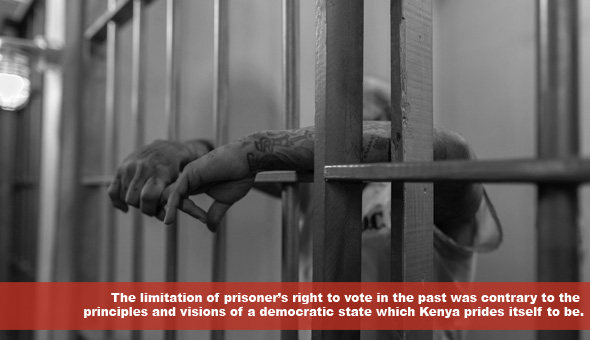
The limitation of prisoner’s right to vote in the past was contrary to the principles and visions of a democratic state which Kenya prides itself to be. For democracy to be effective, people’s right to elect their representatives has to be provided equally without discrimination.[5] Article 83 of the constitution of Kenya, requires that, every citizen who qualifies for registration as a voter, be registered for the purpose of voting during elections. The constitution further outline that every adult citizen of sound mind, and who has not been convicted for any election offense during the preceding five years, qualifies to be registered to vote.[6] Therefore, prisoners jailed of other offenses other than election offenses and, are adults of sound mind are eligible for registration as voters. Consequently, in a case Kituo Cha Sharia V IEBC & 2 Others, the petitioner petitioned the court to compel IEBC to provide for registration of prisoners as voters during the subsequent general election. In determining the matter, the court affirmed that, there was nothing in the constitution disqualifying prisoners who meet requirements set under article 83(1) of the constitution from voting.[7]
To start off, prisoner`s right to vote cannot be unnecessarily limited by the state. This is so because, persons held in custody, retains all rights and fundamental freedoms in the Bill of Rights, except to the extent that a particular right or a fundamental freedom is incompatible with the fact that the person detained is held in custody.[8] Being imprisoned does not necessary mean that a person’s sovereignty is limited.[9]
Additionally, the unnecessary limitation of right to vote, violated prisoner`s dignity and portraying them as unequal to other citizens.[10] The constitution envisions every human being as having the right to dignity and demands that the right to dignity should be respected and protected.[11] Although the constitution does not expressly state whether the right to dignity, as entitled to prisoners who are equally sovereign citizens could as well be limited by the state, it states that, human rights may only be limited in accordance to the law.[12] It further provides that the national values and principles of governance include human dignity.[13] Hence, good governance can only be achieved through respecting and promoting the realisation of human dignity which results in promoting the realisation of peoples sovereignty. Guaranteeing all citizens the right to vote is therefore a manifestation of their sovereignty.
For the realisation of citizen`s right to elect their representatives, the Independent Electoral and Boundaries Commission (IEBC), a key player to the electoral justice system, is tasked with the responsibility to register voters.[14] In performance of its duty IEBC, just like other state organs, is bound by the national values and principles of governance outlined in article 10 of the constitution of Kenya, which include equity, dignity, and public participation among others. For IEBC to ensure that the provisions of article 10 of the constitution are realised, it is obliged to provide an equal opportunity to all citizens, to be registered as voters and, to elect their representatives. Therefore, for IEBC to turn a deaf ear to prisoners’ right to vote, as guaranteed in the constitution, violated their right to equity, dignity and public participation.
Consequently, the court in the Kituo Cha Sharia V IEBC & 2 Others case directed IEBC to put in place necessary measures to facilitate prisoner`s right to vote. IEBC was tasked with a duty to coordinate with other institutions to ensure prisoner`s right to vote is realised.[15] Unlike other rights such as, the right of citizens in diaspora to vote, which may be realised progressively, the court compelled IEBC to immediately put necessary measures in place to facilitate prisoner’s right to vote.[16] The court further required the IEBC to register prisoners who had met the requirements set in article 38 of the constitution, for them to participate in voting in the subsequent general elections. This ensured that prisoners enjoyed the right to vote in the subsequent election cycles, unlike in the previous election regimes, where they were denied this right.
In conclusion, the limitation of prisoner’s right to elect leaders was unjust, unnecessary and violated their right to vote.[17] This is because, prisoners are equally sovereign human beings, despite having some of their rights and fundamental freedoms limited.[18] They also have the right to dignity,[19] as other human beings and limiting their right to vote cast doubt on their sovereignty.
[1] Constitution of Kenya 2010, Article 38(3)(a).
[2] Constitution of Kenya 2010, Article 38(3)(a).
[3] Constitution of Kenya 2010, Article 24(1).
[4] Kituo Cha Sharia V IEBC & 2 Others [2013] eKLR.
[5] J Day, ‘what makes a democracy a democracy? Here are the 14 principles that define and support a democratic society.’ LIBERTIES, https://www.liberties.eu/en/stories/principles-of-democracy/44151 (Accessed 12, April, 2022)
[6] Constitution of Kenya 2010, Article 83(1)
[7] Kituo Cha Sharia V IEBC & 2 Others [2013] eKLR.
[8] Constitution of Kenya 2010, Article 51(1).
[9] Constitution of Kenya 2010, Article 51(1).
[10] Kituo Cha Sharia V IEBC & 2 Others [2013] eKLR. para 2.
[11] Constitution of Kenya 2010, Article 28.
[12] Constitution of Kenya 2010, Article 24(1).
[13] Constitution of Kenya 2010, Article 10(2)(b).
[14] Independent Electoral and Boundaries Commission Act (No.9 of 2011), Section 4
[15] Kituo Cha Sharia V IEBC & 2 Others [2013] eKLR. Para 27
[16] Kituo Cha Sharia V IEBC & 2 Others [2013] eKLR. Para 29
[17] Kituo Cha Sharia V IEBC & 2 Others [2013] eKLR.
[18] Kituo Cha Sharia V IEBC & 2 Others [2013] eKLR. Para 27
[19] Constitution of Kenya 2010, Article 28.
Uday Makokha Keya is a third-year law student at Kabarak University. He serves as Associate Editor for Kabarak Law Review
 AfricLaw