
The right to health, dignity and the plight of pregnant women in Rural Malawi
Posted: 11 November, 2024 Filed under: Golda Chilembwe Rapozo | Tags: access to healthcare, adequate health services, core human rights, degrading treatment, International Covenant on Economic, Malawian health department, maternal health, maternal mortality, medical services, poor infrastructure, pregnant women, right to dignity, right to health, running water, Rural Malawi, Social and Cultural Rights Leave a comment Author: Golda Chilembwe Rapozo
LLM candidate, Centre for Human Rights, University of Pretoria
The right to health and dignity during childbirth
Malawi still experiences one of the highest maternal mortality rates in the world, with 5.7 deaths for every 1000 live births. Poor infrastructure and service conditions mar the maternal experience for women living in rural Malawi. The right to give birth in a dignified manner for women in Malawi is constantly violated. Women are either forced to give birth at home or on their way to health centres due to long distances and poor road infrastructure. In most cases, health centres are located 25 kilometres away, and there are few affordable transportation systems save for bicycles. If they are lucky enough to get to the hospital, they will either have to share beds or sleep on the floor with their newborn babies. In certain instances, these women are even required to bring their own sanitary kits and are subjected to facilities without electricity or running water. In addition, some rural health centres lack trained personnel to provide the necessary care to pregnant women. Not only does this treatment violate their rights, but it also violates the provisions of the International Covenant on Economic, Social and Cultural Rights.
Dignity is inherent in all humans and is a core human rights principle. The right to dignity necessitates the prohibition of torture and cruel, inhumane, and degrading treatment. In terms of maternal health, the right to dignity relates to among others the autonomy of pregnant women, their right to health and to be treated with respect by healthcare workers, and their right to give birth in safe, sanitary, and adequate environments.
Malawi’s obligations towards pregnant women
Section 13 of the constitution of the Republic of Malawi mandates the government to take necessary measures to ensure equal access to healthcare for all Malawians that are in line with international healthcare standards, subject to available resources. Section 30 of the Constitution, which falls under the Bill of Rights, guarantees the right to development, requiring the state to provide equal access to basic necessities, such as healthcare. Malawi is also a state party to the International Covenant on Economic, Social and Cultural Rights (ICESCR), which provides for the right to health under Article 12. This provision states that state parties must recognise everyone’s right to the highest attainable standard of health. In achieving this, steps must be taken to reduce infant and maternal mortality and create conditions that would ensure the provision of medical services and medical treatment in the event of sickness. Malawi has the duty to ensure that health services are acceptable, accessible, available, and of good quality. As a state party to the ICESCR, Malawi must ensure access to basic health services and essential medicines, focusing on the poor and vulnerable. While the right to health relies on the availability of resources, one of the state’s minimum core obligations is to ensure that quality basic health services are available to every citizen. The lack of adequate and quality health posts for most women in rural areas not only violates their right to health but also their right to dignity.
The right to dignity requires that no human shall be subjected to degrading treatment. This means that the right to inherent human dignity cannot be separated from the right to adequate health services and, in this case, the right to give birth in a dignified manner and environment.
Factors affecting the right to health and dignity during childbirth in Malawi
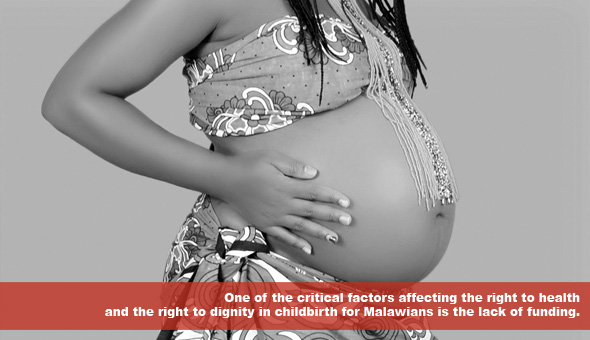
One of the critical factors affecting the right to health and the right to dignity in childbirth for Malawians is the lack of funding. The Malawian health department is severely underfunded. In 2001, Malawi, as a member state of the African Union, made a commitment under the Abuja Declaration to allocate at least 15% of its annual national budget to the health sector. The health sector budget for the year 2023/2024 was 8.7% of the total government budget, which falls short of the required 15%. What further compounds this underfunding is that even these inadequate resources are not safe from abuse. Millions of dollars are lost to illicit financial flows and corruption every year. Mis-procurement is rampant in public institutions, including the health sector. Medicines and medical equipment are acquired at exorbitant prices at the expense of poor Malawians. Further, there is a limited budget allocation for constructing health centres in rural areas to reduce the travel distance for pregnant women to access healthcare facilities. The Malawi government 2024, only 20 health centres were under construction.
Way forward
It is trite that the right to adequate healthcare under the Constitution of Malawi is a directive principle of national policy, rather than as part of the bill of rights, and by its nature as socio-economic right, subject to availability of resources. However, courts must consider these principles when determining the validity of any decisions made by the state. Although the courts in Malawi have been reluctant to decide on how best the state can use the scarce resource at their disposal in providing health care services, often deferring to the legislature and executive, these arms of state have failed to make necessary provisions to meet the minimum core obligation of this right.
Further, health is a fundamental aspect of the right to development, as included in the Bill of Rights in the Malawian constitution, and thus, it can be enforced by the courts. Therefore, the courts should play an active role in upholding and enforcing this right. Since the right is intertwined with the right to dignity for pregnant women, the courts should take the bold step of enforcing the right to health and dignity during childbirth.
The state must also prioritise maternal health in budget allocation and implementation. The state must strive to meet its obligation under the Abuja Declaration to allocate at least 15% of its national budget to healthcare. Where it fails to do so, National Human Rights Institutions and Civil Society Organisations must hold it accountable for failure to take the necessary measures that will allow it to meet the minimum core obligation under the right to health. It is also imperative that the Malawian government effectively utilise the available resources to benefit its citizens. The state must employ measures that consider the violation of the right to health and dignity resulting from corruption, illicit financial flows and misprocurement.
Conclusion
Realising the right to health and dignity for pregnant women in rural Malawi is a fundamental obligation rooted in both national and international commitments. Addressing systemic issues like underfunding, corruption, and inadequate infrastructure is essential for honouring this commitment. With greater accountability from both state, civil society and an activist judiciary, Malawi can move closer to guaranteeing safe and respectful childbirth for every woman, upholding their inherent right to dignity.
About the Author:
Golda Chilembwe Rapozo holds an LLB (honours) from the University of Malawi and has over 5 years of experience at the Malawian Bar. She is pursuing an LLM in Human Rights and Democratisation in Africa at the Centre for Human Rights, University of Pretoria. She currently works with the Anti-Corruption Bureau, Malawi as a Legal and Prosecutions Officer and has served as a Legal Aid Coordinator and Secretary for the Blantyre Chapter of the Women Lawyers Association Malawi, where she advocates for the rights of women and children.

