
The Weight of Votes: Analysing the Principle of Equality in Kenya’s Electoral Boundaries
Posted: 6 November, 2024 Filed under: Uday Makokha Keya | Tags: Constitution of Kenya, customary international law, democracy, electoral body, electoral boundaries, electoral system, Independent Electoral Boundary Review Commission, Kenya, legal framework, population quota, Principle of Equality, protected constituencies, UDHR, unfair representation, Universal Declaration of Human Rights Leave a comment Author: Uday Makokha Keya
Third-year law student, Kabarak University
“A vote is like a rifle: its usefulness depends upon the character of the user”
-Theodore Roosevelt.
“Democracy amplifies the notion of legitimacy of the government and that people are the source of authority for the government. Conversely, democracy can as well be curtailed, and serve as a tool to access power for the elites.”[1]
The Universal Declaration of Human Rights (UDHR) asserts that the legitimate source of authority for the government is the people,[2] and for a government to be legitimate, it ought to draw its authority from the people. While the UDHR is not a treaty, there is predominant consensus that it forms part of customary international law and should therefore be implemented by all states. To that effect, the 2010 Constitution of Kenya provides that citizens have a right to elect their leaders.[3] Further, the law provides that elections for every representative are conducted after every five years.[4]
In addition to people exercising their democratic right to vote, democracy necessitates that the weight of people’s votes should carry the same impact.[5] To ensure equality of the vote, the Constitution in article 89(5) requires that boundaries of each constituency should be demarcated in such a manner that the number of inhabitants in a constituency is nearly equal to the population quota.[6]
Nevertheless, this has not yet been realised. The Independent Electoral Boundary Review Commission (IEBC) conducted a delimitation exercise in 2010, yet equality of the vote was not actualised. About 26 constituencies fell below the population quota and were still preserved as protected constituencies.[7] This resulted in unfair representation of people, due to unequal impact of the voters’ votes.
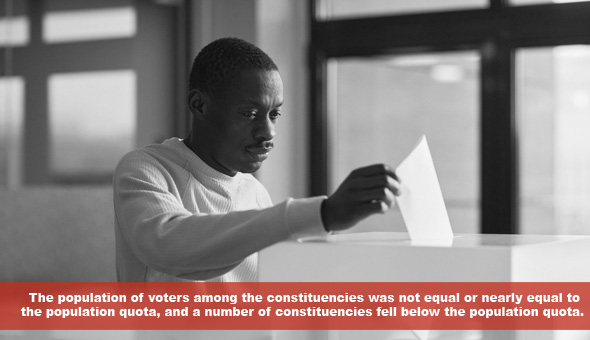
In the 2012 boundary review process, the Independent Review Commission, “popularly known as the Kriegler commission” noted that Kenya’s electoral system did not comply with the principle of equality of the vote in establishing its constituencies.[8] The population of voters among the constituencies was not equal or nearly equal to the population quota, and a number of constituencies fell below the population quota. It further proposed that the delimitation of boundaries among constituencies should be done in a manner that strives to achieve population equality within a reasonable margin. In so doing, citizens’ votes carry the same weight regardless of which constituency they reside.[9]
Further, it was noted that the Kenyan legal framework did not at the moment establish a required maximum possible departure from the general principle of equality of the vote.[10] The maximum departure from the population quota ought to be set by the law for the electoral body to know the maximum departure from the principle. Additionally, before diverting from the principle, the electoral body ought to have considered other factors such as; the population density, means of communication, population trends, geographical features and community of interest that should be retained, while drawing boundaries.[11]
The electoral body, IEBC while conducting delimitation of boundaries in 2012, using the 2009 census data found that there were a number of constituencies that fell below the population quota.[12] These constituencies are; Othaya, Ndaragwa, Budalang’i, Vihiga, Voi, Wundanyi, Mwatate, Galole, Bura, Isiolo South, Samburu East, Laisamis, North Horr, Saku, Kilome, Mukurweini, Mbeere North, Mathioya, Kangema, Marakwet East, Keiyo North, Tetu, Mogotio, Lamu East, Lamu West and Mvita.[13] This resulted in a scramble by members of parliament to protect these constituencies. Consequently, a political agreement was arrived at to preserve the constituencies, resulting in what is called ‘protected constituencies’. These constituencies were to be left for a period of 10 years, and their fate to be determined in the next boundary review exercise, which is required to happen between 2020 and not later than 2024.[14]
Consequently, many questions have arisen in relation to past delimitation of constituencies boundaries in Kenya. Firstly, the effects of the decision to regard the constituencies that failed to meet the population quota as protected constituencies. Secondly, whether the previously protected constituencies should be reserved in the next boundary review exercise, expected to be in 2024 as per the law.[15] And thirdly, the independence of IEBC while conducting the delimitation process.
Firstly, the decision to designate these constituencies as protected constituencies has had a negative impact on the realisation of equality of the vote. This is because the drawing of constituencies is a central principle to the equality of the vote, and in the situation where it is not based on equality of the vote, the impact of the weight of the votes becomes unequal. These constituencies were protected due to political reasons such as, to preserve seats of members of parliament, which are aside from attaining equality of the impact of the vote across the constituencies.
Additionally, since members of parliament enact laws that impact all constituencies across the country, inequality in the weight of the vote might lead to marginalisation of some communities. Constituencies with a higher number of voters than others could be under-represented. Since, their votes confer a small impact on the decisions made through their representatives. On the other hand, voters in constituencies that fail to meet the population quota (protected constituencies), have a greater impact on parliamentary laws made, due to the weight of their vote. Consequently, laws made might turn out to be in favour of the communities that are over-represented.
Secondly, we need to address the way forward for the coming boundary review exercise, in relation to the protected constituencies. The law requires that the boundaries of these constituencies should be redrawn to ensure the population in the constituencies is close to the population quota. This is because it’s central to ensuring equality of the vote. By maintaining the existing constituencies, including those designated as protected even while not meeting the population quota without a convincing justification beyond political expediency, citizens’ right to equality of the vote would be curtailed.[16]
Further, the decision to regard these constituencies as protected, was only to protect these constituencies for a short period of time – a minimum of 8 years to a maximum of 12 years.[17] This decision was arrived at due to political consideration of preventing other members of parliament from losing their seats. This time frame has lapsed and maintaining these constituencies without ensuring they meet the population quota would be unlawful.
There are attempts by the members of parliament to amend article 89 of the constitution to regard these constituencies as protected.[18] Amending the constitution to protect constituencies that fail to meet the population quota is against the principle of equality of the vote, which requires that, in delimitation of electoral boundaries, the number of inhabitants in the constituencies is as near as possible to the population quota. Consequently, amending key constitutional provisions such as article 89(5) defeats the basic purpose of delimitation of constituencies.
Thirdly, the result of the delimitation of boundaries process has often been hijacked by political leaders making the delimitation exercise not to be impartial, as politicians struggle to control the outcome of the delimitation process, in order to preserve seats in parliament. As a result, in the previous delimitation exercise, IEBC was forced to preserve the boundaries of constituencies that failed to meet the population quota threshold. For an effective delimitation process, the entire review process should be conducted by an independent and a non-partisan body, for it to yield the desired results.[19]
In conclusion, Kenya has enacted laws providing for equality of the weight of the vote. Nevertheless, efforts to actualise this have remained unfruitful due to political interference. To actualise the equality of the vote, the delimitation exercise ought to be fully conducted by a non-partisan institution that is not influenced by the interest of political parties. Further, the legislature should not interfere with the principle of equality of the vote by enacting laws to preserve constituencies that fail to meet the population quota.
[1] The delimitation process in Kenya is not impartial as it ought to be, since members of parliament struggle to protect their seats in parliament ahead of the delimitation exercise. This has led to it yielding minimal fruits, the exercise is not aimed at achieving equality of votes, but it has been tuned to serve interests of a few individuals.
[2] Article 21, Universal Declaration of Human Rights
[3] Article 38(2), Constitution of Kenya (2010)
[4] Article 177(4), Constitution of Kenya (2010)
[5] Article 21, Universal Declaration of Human Rights
[6] Article 89(5), Constitution of Kenya (2010)
[7] J Thiong’o: MPs race to save 26 constituencies facing the axe in boundaries audit’ Standard media, April, 2024 https://www.standardmedia.co.ke/politics/article/2001491205/mps-race-to-save-26-constituencies-facing-the-axe-in-boundaries-audit (accessed 9 July 2024)
[8] K Waki ‘KRIEGLER AND WAKI REPORTS’, Primark Ventures,(2009)17.
[9] Article 89(5), Constitution of Kenya (2010)
[10] K Waki ‘KRIEGLER AND WAKI REPORTS’, Primark Ventures,(2009)17.
[11]K Waki ‘KRIEGLER AND WAKI REPORTS’, Primark Ventures,(2009)24.
[12] Kenya National Commission on Human Rights, ‘ADVISORY ON THE DELIMITATION AND BOUNDARY REVIEW PROCESS IN KENYA’, Kenya National Commission on Human Rights (2024), 5.
[13] J Thiong’o: MPs race to save 26 constituencies facing the axe in boundaries audit’ Standard media, April, 2024 https://www.standardmedia.co.ke/politics/article/2001491205/mps-race-to-save-26-constituencies-facing-the-axe-in-boundaries-audit (accessed 9 July 2024)
[14] Kenya National Commission on Human Rights, ‘ADVISORY ON THE DELIMITATION AND BOUNDARY REVIEW PROCESS IN KENYA’, Kenya National Commission on Human Rights (2024), 5.
[15] This delimitation exercise was expected to be conducted by the end of 2024. Nevertheless, this might not be possible as IEBC, is yet to be reconstituted.
[16] Article 89(5), Constitution of Kenya ( 2010)
[17] E Matara, New Bill: Race against time to save 40 constituencies’ Nation Media Group, 10 March 2024. https://nation.africa/kenya/news/new-bill-race-against-time-to-save-40-constituencies-4551548 (accessed 10 July 2024)
[18] E Matara, New Bill: Race against time to save 40 constituencies’ Nation Media Group, 10 March 2024 https://nation.africa/kenya/news/new-bill-race-against-time-to-save-40-constituencies-4551548 (accessed 10 July 2024)
[19] L Handley, ‘Challenging the Norms and Standards of Election Administration: Boundary Delimitation’, The Electoral Knowledge Network, 2007, 60
About the Author:
Uday Makokha Keya is a third-year law student at Kabarak University. He serves as Associate Editor for Kabarak Law Review
 AfricLaw