
Narratives of Belonging: The Case of Chidimma Vanessa Adetshina
Posted: 30 September, 2024 Filed under: Namatirayi Ngwasha, Zekhethelo Cele | Tags: Aliens Control Act of 1973, belonging, birth country, Chidimma Vanessa Adetshina, cultural authenticity, debate on identity, Department of Home Affairs, dual heritage, dual identities, heritage, human rights, identity fraud, Immigration Act in 2002, immigration laws, immigration policies, Miss South Africa pageant, national identity, nationality, race, second-generation migrants, social exclusion, socio-economic challenges, The South African Citizenship Act of 1995, tribal affiliations, xenophobic violence 6 Comments Author: Zekhethelo Cele
LLM Candidate, Centre for Human Rights, University of Pretoria
Chidimma Vanessa Adetshina’s nationality has sparked a significant debate on identity, belonging, and representation between South Africa and Nigeria. Allegedly born in South Africa to a Nigerian father and a Mozambican mother, Chidimma’s story resonates with many second-generation migrants who grapple with dual identities and the challenges of being fully accepted in their birth country while maintaining a connection to their heritage.
Recently crowned Miss Universe Nigeria 2024, Chidimma’s journey has been marked by both triumph and controversy. Her participation in the Miss South Africa pageant faced backlash, with some South Africans questioning her nationality and prompting an investigation by the Department of Home Affairs. The Department suggested that Chidimma’s parents might have obtained South African citizenship fraudulently, with her mother allegedly using an identity number assigned to a South African woman. This led to Chidimma’s withdrawal from the Miss South Africa pageant and set the stage for her subsequent victory in Nigeria.
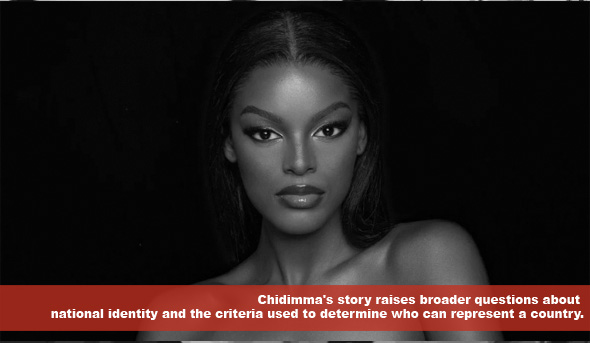
Chidimma’s story raises broader questions about national identity and the criteria used to determine who can represent a country. It also highlights the themes of resilience and the quest for belonging in an increasingly interconnected world. Her victory in Nigeria was celebrated by some, but also drew criticism and calls for her parents’ arrest for alleged identity fraud in South Africa. The ongoing dialogue about national representation is complicated by issues of race, nationality, cultural authenticity, and tribal affiliations, which both South Africa and Nigeria have struggled with in the past.
Black South Africa’s relationship with the rest of Africa has been intermittently marred by xenophobic violence, most notably the 2008 attacks that left hundreds dead and displaced. These incidents are not isolated; they are part of a long history of territorialism and racial conflict dating back to the arrival of colonial settlers in the 17th century. This troubled past often resurfaces in modern discourse, with some arguing that South Africa is more accepting of its historical oppressors than of fellow Africans.
The “outsider” concept, or “uitlander,“ has a long history in South Africa, influencing policies like the Aliens Control Act of 1973, which imposed severe restrictions on non-citizens. Despite amendments in the 1990s and the eventual replacement of this act by the Immigration Act in 2002, remnants of apartheid-era sentiments persist. The South African Citizenship Act of 1995 outlines three paths to citizenship: by birth, descent, or naturalisation. The investigation into Chidimma’s nationality revealed that she received citizenship through naturalisation. However, the controversy centres on whether she is “South African enough” to represent the nation, given her Nigerian name and heritage.
This controversy reflects deeper issues of post-apartheid identity among black South Africans. Socio-economic challenges and lingering inequalities contribute to the perception that black and brown immigrants, like Chidimma, are taking opportunities away from native South Africans who are still struggling to realise the promises of the Constitution. These sentiments strain South Africa’s relationship with the rest of Africa and foster a less-than-welcoming attitude toward the millions seeking better lives in what is often seen as a land of opportunity.
For second-generation immigrant children like Chidimma, navigating these complexities is particularly challenging. While Nigeria has managed to forge a cohesive national identity from its diverse cultures and ethnicities, children with dual heritage in South Africa face a different reality. They often cannot openly embrace their Nigerian roots for fear of victimisation and xenophobia. Conversely, if they return to Nigeria, they may lack cultural knowledge or language skills, leading to social exclusion.
Chidimma’s story, regardless of its outcome, demands a deeper discussion about identity and belonging in South Africa. While superficially it may seem that the country is inherently xenophobic or afrophobic, a deeper inspection suggest that the strong reaction comes from insecurities arising from inequality, lack of opportunities and other social challenges. The global trend towards stricter immigration laws further complicates this discourse, reinforcing divisions between citizens and foreigners.
Nevertheless, the case of Chidimma Vanessa Adetshina offers crucial lessons for South Africa’s immigration policies and perhaps corruption at the Department of Home Affairs. It underscores the need for a more inclusive understanding of national identity that reflects the country’s diverse population. Rather than relying on rigid definitions of citizenship and nationality, South Africa must embrace the complexities of dual identities and the experiences of second-generation migrants. The controversy also highlights the dangers of xenophobia and how it undermines social cohesion.
Transparent and fair immigration processes are essential to prevent fraud and ensure that all applicants are treated justly. By learning from Chidimma’s story, South Africa can build a more inclusive and tolerant society that values diversity and human rights. The controversy serves as a reminder that South Africa is still grappling with its national identity. As a “rainbow nation,” it must confront broader social issues that cannot be simplistically blamed on African migrants.
About the Author:
Zekhethelo Cele is an attorney of the High Court of South Africa and practices law at Lawyers for Human Rights under the Refugee & Migrant Rights Rights & Penal Reform Programmes. Under these programmes she has litigated up to the Supreme Court of Appeal on immigration and refugee law issues in South Africa. She is currently completing her Master of Laws in Human Rights and Democratisation in Africa at the University of Pretoria.
 AfricLaw
Exploring the deep connections between identity and place, this article unpacks the powerful narratives that shape our sense of belonging. A well written piece by Zekhethelo.👏🏾🙌🏾
what a well written piece. Well done Zekhethelo
You’ve addressed such a complex and sensitive topic with depth and clarity. Well done!
What a well narrated and insightful article! You did an exceptional job of breaking down a complex topic and making it not only understandable but also deeply engaging. This article was both enlightening and impactful. Keep up the great work Zekhethelo.
An outstanding article! Your insights were profound and expertly unpacked, offering a clear and accessible understanding of the topic. Thank you for this valuable contribution.
This is so well-researched and thorough. I’m impressed, well done Zekhethelo 🙌🏽