
Right to education: A conundrum for children with disabilities in South Sudan
Posted: 8 August, 2024 Filed under: Akot Makur Chuot, Yeabsira Teferi | Tags: African Charter on Human and Peoples’ Rights, Children with disabilities, contribution to the nation, delay of results, excessive heatwaves, fundamental human right, inaccessibility of classrooms, inclusive education, inexperienced teachers, limited education materials, long distances to and from schools, personal development, poor infrastructure, right to education, South Sudan, Transitional Constitution of the Republic of South Sudan of 2011, United Nations Convention on the Rights of the Child, United Nations Sustainable Development Goals Agenda 2030 1 Comment Author: Akot Makur Chuot
LLM Candidate, Centre for Human Rights, University of Pretoria
Introduction
As the world steers to inclusive education in line with the United Nations Sustainable Development Goals Agenda 2030, particularly goal 4, which reiterates the right to education for everyone, including children with disabilities, South Sudan lags in meeting this goal. The right to education is a fundamental human right upon which other rights can be achieved. Quality education equips children with the tools, talents, and skills to cope with the challenges they face in life and be responsible global citizens. Although South Sudan is a party to the African Charter on Human and Peoples’ Rights, the United Nations Convention on the Rights of the Child (CRC), and the Convention on the Rights of Persons with Disabilities (CRPD), and have enacted legislations that prohibit discrimination and guarantee all children’s right to education, children with disabilities face significant challenges in achieving the right to education.
This article demonstrates the need for South Sudan to provide inclusive education, reflect children with disabilities in the education budget and implement policies and legislation that ensure the right to education. It stresses the importance of education for children with disabilities in light of their personal development and contribution to the nation.
The need for inclusive education for children with disabilities
As posited at the outset of this article, the right to education is a fundamental human right as echoed in the 2024 African Committee of Experts on the Right and Welfare of the Child’s theme “Education for all children in Africa: the time is now’. For the purpose of this article, children with disabilities are those ‘having a long-term physical, mental, intellectual or sensory impairment which when interacting with the environment impedes their ability to participate in society on an equal basis with others’.
Despite the legal and policy guarantees, children with disabilities in South Sudan continue to be deprived of their right to education. Many factors hinder their access to education, ranging from poor infrastructure characterised by inaccessibility of classrooms and toilets, long distances to and from schools, 70 per cent of the children with disabilities lacking access to assistive devices, inexperienced teachers and limited education materials for children with disabilities.
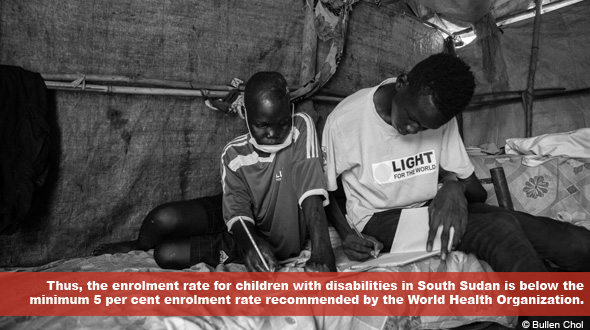
According to the Ministry of General Education and Instruction Policy of 2017-2022, as of 2015, only a staggering 1.7 per cent, approximately 21, 300 of the children with disabilities were enrolled in primary school and 3 per cent enrolled in secondary school. Thus, the enrolment rate for children with disabilities in South Sudan is below the minimum 5 per cent enrolment rate recommended by the World Health Organization. This is exacerbated by the latest announcement on 17 June 2024 by the Ministry of General Education and Instruction Policy of 2017-2022 of the delay in releasing last year’s secondary school results due to financial constraints. Although this is a general challenge, it disproportionately affects the right of children with disabilities to higher education. Delaying the results for nearly ten months and counting will frustrate the hopes of these children and increase their chances of dropping out of school before completing higher education. This is inconsistent with the Committee on Economic, Social and Cultural Rights General Comment 13 which emphasises that education should be available and adaptable. The prolonged delay of results and uncertainty about when they will be released do not meet the accessibility and adaptability requirements.
Early this year, South Sudan shut down schools due to excessive heatwaves. Due to a lack of preparatory and adaptation measures, children, especially those with disabilities, were disproportionately affected by the heatwaves and closure of schools. With a small number of approximately 1.7 per cent of children with disabilities enrolled in primary school, the shutdown could have potentially increased the dropout of these children.
Obligations of South Sudan
Article 28 CRC guarantees the right to education for every child including children with disabilities, obliges State parties to make education free and compulsory at the primary level, make it accessible and affordable in other levels of education and endeavour to make attendance regular in schools. This is premised on the principle of non-discrimination envisaged in Article 2. In this vein, children with disabilities in South Sudan do not have access to education on the same basis as their counterparts who do not have any disabilities. This is attested by the low levels of enrolment of children with disabilities and the lack of ramps, and assistive devices to aid them in studies. These do not conform to the obligation of South Sudan to provide reasonable accommodation to children with disabilities as provided for by Article 24(2)(c) of the CRPD and Article 24(2)(c) which obliges South Sudan to provide education to children with disabilities on equal, inclusive and quality bases. Moreover, children with disabilities have the inalienable right to education, reaffirmed by Article 29(1) of the Transitional Constitution of the Republic of South Sudan of 2011 as amended.
For the above reasons, this article argues that the low enrolment rates and deplorable infrastructure in education do not meet the thumb rule of the right to education for every child in South Sudan without discrimination. This deprives children with disabilities of the aims of education provided by Article 29 of the CRC. These aims are the development of the child’s talents and skills, inculcating respect for human rights and the natural environment, instilling respect for one’s parents, respect for cultural identity, and values of the country and being patriotic and responsible citizens who are tolerant of others.
Conclusion
South Sudan is obliged by the Convention on the Rights of the Child, the Convention on the Rights of Persons with Disabilities, the Transitional Constitution of the Republic of South Sudan, other international human rights instruments and domestic legislation to provide inclusive education to all children including those with disabilities. The low rate of enrolment and lack of reasonable accommodation in the institutions of learning manifested by the lack of ramps and assistive devices to aid the learning of children with disabilities is not consistent with the obligation of South Sudan under human rights and domestic legal regimes to provide inclusive access to education to all children on non-discriminatory bases. The failure to provide inclusive education to children with disabilities in South Sudan will curtail their development. In the spirit of securing a bright future, this article reminds South Sudan of her obligation to provide an inclusive education for all children.
Recommendations
Against the backdrop of the preceding analysis, the article therefore recommends that: First, the government should make children with disabilities visible in the budget for education; Second, the institutions of learning should provide reasonable accommodation to children with disabilities by constructing ramps, providing assistive devices, and training teachers specialised in teaching children with disabilities; Lastly, the government should take more legislative measures such ratifying the African Disability Protocol, African Charter on the Rights and Welfare of the Child, and enacting specific legislation for persons with disabilities including children
About the Author:
Akot Makur Chuot holds an LLB (First Class Honours) from the University of Juba. He is currently an LLM Candidate in Human Rights and Democratisation in Africa, at the University of Pretoria. He teaches law as Assistant Lecturer and serves as a Moot Court Coach at the School of Law, the University of Juba, South Sudan. He holds a Certificate in Legal Practice (LP), from the South Sudan Bar Association and is an Associate at City Law & Co. Advocates, South Sudan.


[…] Wiebusch is an Associate Professor (adjunct) at the Faculty of Law of the University of Cape Town, where he heads the Research Unit of the Judicial Institute for Africa (JIFA). He is also a senior […]