
Beyond Crisis: The State of Access to Information and the Internet for Rural Dwellers in South Africa
Posted: 1 July, 2024 Filed under: Ompha Tshamano | Tags: Access to Information, access to socio-economic rights, apartheid, ATI, digital communication, digital divide, digital technology, fundamental human rights, ICT, internet, post-apartheid, real-time information, right to access information, right to information, rural communities, social media, socio-economic underdevelopment, South Africa 7 Comments Author: Ompha Tshamano
Project Associate, Centre for Human Rights, University of Pretoria
1 Overview
South Africa has a long history of socio-economic underdevelopment, largely resulting from the sustained effects of apartheid. Despite the end of apartheid, the position of rural communities in South Africa remains precarious, with limited access to resources and infrastructure. The creation of Bantustans during apartheid further exacerbated economic disparities amongst different racial groups, leading to poverty, inequality, and unemployment. Slow technological adoption and development in South African rural areas also contribute to limited access to information and restricted opportunities. This situation has resulted in the maintenance of the status quo, with socio-economic underdevelopment and inequality continuing to be major challenges in post-apartheid South Africa. In this context, this article seeks to critically examine the state of access to information for rural dwellers in South Africa and the initiatives being taken to improve this situation.
2 The Digital Divide in South Africa.
South Africa continues to exist as an anti-black bifurcated society with ‘zones of beings’ occupied by white people and the black bourgeoisie, and ‘zones of non-beings’ occupied by the black proletariats who remain socially excluded and racially dehumanised.[1] The classification of beings and non-beings is attributed to race–race still remains a key determinant to access to socio-economic rights within South Africa. This is mostly coupled with other determinants such as geography, class, culture, sexual orientation and gender amongst others.
Whilst there have been considerable efforts to ensure that access to socioeconomic rights is realisable, they still remain largely skewed in favour of the white minority. The access or rather the ability to maintain the access remains constrained through racialised poverty which has been exacerbated through globalisation and subsequently through the adoption of neoliberal policies which furthers the digital divide.
Fuchs and Horak define the digital divide as:
Unequal patterns of material access to, usage capabilities of, benefits from computer-based information–and communication technologies that are caused by certain stratification processes that produce classes of winners and losers of the information society, and participation in institutions governing Information and Communications Technologies and society.[2]
The digital divide is therefore a multidimensional phenomenon that is not only linked to access to the internet, but also tackles issues of usage and the benefits of the usage.[3] For the purpose of this article, the author seeks to discuss only two aspects of the divide, namely material and mental access in relation to the state of access to the internet for rural communities in post-apartheid South Africa.
3 The State of Access to the Internet for rural communities in South Africa.
The right to access communication and information is a fundamental human right that is essential for the exercise of nearly all other human and constitutional rights [4] In today’s world however, access to the internet is considered an implied right within the broader framework of information accessibility. [6] This right is seen as a privilege despite being a necessity for the sustenance and improvement of the standard of living for anyone living in an information society. It is within this view that information should be regarded as a primary good that is required for people to function effectively.[7] Information therefore should not only be regarded as a positional good but as a vital element needed to survive within economic, social and cultural spaces. [8]
The lived experiences of rural communities in South Africa reveal a differential level of survival, whilst information is a social capital – the access or rather the ability to sustain this right seems a bit far-fetched for some if not all rural dwellers in South Africa. Rural communities are further marginalised within the information society, their ability to access the internet and subsequently engage in the dissemination of information is limited by several factors which as discussed above have contributed to the digital divide, namely unemployment, politics, socio-cultural norms, and the lack of proper digital skills training. Being able to constantly access these technologies had the potential of closing the disparities between social groups.[9] In the section that follows, I discuss factors that have hugely impacted the state of access to the internet for rural communities in South Africa.
3.1 The existence of Information and Communications Technologies (ICTs) Infrastructures.
The distribution of internet access was limited to the big cities dominated by white people to the detriment of rural communities which are dominated by black women. [10] The history of the ICT sector and ICT policies during apartheid and seemingly in the post-apartheid era do not address the needs of all people– the telecommunication network has tenets that present racial duality. [11]
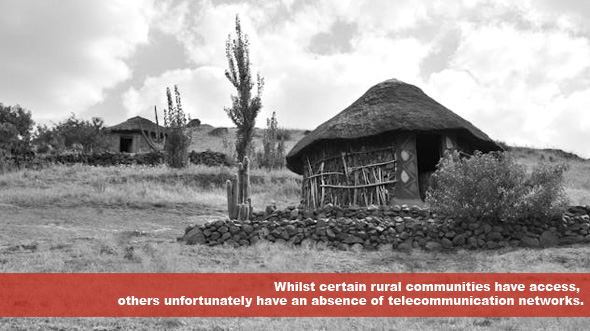
Whilst looking at the different rural communities and their positions within the post-apartheid information society, what becomes visibly clear is the remnant of apartheid infrastructure. Telecommunication companies do not adequately provide and maintain infrastructure in rural communities dominated by black people, while neighbouring white communities have well-maintained and abundant access to similar infrastructure.[12] Whilst certain rural communities have access, others unfortunately have an absence of telecommunication networks.
Most ICT projects aimed at ensuring digital accessibility and inclusion have failed due to poorly formulated policies, poor understanding of ICTs, lack of user participation and most importantly poor management. [13] It is evident that communities with lower income have limited access to digital technology opportunities, this is attributed to general shortage and high cost of infrastructure ranging from the exorbitant cost and insufficient power supply to limited ICT infrastructures that are available for use. [14]
Furthermore, rural communities are generally underfunded- through the adoption of neoliberalism, there has been a focus on market access to the detriment of income distribution and educational and skills access which are crucial to rural communities participating in the digital economy and technology– the ability of women living in rural areas to access and use the digital technology is directly and indirectly affected by the investment dynamics, regulations and competition. [15]
In conclusion, there is a correlation between investments and internet usage. The total number of internet users is increasing, and women make up the majority of those without access to the internet further adding to their marginalization and restricting them from fully participating in globalisation. [16]
3.2 Internet Access Affordability.
The telecommunication sector in South Africa has continuously been liberalised and privatized.[17] While some argue that market liberalization has led to lower costs and increased access for low-income consumers, the above argument is flawed. Thus, whilst market liberalisation has been increasing the potential for access, it has continuously broadened the digital divide. Consequently, whilst there is access to phone lines, mobile lines, and internet connections the ability to sustain access to these ICTs proves to be nearly impossible due to their high costs.
The internet penetration rate in South Africa has been significantly increasing, as of early 2024, the rate sits at an impressive 74.7% among its population of 60.69 million.[18] While this is commendable, it should not detract from the fact that affordability issues are more severe for rural residents, with communication costs reaching as high as 22% of their monthly income. [19] The poverty-stricken pay more for data as compared to the wealthy.[20] The pricing of prepaid data packages for people living in rural areas in South Africa costs significantly more than contract data or post-paid per megabyte–similarly, the price of small-value bundles purchased by low-income earners is usually higher than the discounted amounts bought by the affluent. [21] There is a correlation between internet usage and income as shown above – internet usage remains largely at the hands of the wealthy black bourgeoise and the whites.
Although mobile access has increased, most of the users of ICT infrastructures are not advanced users. They use their phones for voice calls, SMS and in some instances, social media. The increase in the usage of phones signifies an opportunity for networked communication and growth within the broadband sector.[22] This growth requires careful monitoring, and comprehensive policies should be developed to promote affordable access to ICT infrastructures regardless of age, race, gender, or religion.
4 Conclusion
South Africa remains hugely unequal – race, class and gender still remain the key determinants to accessing the right to the internet. Whilst there are laws that allow for the right to information to exist, rural communities still remain marginalized and, to some extent, alienated. To mitigate the marginalization of rural communities, the government and Big Tech companies need to increase internet connections by investing in rural ICTs infrastructures. The digital divide is not closed off by fostering privatisation and liberalisation, South Africa is still facing major social problems due to the transition that took place in 1994. There is a need to change the market model within South Africa to ensure that access is broadened. The lack of investment in rural areas is a clear indication of the global digital divide, which reflects the unequal geography of global capitalism. Market protectionism and the lack of investments in rural areas are the effects of colonial and post-colonial exploitation, exclusion, and the dependency on third world countries.[23]
[1] T Madlingozi ‘Social Justice in a time of Neo-apartheid constitutionalism: Critiquing the anti-black economy of recognition, incorporation and distribution’ (2017) 28 Stellenbosch Law Review 123-124.
[2] C Fuchs & E Horak ‘Africa and the Digital Divide’ 25 Telematics and Informatics 101.
The digital divide refers to ‘unequal access to the internet’. It is also seen as ‘any disparities within the online communities’– it presents the gap between those who do and do not have access to computers and the Internet. From the aforementioned definition, it becomes clear that this phenomenon is multidimensional and exists within three tenets, thus the global digital divide(signified by the divergence of internet access between industrialized and developed societies), the social divide (gap between the poor and the rich) and the democratic divide(difference between those able or unable to use opportunities of digital resources to engage, mobilise, and participate in public life). The digital rights guaranteed in South Africa include the right to freedom of expression, information and communication, the right to universal and equal access and the right to privacy and data protection amongst others. Important to note, is that these rights are guaranteed to every citizen of South Africa, however, their access especially for rural communities seems to be limited and determined by demographics such as age, gender, class, geography, and race.
[3] Fuchs (n 2) 99.
[4] Dr C Lewis ‘ A step-closer to achieving a connected South Africa where no one is left behind’ 31 March 2023 ICASA https://www.icasa.org.za/news/2023/a-step-closer-to-achieving-a-connected-south-africa-where-no-one-is-left-behind (accessed 24 September 2023); Section 32 of the Constitution of the Republic of South Africa, Act 32 of 1996 provides that everyone has the right to information everyone the right to any information held by the state or any information that is held by another person that is required for the exercise or protection of any rights.
[6] S Mtuze ‘The right to internet is a major part if the right to information but Africa lags badly’ 04 October 2021 The Daily Maverick https://www.dailymaverick.co.za/opinionista/2021-10-04-the-right-to-internet-access-is-a-major-part-of-the-right-to-information-but-africa-lags-badly/#:~:text=The%20ability%20to%20access%20the,now%20have%20an%20enforcement%20mechanism (accessed 19 September 2022.
[7] E Bornman ‘Information Society and digital divide in South Africa: results of longitudinal surveys’ (2015) Information, Communication &Society 266.
[8] As above.
[9] K Arubela & N Jere ‘Exploring digital transformation challenges in rural areas of South Africa through a systematic review of empirical studies’ (2020) 16 Scientific African 10.
[10] Arubela (n 9) 3.
[11] As above.
[12] As above.
[13] As above.
[14] As above.
[15] C Dube ‘There is an urgent need for policies in order to bridge the digital gender divide’ 08 March 2023 Mail & Guardian https://mg.co.za/thoughtleader/opinion/2023-03-08-there-is-an-urgent-need-for-policies-in-order-to-bridge-the-digital-gender-divide/ (accessed 12 September 2023).
[16] M Chisiza ‘No woman left behind in the gender digital divide’ 11 May 2017 South Africa Institute of International Affairs https://saiia.org.za/research/no-woman-left-behind-the-gender-digital-divide/
[17] Fuchs (n 2) 109.
[18] S Kemp ‘Digital 2023: South Africa’ 13 February 2023 Data Reportal https://datareportal.com/reports/digital-2023-south-africa (accessed 22 September 2023).
[19] S Pather & Ret Moreno Advancing rural connectivity in South Africa: A case for community networks policy brief (2018) 3.
[20] Arubela (n 10).
[21] As above.
[22] Bornman (n 7) 268.
[23] Fuchs (n 2) 115.
About the Author:
Ompha Tshamano is a Project Associate at the Centre for Human Rights and an LLM Candidate at the University of Pretoria with a keen interest in socioeconomic rights for marginalised and vulnerable persons in South Africa.
 AfricLaw
[…] disparities. These still show in unequal access to education and infrastructure. Today, rural areas lack reliable internet connections. (About 31.18% of South Africa’s population live in rural areas.) This makes it nearly impossible […]
[…] rural areas lack reliable internet connections. (About 31.18% of South Africa’s population live in rural areas.) This makes it nearly impossible […]
[…] rural areas lack reliable internet connections. (About 31.18% of South Africa’s population live in rural areas.) This makes it nearly impossible […]
[…] rural areas lack reliable internet connections. (About 31.18% of South Africa’s population live in rural areas.) This makes it nearly impossible […]
[…] rural areas lack reliable internet connections. (About 31.18% of South Africa’s population live in rural areas.) This makes it nearly impossible […]
[…] rural areas lack reliable internet connections. (About 31.18% of South Africa’s population live in rural areas.) This makes it nearly impossible […]
[…] rural areas lack reliable internet connections. (About 31.18% of South Africa’s population live in rural areas.) This makes it nearly impossible […]