
The rationality of the electorate as a catalyst for political change- Lessons from Senegal
Posted: 16 May, 2024 Filed under: Bonolo Makgale, Matthew Ayibakuro | Tags: Constitutional Council, corruption, democratic governance, diplomatic interventions, elections, political change, political dispute, President Mack Sall, presidential elections, Senegal, social media campaign, Sovereignty, systemic change, transfer of power Leave a comment |
Author: Bonolo Makgale Centre for Human Rights, University of Pretoria |
 |
Author: Matthew Ayibakuro Governance Adviser and Development Consultant |
The recent presidential elections in Senegal took place against a backdrop of constitutional disputes and widespread political fervour. This was after the Constitutional Council overturned former President Mack Sall’s decree postponing the election, declaring it unconstitutional. This election remains one of Senegal’s most historic. It signalled the end of Sall’s 12-year rule, and with 17 candidates vying to succeed him, it was the most competitive presidential race since Senegal’s independence from France in 1960. It also marked the culmination of a contentious political dispute over the date of the election, which began when Sall moved it to extend his term, sparking widespread protests and boosting support for the opposition.
Of the 17 presidential candidates, 44-year-old Bassirou Diomaye Faye emerged victorious to become Africa’s youngest president. It came just 10 days after he was released from prison through a parliamentary amnesty on 14 March, sparking celebrations in the streets of Dakar. The new president was little known until Ousmane -Sonko, a popular opposition figure who came third in the last election in 2019, nominated him to run in his place after being barred from standing due to a previous conviction. Accused of being a populist and provoking an uprising, Sonko is a 48-year-old tax inspector-turned-whistleblower who is popular for electrifying young people with a slick social media campaign, which he uses to rip Senegal’s elites and whip up nationalist sentiment. After being disqualified from running, Sonko announced Faye, a former tax inspector who has never held elected office, as his successor.
Bassirou Diomaye Faye won more than 54 per cent of the vote in Senegal’s presidential election. The 44-year-old victor said he wanted a “break” with the current political system and promised systemic change, greater sovereignty and calm after years of deadly turmoil. He has vowed to “defend the integrity of the territory and national independence and spare no effort to achieve African unity”. Faye has vowed to protect Senegal from corruption and interference by foreign powers such as former colonial ruler France, and his victory reflected youth frustration with high unemployment and concerns about governance in the West African nation.
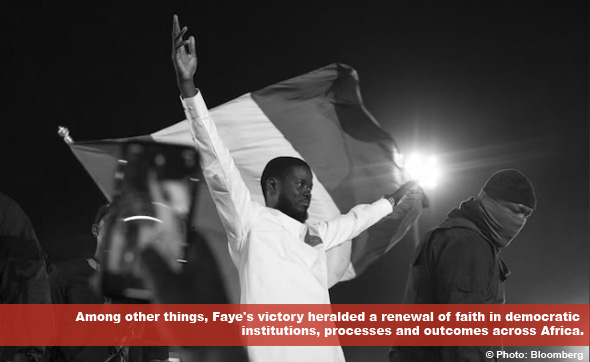
Among other things, Faye’s victory heralded a renewal of faith in democratic institutions, processes and outcomes across Africa. In the light of recent events elsewhere, particularly in West Africa, there was real concern that the situation in Senegal could quickly deteriorate along an undemocratic path. In the end, the timely and constitutional transfer of power strengthened confidence in democracy, not only for the citizens of Senegal, but for many across the continent. Senegal’s positive example has symbolically halted the nascent narrative of democratic backsliding in Africa. It has created a palpable sense of optimism across the continent for a future built on the pillars of democratic values, with the will of citizens at its heart.
Voter rationalism in Senegal
Faye’s rise to the presidency is a sign of the electorate’s awareness of the incumbent’s failures. Senegalese voters demonstrated a strong sense of agency in the face of the former president’s attempts to extend his term and used their agency and their vote to usher in a new political era. It was a clear demonstration of their commitment and determination to shape the future of their country. The electorate signalled their readiness for change and their belief in the potential of an alternative leadership to effectively address their concerns. In essence, Faye’s election reflects not only a changing of the guard in Senegalese politics, but also an affirmation of the electorate’s rationality and capacity to drive meaningful political change. Equally telling was the sustained demonstration of this agency long before polling day. For nearly three years before the election, Senegalese citizens rallied behind the main opposition leaders and took a stand against the undemocratic actions of the incumbent government. These acts of defiance eventually led to action by the Constitutional Court and the National Assembly in the weeks leading up to the election.
The electorate’s rejection of the status quo and support for new opposition candidates also highlights a broader phenomenon observed across the African continent: the role of the incumbent’s actions in shaping opposition responses. In Senegal, the behaviour of the incumbent regime acted as a catalyst for political change. The unconstitutional actions of the former president galvanised opposition parties and led them to coalesce around strategies aimed at addressing the failures of the existing regime.
This confluence of factors ultimately led to the collapse of the incumbent government, as Senegalese voters rejected unconstitutionalism and embraced candidates who offered a vision of accountable and responsive governance. This was a common trend in African countries such as Malawi, Zambia and Kenya, highlighting how the actions of incumbent governments influence the strategies and narratives of opposition parties. More recently, in South Africa, new parties have emerged as vocal advocates for leadership change, citing the failures of the ruling party, African National Congress (ANC), which has been tainted by issues such as corruption and poor service delivery over the past 30 years, as grounds for renewal.
There are lessons for other contexts where opposition coalitions have not been as successful. Offering citizens an alternative collective vision is as important as exploiting the failures of an incumbent government. In Nigeria’s recent presidential elections, the opposition’s failure to unseat the incumbent party was largely due to the inability of key opposition figures to present a common vision to citizens. This meant that neither of the two leading opposition parties – the Peoples Democratic Party and the Labour Party – was able to secure a majority of votes, as Faye did in Senegal. The final count showed that the two opposition parties together received over sixty per cent of the votes cast.
Institutionalising the intervention of former presidents in political turmoil
In the midst of such political dynamics, it is important to recognise the significant impact of the interventions of former statesmen. In the context of Senegal’s political dynamics, President Thabo Mbeki’s intervention played a pivotal role in influencing the course of events. His direct communication with the former president of Senegal, warning against attempts to retain power through unconstitutional means, carried considerable weight. Mbeki’s stature as a respected African leader and advocate of democratic governance lent credibility to his warning and potentially influenced the decision-making process of Senegal’s political leadership. By stressing the importance of upholding constitutional principles and respecting democratic norms, Mbeki’s intervention helped to avert a potential constitutional crisis in Senegal. His proactive engagement in promoting democratic governance is a testament to the value of diplomatic interventions by former statesmen in safeguarding democratic processes and institutions across the African continent.
Moving Ahead
As Senegal turns a new page under the leadership of President Faye, the lessons of this experience resonate far beyond its borders. The country’s political evolution is a testament to the enduring importance of voter agency and democratic resilience in fostering accountable and responsive governance. The realisation of this potential, and the sustainability of these immediate gains, will be determined by how best the former opposition figures – now the President and Prime Minister – are able to continue to represent the voice of Senegalese citizens in their current and future political prospects. Nevertheless, in a region beset by uncertainty and upheaval, Senegal stands as a beacon of hope, where the will of the people prevails, and the promise of democracy endures.
About the Authors
Bonolo Makgale is a democracy practitioner and the Manager of the Democracy and Civic Engagement Unit of the Centre for Human Rights, University of Pretoria.
Dr. Matthew Ayibakuro is a Governance Adviser and Development Consultant
 AfricLaw