
Climate change and children’s right to education: Exploring sustainable approaches to climate-induced heatwaves in South Sudan
Posted: 10 May, 2024 Filed under: Justin Monyping Ater | Tags: children’s right to education, children’s rights, climate change, climate change solutions, climate related deaths, climate resilient classrooms, closing of schools, heatwaves, human rights, South Sudan, South Sudan’s Constitution and Child Act 2008, sustainable strategies, United Nations Convention on the Rights of the Child 1 Comment Author: Justin Monyping Ater
Law lecturer, School of Law, University of Juba, South Sudan
Introduction
South Sudan is increasingly becoming extremely vulnerable to climate change events such as excessive climate-induced heatwaves. Evidence suggests that this may be because the country falls under the category of the least developed Countries (LDC). These countries bear a greater burden of climate change’s adverse consequences than developed countries, yet they emit less greenhouse gases. This is because LDCs lack resources and the capacity to mitigate and adapt to climate change. The rationale also applies within a country. Each state has communities and individuals who are disproportionately vulnerable to climate change and its effects. For instance, as of 14, 15, and 16 March 2024, South Sudan’s government made considerable press releases spotlighting the disproportionate impacts of heatwaves on vulnerable groups such as children. This resulted in, for example, climate related deaths and consequently closing and re-opening of schools without strategies to keep the schools open and avoid the perpetual violation of children’s right to education. In light of this, it is argued that the government’s response of closing down schools was unsustainable. To avoid future interruption to learning, the government should adopt sustainable strategies such as the construction of climate resilient classrooms. However, in the meantime, children should be educated about climate change and its consequences to make them climate resilient. Following this introduction, the article discusses South Sudan’s obligation under international and national frameworks that provide basis for initiating and developing durable strategies to curb climate change and thereby protect children’s right to education.
International children’s rights-specific frameworks
The leading instrument at the global level that continues to advance child-specific rights and which has been ratified by South Sudan’s government without reservations concerning the right to education is the United Nations Convention on the Rights of the Child (UNCRC). The UNCRC under article 28 references the right to education for every child. While article 28 enjoins the right to education, article 29 outlines the direction and importance of education to a child such as an education that encourages children’s ‘respect for the natural environment’ and ‘prepares them for a responsible life’. Invoking this provision would make children part of the climate change solutions.
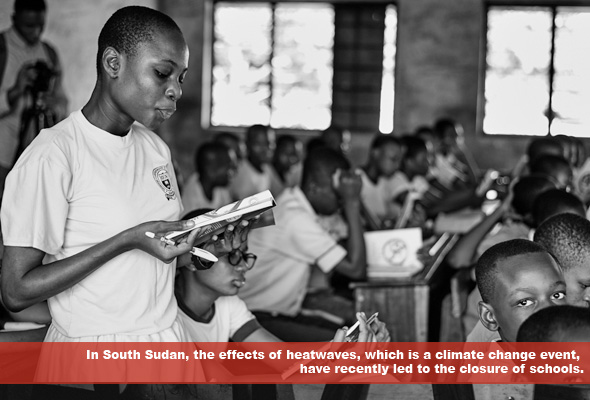
It is indeed not surprising that among the current global threats to human rights particularly on children’s rights, is climate change. In South Sudan, the effects of heatwaves, which is a climate change event, have recently led to the closure of schools. Correspondingly, South Sudan under article 28 of the UNCRC is obliged to protect children’s right to education from climate change and its adverse consequences by adopting sustainable coping measures. Since South Sudan is mandated to promote and protect the right to education, it must undertake measures to protect the children’s right to education. The rationale for closing down schools and preventing children from attending them is because of lack of resilient classrooms and consequently the disproportionate impact of heatwaves on children’s health. In this respect, South Sudan is encouraged to allocate funding to all schools. This funding should be invested in constructing classrooms that are climate resilient. Furthermore, educating children has many advantages. Firstly, it will afford them the opportunity to learn about the consequences of climate change and how to avoid and/or adapt to it. Secondly, it will enhance the government’s development and implementation of climate change strategies. This is what is explicitly stated and envisioned in article 29 of the UNCRC.
Contextualising the right to education
Generally, there are strong constitutional provisions that expressly advance human rights. Particularly, article 9(3) of the Bill of Rights, stipulates that international treaties ratified by South Sudan are directly applicable before the courts of law to the extent that their provisions not only guide the courts but also bind them.
Furthermore, South Sudan’s Constitution and Child Act 2008 contain a child-specific provision for the protection and promotion of children’s rights to education. Additionally, there is a general provision on the right to education within the Constitution. Indeed, these provisions advance the same right and require the government to take measures to promote and protect the right to education. It is argued that since climate change has become a perpetual hindrance to the full enjoyment of the right to education, the government should allocate funding and adopt other measures to address heatwaves. Such a budget should prioritise the construction of climate resilient classrooms and the planting of trees around schools.
Ways forward
The article has unpacked the level of severity of climate change in the form of heatwaves in South Sudan and showed that South Sudan did not adopt appropriate measures to ensure the continuous realisation of children’s right to education. In this respect, it is recommended that South Sudan comply with its obligations by funding schools to construct classrooms that are conducive and climate resilient and by encouraging the learning of climate change and its effects to ensure that children become climate resilient.
About the Author:
Justin Monyping Ater is a law lecturer at the School of Law University of Juba and Starford International University, in Juba, South Sudan. He is currently a Doctor of Laws (LLD) Candidate at the Faculty of Law, University of Pretoria. He holds an LLM degree in Human Rights and Democratisation in Africa (HRDA), from the University of Pretoria, an LLB (Hons) degree from the School of Law, University of Juba, and a Certificate of Legal Practice from the South Sudan Bar Association. His research interests are in the areas of human rights law and international humanitarian law.
 AfricLaw
[…] by the people of South Sudan particularly the vulnerable group such as children. For example on 15 April 2024, the government of South Sudan closed down schools because the heatwaves were too severe to the […]