
South Sudan is set to hold its first election in 2024: 3 critical preconditions for the election
Posted: 4 April, 2024 Filed under: Mark Deng | Tags: 2024 election, arms proliferation, civil war, communal conflicts, deadly violence, democratic right, epidemic of insecurity, incidents of violence, outbreak of violence, population census, revitalised agreement, South Sudan, Transitional Period, Unification of forces 2 Comments Author: Mark Deng
McKenzie Postdoctoral Research Fellow, University of Melbourne, Australia
South Sudan was supposed to hold its first election as an independent country in 2015. However, a civil war erupted in 2013 that threw the country into a deep state of insecurity, inevitably altering the government’s priorities. Restoring peace urgently became the focus for the government.
The government and other parties to the war signed the revitalised agreement in 2018, paving the way for the establishment of the current unity government at the beginning of 2020. The unity government was given a 3-year tenure – the transitional period. This was extended in 2022 for 2 more years to give the parties enough time to resolve critical issues outstanding in the revitalised agreement.
The revitalised agreement mandates many important things to take place before the transitional period concludes. One is holding an election. President Salva Kiir Mayardit announced in 2023 that the election will be held in December of 2024, declaring himself as a candidate for president at the same time.
There are serious challenges that stand in the way of the election. I discuss 3 of the challenges in this piece, namely epidemic of insecurity, conducting a population census and unification of forces. My position, overall, is that these challenges should be addressed first before the election can be held. If it is impossible to do this within the remaining time, the transitional period should be extended further.
Epidemic of insecurity
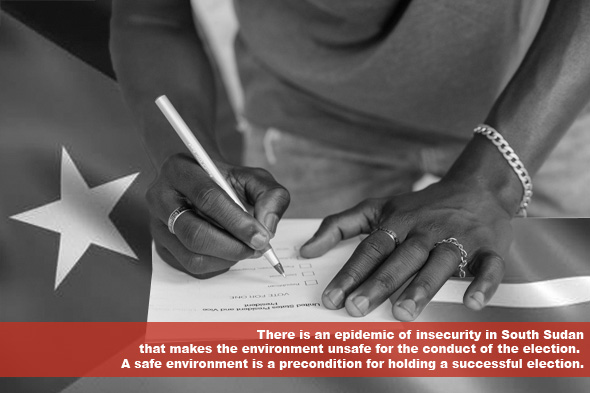
There is an epidemic of insecurity in South Sudan that makes the environment unsafe for the conduct of the election. A safe environment is a precondition for holding a successful election.
As I discussed in my 2022 Conversation Africa article, insecurity has been a tenacious problem facing the new nation since independence. It is caused largely by communal conflicts, and it has been made much worse by arms proliferation in the civilians’ hands.
In the beginning of February, for example, fighting occurred between the Pakam youth of Rumbek North County, Lakes State, and Luanyjang section of Warrap State that left nearly 70 people dead. The Pakam youth (along with youth from other sections of Lakes State) came to raid cattle from Luanyjang, according to report. This is just one example among many.
Given the persistence of these incidents of violence, there is a real fear that the civilians could be subjected to organised or vengeful violence during the election.
A large part of the solution needed is to disarm the civilians. This should be a focus for the government between now and the election time. Removing guns from the civilians’ hands will reduce the number of deaths and minimise youth’s propensity to violence.
Population Census
A population census is needed for the conduct of the election for many important reasons. It is required for ‘voter registration and … drawing … constituency boundaries’, for example. Without meeting these requirements, it is difficult to see how a credible election can possibly be conducted in South Sudan.
This is not to deny that conducting a census will require time. But there is enough time between now and the election date in December to do this. The government just needs to supply money, however much is required. Alternatively, as the newly appointed Chairperson of South Sudan’s National Bureau of Statistics has requested, the election date could be extended for 3 more months to give him enough time to complete the census. He is pretty confident that he could get it done by March 2025.
Some people have suggested that the 2008 census could be used to make population projections. But there are serious issues with using the 2008 census. For one thing, it has been 16 years since the census was conducted, meaning it would not account for the growth in the population. Also, the 2013 war has displaced an estimated 2.3 million South Sudanese people, which the 2008 census would not account for. Relatedly, the SPLM disputed the 2008 census, saying it misrepresented the population of South Sudan. The population was somehow smaller than expected. Why should the SPLM take the census as credible now when it did not do so then?
Unification of forces
The revitalised agreement requires the unification and deployment of the armed forces to be completed before the election can take place. It requires this to be completed within a period of 8 months. The target is 83000 soldiers.
Reports indicate that only around 55000 soldiers were graduated late last year and were going to be deployed. It is unclear whether they have been deployed or not. The government said that there were no arms to be given to the soldiers, citing the arms embargo imposed on South Sudan in 2018 that does not allow the government to purchase arms.
But the real reason the unification of forces has taken so long is that the government and opposition parties are not fully committed to it. It is an open secret that the parties are holding back their seasoned fighters and sending less seasoned or new recruits to the unified forces.
They have done so because they do not trust each other, or they anticipate a return to hostilities. A return to hostilities is a possibility, especially if President Mayardit and Dr Riek Machar Teny are going to run against each other. To counter the potential outbreak of violence from the election, the peace guarantors/monitors – IGAD, AU, UN, and the Troika nations – need to put in place effective measures. These could mean deploying more troops, say joint AU and UN forces, to South Sudan to protect the civilians in the likely event of the election resulting in another deadly violence.
In short
Holding an election in South Sudan is welcome news for many good reasons. It will give the people the opportunity to exercise their collective democratic right for the first time since independence. It will also mean that a new government will have democratic legitimacy – which the SPLM led government has been lacking for over a decade now.
However, without addressing the challenges introduced above – insecurity, census and unifying the forces – it is difficult to see how the election can be conducted successfully. The transitional period should be extended further to resolve these issues if need be. There is no point in rushing an election that is likely going to result in violence.
About the Author:
Mark Deng is a McKenzie Postdoctoral Research Fellow at the University of Melbourne, Australia. He’s a co-Convenor of the Brown Bag Seminar Series at the Centre for Comparative Constitutional Studies, Melbourne Law School. His research intersects the South Sudanese public law, human rights, and customary law and practices. He’s currently working on a book on the emerging constitutionalism in South Sudan (Hart Publishing).


[…] my recent article, I discussed how President Salva Kiir Mayardit has vowed to hold the first election in South Sudan […]
[…] Agreement, which largely governs South Sudan during this transitional period. (This is a period of 3 years and it began in 2020, but it has been extended a few times to give the parties enough time to resolve issues outstanding […]