
Lethal Skies, Absent Law: Drone Warfare in Sudan and the Limits of International Humanitarian Law
Posted: 13 April, 2026 Filed under: Razan E H Ali | Tags: accountability, armed conflicts, Arms Supply Problem, drone strikes, drone technology, Geneva Conventions, International Committee of the Red Cross, international human rights law, international legal community, legal architecture, Rapid Support Forces, Sudan, Sudanese Armed Forces, Sudanese domestic law, summary executions, transparency failures Leave a comment Author: Razan Ali
Centre for Human Rights, University of Pretoria
1 Introduction
The proliferation of drone technology into an ever-growing number of armed conflicts has generated deep unease within the international legal community. As the United Nations Secretary-General observed in 2020, this proliferation ‘reinforces long-standing concerns over compliance with international humanitarian and international human rights law, accountability and transparency’. Nowhere is this concern more acutely illustrated than in Sudan.
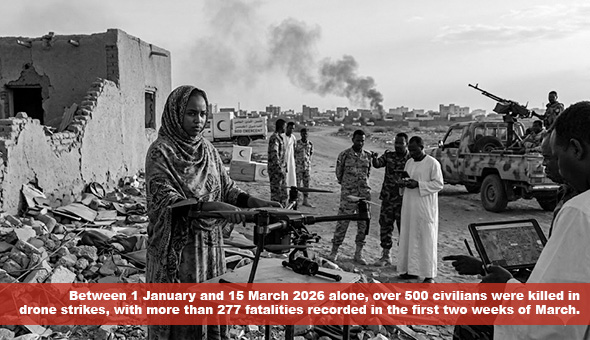
Since the outbreak of armed conflict between the Sudanese Armed Forces (SAF) and the Rapid Support Forces (RSF) in April 2023, UAVs have emerged as a defining feature of the battlefield. Between 1 January and 15 March 2026 alone, over 500 civilians were killed in drone strikes, with more than 277 fatalities recorded in the first two weeks of March. Just a few days ago, a drone strike tragically hit the town of Kutum in North Darfur, killing 30 people at a wedding ceremony. Earlier, on March 20, 2025, during the first day of Eid al-Fitr, coordinated air and drone strikes targeted El Daein Teaching Hospital in East Darfur, resulting in at least 64 deaths, including 13 children, and causing the hospital’s emergency, maternity, and pediatric units to become entirely non-operational.
These are not incidental tragedies; they represent a pattern of conduct that raises serious questions about compliance with the foundational rules of armed conflict. This article proceeds in four parts. It begins by locating drones within the existing IHL framework. It then examines the application and systematic breach of the principles of distinction, proportionality, and precaution in the Sudanese context. The third section addresses accountability and transparency failures, including the opacity of arms supply chains. Then, finally, the article concludes with reflections on the adequacy of the current legal architecture and the reforms required to close its most dangerous gaps.
2 Drones Under International Humanitarian Law: The Legal Framework
At the outset, it is important to clarify that no treaty expressly prohibits UAVs. The International Committee of the Red Cross (ICRC) has confirmed that armed drones are legally comparable to weapons launched from manned aircraft, and their deployment must comply with the same rules applicable to all weapons in armed conflict (ICRC, 2013). Drones are therefore not inherently unlawful; they become unlawful when used in ways that violate existing IHL norms.
The applicable legal framework is the law of armed conflict, specifically, the rules governing the conduct of hostilities as codified in the Hague Regulations, the four Geneva Conventions of 1949, and Additional Protocols I and II of 1977, as well as customary IHL. Notably, three principles under IHL are particularly relevant to drone operations: distinction, precaution, and proportionality.
Sudan is party to the Geneva Conventions and, while it has not ratified Additional Protocol I, the core principles of distinction, proportionality, and precaution are widely regarded as norms of customary international law binding on all parties to any armed conflict, international or non-international, and since the current conflict between the SAF and RSF is classified as a non-international armed conflict (NIAC), it therefore falls squarely within the ambit of IHL.
A. Distinction
The principle of distinction, codified in Articles 48 and 51 of Additional Protocol I and reflected in customary IHL Rule 1, requires all parties to an armed conflict to distinguish at all times between civilians and combatants, and between civilian objects and military objectives. In this sense, attacks may only be directed against combatants and military objectives.
In Sudan’s conflict, the application of this principle is gravely compromised. The RSF, in particular, operates within and among civilian populations, markets, hospitals, and residential quarters, making meaningful distinction exceptionally difficult even for a technologically sophisticated actor operating in good faith. Yet the documented pattern of strikes on hospitals, civilian convoys, and populated urban areas suggests that distinction is not being treated as a genuine operational constraint. The targeting of El Daein Teaching Hospital, a protected object under Article 19 of Geneva Convention IV, and a crowded market killing at least 60 with just over 250 injured, including women and children, on 1st January 2025, cannot be reconciled with a good-faith application of the principle of distinction.
The technological nature of drone warfare does not solve this problem and may, in some respects, deepen it. While proponents argue that drones equipped with advanced sensors and real-time surveillance are better positioned than ground forces to make fine-grained targeting decisions, the reality of Sudan’s conflict, where both warring parties have demonstrated either inability or unwillingness to distinguish civilians from combatants, reveals the fallacy of technological optimism divorced from legal compliance and command accountability.
B. Proportionality
Article 51(5)(b) of Additional Protocol I sets the foundation for the proportionality principle by prohibiting attacks expected to cause incidental loss of civilian life, injury to civilians, damage to civilian objects, or a combination thereof, which would be excessive in relation to the concrete and direct military advantage anticipated.
In the Sudanese context, the strikes on civilian infrastructure, including an electricity substation and engineering college in Al Dabbah on 20 March 2026, are difficult to square with proportionality analysis. The military advantage of striking a substation serving a civilian population, against the cost of cutting power entirely to a locality, requires justification that neither warring party has provided. The OHCHR has noted that continued patterns of attacks on civilian infrastructure ‘raise serious concerns about compliance with the fundamental principles of distinction, proportionality and precaution, and may amount to war crimes’.
C. Precaution
The principle of precaution, reflected in Article 57 of Additional Protocol I and customary IHL Rule 15, requires parties to take all feasible precautions to avoid or minimise incidental civilian harm. This includes verifying that targets are military objectives, choosing means of attack that minimise civilian casualties, and calling off attacks when disproportionate civilian harm becomes apparent.
The use of drone strikes on civilian convoys and health facilities in a conflict already characterised by catastrophic displacement and humanitarian collapse is inconsistent with the exercise of precaution. The precautionary obligation is not merely formal; it demands genuine operational effort to protect civilian life before, during, and after an attack. The evidence from Sudan suggests systematic failure on all three dimensions.
3 Accountability, Transparency, and the Arms Supply Problem
A. The Accountability Deficit
Accountability is the legal and institutional mechanism that gives IHL its teeth. It encompasses the responsibility of states and individuals to justify their conduct, and the obligation to investigate, prosecute, and provide reparations for violations. However, in Sudan, this mechanism is effectively non-functional.
Neither the SAF nor the RSF has demonstrated a credible commitment to investigating civilian casualties caused by drone strikes. Local reports and conflict monitors have attributed specific attacks to the SAF, yet both parties trade accusations without a transparent investigation. This mutual finger-pointing shows a lack of transparency and a genuine intention to hold accountable those who have harmed victims. The absence of transparency does not merely impede oversight; it structurally forecloses the possibility of reparations for affected communities, violating the right to an effective remedy under international human rights law.
The Human-Machine Partnership model, whereby human operators retain responsibility for all lethal decisions, offers a theoretical path to clear accountability. When a human operator authorises a strike, the chain of command is traceable and responsibility assignable. The problem in Sudan, as in many contemporary drone conflicts, is not the absence of human operators, but the absence of any functioning accountability system capable of reaching them. Command responsibility under IHL, which holds commanders liable for violations they knew or should have known about and failed to prevent or punish, remains entirely uninvoked.
B Third-State Responsibility and Arms Transfers
An underexplored dimension of the Sudan drone crisis is the role of external actors supplying weapons to the belligerents. Both warring parties rely on foreign-supplied UAV systems. The RSF is widely reported to deploy Chinese-manufactured CH-95 long-range drones supplied through the United Arab Emirates, allegations the UAE denies. The SAF is believed to operate Turkish Baykar drones, including the advanced Akinci combat model, despite Turkey officially denying direct support to the armed forces; however, Egypt has reportedly allowed Turkish drones to be launched from Egyptian territory near the Sudanese border.
These supply relationships carry legal significance. The 2016 Joint Statement on Armed and Strike-Enabled UAV Policy signed by the United States and 52 other countries recognises ‘the applicability of international law, including both the law of armed conflict and international human rights law, as applicable, to the use of armed or strike-enabled UAVs’. The Arms Trade Treaty (ATT), to which Sudan is not a party to yet several supplier states are party, prohibits arms transfers where the exporting state knows the weapons will be used in attacks against civilians or civilian objects.
The German Federal Administrative Court’s 2019 ruling on the use of Ramstein Airbase for US drone operations is instructive here. The court held that Germany, by providing material assistance to US drone operations, acquired jurisdiction over those strikes and incurred an obligation to protect the right to life of those targeted. It further held that assurances of legality from the operating state are insufficient, and that the provision of assistance to unlawful strikes is a matter of law, not politics. Applied to Sudan’s arms suppliers, this reasoning suggests that states providing drones used in strikes on civilians bear legal responsibility that cannot be discharged by denial or diplomatic deflection.
4 Towards a More Effective Legal Architecture
The foregoing analysis demonstrates that the problem in Sudan is not a gap in the law. IHL applies to drone warfare as it applies to all means and methods of conflict. The principles of distinction, proportionality, and precaution are legally binding on both the SAF and the RSF. Hence, the problem lies in implementation, enforcement, and political will.
Four reform pathways warrant consideration. First, the international community must move beyond standard-setting toward concrete accountability mechanisms. The African Commission on Human and Peoples’ Rights’ 2024 resolution condemning the disproportionate use of force in Sudan and its 2025 Fact-Finding Mission report, which found both the SAF and RSF responsible for documented violations, represent important starting points, but documentation without prosecutorial follow-through yields limited protection for civilians.
Second, the ATT’s transfer-review obligations must be applied more rigorously by supplier states. The pattern of denial, UAE denying supply to the RSF, Turkey denying support to the SAF, while drone strikes on civilians continue with weapons traceable to those supply chains, represents a systemic failure of the ATT’s object and purpose. Independent monitoring mechanisms with genuine investigative capacity are required.
Third, transparency obligations must be operationalised. This lack of transparency is compounded not just among the warring parties but also among the states supplying them with arms. States deploying or facilitating drone operations should be required to disclose rules of engagement, targeting criteria, and civilian casualty assessments to independent oversight bodies. The Sudanese conflict illustrates how opacity on all sides creates a legal vacuum in which violations are impossible to investigate and victims are impossible to compensate.
Fourth, the international community should cease seeking technological advancements that are more moral as a substitute for legal measures compliance. The Human-Machine Partnership model, in which human operators retain responsibility for lethal decisions, only produces accountability if supported by functioning command structures, judicial institutions, and the political will to use them.
Fifth, the UN arms embargo currently imposed on Darfur should be expanded to encompass the entire territory of Sudan. This extension would help ensure comprehensive protection for all affected populations, prevent exclusion, and reinforce the mechanisms for accountability and justice.
5 Conclusion
Sudan’s drone war is not merely a humanitarian catastrophe; it is a case study in the failure to translate formally applicable law into operational reality. The principles of IHL are clear: combatants must be distinguished from civilians; civilian harm must be proportionate to military advantage; and all feasible precautions must be taken. These obligations bind the SAF and the RSF equally, and they bind the states that supply both with the weapons that make drone warfare possible. Yet, more than 500 civilians killed in Sudanese drone strikes in the first quarter of 2025 alone, including patients in a teaching hospital on the morning of Eid, represent not merely a military failure, but a legal and moral one.
The regulatory architecture exists. The accountability architecture does not. Bridging that gap is the defining challenge of drone warfare in the contemporary era, and Sudan makes the cost of failure impossible to ignore.
About the Author:
Razan Ali is a human rights practitioner and researcher from Sudan with over eight years of experience working on human rights issues in conflict-prone regions. She has worked with leading international organisations, including the United Nations Development Programme (UNDP) and the Norwegian Refugee Council. She holds two LLM degrees: one in International and European Business Law from Trinity College Dublin and another in Human Rights and Democratisation from the Centre for Human Rights, University of Pretoria, where she is currently enrolled in the LLD programme. Her areas of specialisation include international human rights law, international humanitarian law (IHL), business and human rights, and peace and conflict studies. She is also a Columbia University Emerging Scholar Research Fellow.
 AfricLaw