
Are we really on the same page? Understanding the distortion of human rights law in Africa by anti-rights actors
Posted: 16 March, 2026 Filed under: Lakshita Kanhiya, Michael Gyan Nyarko | Tags: African Charter on Human and Peoples’ Rights, African Committee of Experts on the Rights and Welfare of the Child, African Court on Human and Peoples’ Rights, African values, anti-rights actors, anti-rights backlash, challenges, constitutionalism, culture, family, human rights law, morality, national sovereignty, regional norm-setting, religion, religious fundamentalism, shrinking civic space, strategic litigation, the human rights mechanisms, transnational funding Leave a comment |
Author: Lakshita Kanhiya Legal Officer, Initiative for Strategic Litigation (ISLA) in Africa |
 |
Author: Michael Gyan Nyarko Deputy Executive Director, Institute for Human Rights and Development in Africa (IHRDA) |
Too much ‘progress’ too soon?
For the past two and half decades, Africa’s human rights architecture has steadily expanded normatively, institutionally, and jurisprudentially. From the humble beginnings of African Charter on Human and Peoples’ Rights and ‘baby’ steps of its monitoring body the African Commission on Human and Peoples’ Rights in the 1990s, the turn of the new millennium saw an increase in the number of norms as well as institutions mandated by the African Union to promote and protect human rights, including the establishment and operationalisation of the African Court on Human and Peoples’ Rights and African Committee of Experts on the Rights and Welfare of the Child. Even with all the institutional, political and other challenges that regional these institutions have faced, they have contributed to relatively progressive human rights landscape, influencing progressive decisions of national courts and regional bodies, and contributed to embedding the language of dignity, equality, and freedom in legal and political discourse across the continent. Constitutionalism, regional norm-setting, and strategic litigation have strengthened the visibility and legitimacy of human rights principles in both legal and public arenas.
Yet today, a troubling paradox confronts us. While human rights norms have gained prominence, the human rights mechanisms have faced increasing backlash from some influential member states of the African union and the very legal frameworks designed to protect human rights are increasingly being appropriated, reinterpreted, and weaponised by anti-rights actors to undermine their emancipatory promise from within. The latter of these two challenges is the focus of this article. This phenomenon, best understood through the lens of lawfare, raises a critical question for jurists, advocates, and institutions alike: are we truly aligned in our understanding of how human rights law is being distorted in Africa, or are we responding to fundamentally different diagnoses of the problem?
Identifying anti-rights actors in Africa: Markers, methods, and legal behaviour
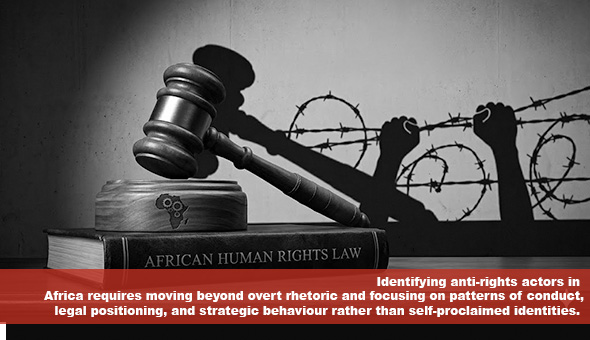
Identifying anti-rights actors in Africa requires moving beyond overt rhetoric and focusing on patterns of conduct, legal positioning, and strategic behaviour rather than self-proclaimed identities. These actors rarely describe themselves as opposing human rights, instead, they present as defenders of morality, culture, religion, family, national sovereignty or so-called ‘African values’. A key marker is their selective engagement with human rights law. They invoke rights language when it serves exclusionary ends while resisting its application to marginalised groups, particularly sexual and gender minorities, women, human rights defenders, and migrants. Their legal strategies often include initiating or supporting constitutional challenges against progressive reforms, intervening as amici curiae to reframe equality claims as threats to social order, as foreign impositions that contradict ‘African values’ and advancing majoritarian or religious arguments under the guise of democratic legitimacy. Organisationally, anti-rights actors frequently operate through well-networked civil society organisations, faith-based groups, or ‘family values’ coalitions that enjoy transnational funding and coordination, enabling consistency across jurisdictions. Their presence is also discernible in procedural abuse, including strategic lawsuits against public participation (SLAPPs), repetitive litigation, and forum shopping aimed at exhausting activists and shaping jurisprudence through attrition rather than merit. Crucially, anti-rights actors seek institutional legitimacy by engaging regional and international human rights mechanisms, framing their positions as reasonable legal disagreements rather than ideological opposition. Taken together, it is this convergence of narrative framing, juridical strategy, and institutional engagement rather than overt hostility to human rights that has increasingly become emblematic of anti-rights actors within Africa’s contemporary legal and political landscape. It is this level of cunning sophistication that enables many anti-rights actors across Africa to operate in the open, often times pretending to be legitimate civil society organisations concerned about the ‘preservation’ of national or regional cultural mores.
Lawfare, not lawlessness: How anti-rights actors operate from within
At first glance, there appears to be broad consensus. Civil society organisations, progressive lawyers, feminist movements, and sexual and gender minority rights advocates routinely speak of ‘anti-rights backlash’, ‘shrinking civic space’, and ‘religious fundamentalism’. These terms populate reports, side events, donor strategies, and academic writing. However, convergence in vocabulary does not necessarily translate into convergence in analysis or strategy. In the recent past, anti-rights actors in Africa have rarely operated outside the law. They engage constitutional courts, regional mechanisms, and legislative processes with sophistication and intent. The rise in the activities of anti-rights actors across the continent is not a rejection of human rights law but a tactical occupation of it. Anti-rights actors exploit doctrinal ambiguities, procedural vulnerabilities, and the normative pluralism embedded in African human rights systems, cloaking exclusionary agendas in the familiar language of rights. They speak of ‘protecting children’, ‘defending women’, ‘preserving dignity’, ‘respecting culture and religion’ and protecting or enforcing ‘African values’. This rhetorical adaptation is not accidental. In a legal environment where outright rejection of human rights norms would be politically costly, distortion becomes a more effective strategy than outright denial.
Where consensus fractures: Universality, strategy, and misdiagnosis
Here lies one of the first points where we are not fully on the same page. Many human rights advocates respond to these distortions by reasserting the universality and indivisibility of human rights. While normatively correct, this response is often politically insufficient. Anti-rights actors are not merely contesting universality, they are reframing human rights as colonial impositions detached from African ‘values’ and realities. Without deeper engagement with colonial legal legacies, post-colonial anxieties about sovereignty, and the political economy of culture and religion, appeals to universality risk appearing abstract, elitist, or disconnected. Within advocacy spaces, there is not always shared clarity about the legal implications of distortion. Some responses remain anchored in treaty supremacy and constitutional hierarchy, while others focus narrowly on individual cases without situating them within a coordinated architecture of backlash. This fragmentation reflects a deeper uncertainty – is anti-rights litigation episodic or systemic, defensive or transformative in intent? Without consensus on this question, resistance risks being reactive rather than strategic.
Courts as battlegrounds: Strategic litigation and juridical occupation
The increasing presence of anti-rights actors before courts further complicates this landscape. These actors do not merely respond to progressive litigation, they initiate it. They file constitutional challenges against administrative reforms, seek advisory opinions to pre-empt rights-affirming developments, and intervene as amici curiae to reshape legal questions before the bench. Their submissions often mirror the formal grammar of human rights law, citing treaties, comparative jurisprudence, and constitutional provisions, while advancing interpretations that entrench exclusion. This juridical sophistication demands a correspondingly rigorous response. Yet in some quarters, anti-rights litigation is dismissed as frivolous or unlikely to succeed before ‘progressive’ courts. Such assumptions underestimate the indeterminacy of legal reasoning and overestimate judicial insulation from political, religious, and social pressure. Courts, particularly in fragile democracies, do not operate in a vacuum. They are embedded within broader struggles over morality, national identity, and sovereignty – precisely the terrain on which anti-rights actors thrive.
Weaponising women’s rights and the limits of selective feminism
The distortion of women’s rights constitutes another critical fault line. Anti-rights movements frequently position themselves as protectors of women, especially in debates around sexuality, family, and reproduction. They deploy a narrow, heteronormative vision of womanhood, wife, mother, moral guardian, while opposing bodily autonomy, comprehensive sexuality education, and protections for lesbian, bisexual, and transgender women. This selective feminism flourishes where feminist and broader human rights movements remain insufficiently integrated or where intersectionality is treated as rhetoric rather than practice. Within progressive coalitions, there is sometimes reluctance to confront these tensions directly, particularly when religious or cultural arguments are framed as emanating from ‘the community’. Yet failing to interrogate how women’s rights are instrumentalised against other rights weakens feminist and human rights struggles alike.
Anti-rights engagement with human rights mechanisms: False equivalence as strategy
Anti-rights actors are also increasingly engaging regional and international human rights mechanisms. Rather than disengaging, they seek observer status, submit shadow reports, intervene in consultations, and lobby states. Their positions are framed as legitimate disagreements within human rights law, invoking notions of ‘balance’, ‘morality’, and ‘social cohesion’. This strategy creates a false equivalence between claims rooted in equality and those rooted in exclusion. Within advocacy spaces, there is divergence on how seriously this engagement should be treated. Some dismiss it as fringe, others view it as an existential threat. Both underestimation and overreaction carry risks. What is needed is sober, collective analysis that recognises anti-rights actors as legally and politically sophisticated, without inflating their moral legitimacy.
Not yet on the same page: Toward strategic and analytical alignment
Ultimately, the question is not whether anti-rights actors distort human rights law – they undeniably do – but whether those committed to justice have developed a shared, grounded understanding of how that distortion operates across law, politics, religion, and culture. There is convergence in diagnosis but divergence in depth, strategy, and risk assessment. Moving forward requires investment in political education within human rights movements themselves. Education about histories of backlash, the mechanics of legal distortion, and the power of narrative. It requires centering voices from the margins who experience the material consequences of distorted law, rather than treating them as symbolic beneficiaries of abstract rights. And it requires resisting the temptation to treat anti-rights actors as either irrational extremists or legitimate interlocutors, instead recognising them as strategic opponents operating on the same legal terrain. So, are we really together on the same page? Not yet. But acknowledging that dissonance is not a sign of failure. It is a necessary step toward coherence. If human rights law in Africa is to remain a tool for liberation rather than exclusion, alignment must go beyond shared vocabulary. It must rest on shared analysis, shared courage, and a willingness to confront distortion not only in hostile spaces, but within our own movements.
About the Authors:
Lakshita Kanhiya is a Legal Officer for Countering Anti-Rights Actors at the Initiative for Strategic Litigation in Africa (ISLA) and a Doctoral Candidate and the Centre for Human Rights, University of Pretoria.
Michael Gyan Nyarko is the Deputy Executive Director of the Institute for Human Rights and Development in Africa (IHRDA)
 AfricLaw