
Oil production in South Sudan: A lifeline for the economy or an infringement on children’s right to a safe, clean and healthy environment?
Posted: 22 November, 2024 Filed under: Akot Makur Chuot, Yeabsira Teferi | Tags: accountability, African Charter on Human and Peoples’ Rights, African Charter on the Rights and Welfare of the Child, business enterprises, children’s rights, Constitution of the Republic of South Sudan of 2011, deaths of children, economic interference, effective remedies, environment, environmental assessments, environmental pollution, fairness, human rights, international human rights law, legislation, Ogoni people, Oil production, oil sector, oil-fields, South Sudan, UN Guiding Principles on Business and Human Rights, violations of children’s rights Leave a comment Author: Akot Makur Chuot
LLM Candidate, Centre for Human Rights, University of Pretoria
Introduction
Oil-operating companies have been acting carte blanche with absolute impunity in South Sudan without complying with international practices premised on human rights considerations. The human rights violations in Unity and Upper Nile States are a testimony that private businesses in the oil and gas industry are unfettered in South Sudan. As a result, the actions and omissions of oil-operating companies in South Sudan have resulted in violations of children’s rights as will be explored in section 4 of the article. This is attested by the birth of children with deformities, stillbirth and several health concerns. It can be argued that the failure of South Sudan to regulate the business enterprises in the oil sector is a breach of its obligations under international human rights law.
Attempts to hold oil-operating companies accountable have fallen on deaf ears or have been nipped in the bud. This raises concerns about how long children should bear the brunt of environmental pollution and what is at stake for children’s rights in South Sudan. To clarify these concerns, this article interrogates South Sudan’s obligation to protect children’s rights from the acts and omissions of businesses. The article further seeks to highlight the role of companies in protecting children’s rights. Furthermore, the article exposes the negative implications of environmental pollution and degradation on children’s rights. The article then concludes with a synopsis of the main issues and offers recommendations to the government and business enterprises.
Against this backdrop, the next section demonstrates South Sudan’s obligation to protect children’s rights from oil-operating companies.
Obligation of South Sudan to protect children’s rights
To realise the right to a clean, safe and healthy environment, South Sudan is duty-bound to protect children’s rights under the African Charter on Human and Peoples’ Rights (African Charter), African Charter on the Rights and Welfare of the Child (African Children’s Charter), United Convention on the Rights of the Child (CRC), United Nations Guiding Principles on Business and Human Rights, Transitional Constitution of the Republic of South Sudan of 2011 as amended and other international human rights instruments. Despite enacting the Constitution and Petroleum Act of 2012, oil operating companies have incessantly violated the right to a safe, clean and healthy environment.
In Social and Economic Rights Action Center (SERAC) and Center for Economic and Social Rights (CESR) v Nigeria, the African Commission held that the government of Nigeria has an obligation to protect the right to the environment and prevent private actors from violating the rights of the Ogoni people. According to the SERAC’s case, the obligation to protect requires the State to ‘take measures’ to protect the right holders against ‘political, social and economic interference.’ The obligation to protect also entails protecting ‘right holders’ against other subjects including businesses by enacting legislation and regulations and providing effective remedies. This is manifested in the Constitution and Petroleum Act of 2012. For remedies to be effective, they must be fair, available, efficient and transparent and be available to be pursued before competent courts.
Furthermore, according to Principle 1 of the UN Guiding Principles on Business and Human Rights, the obligation to protect means that States must protect against human rights abuses perpetrated by third parties within their territory, including businesses. States need to take appropriate measures to ‘prevent, investigate, punish and redress such abuses through effective policies, legislation, regulations’. According to the Commentary on Principle 1, failure by States to ‘prevent, investigate, punish and redress private actors’ abuse amounts to the State’s breach of its international human rights law obligations’.
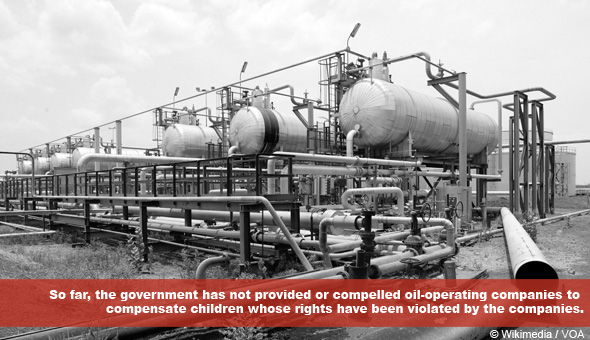
So far, the government has not provided or compelled oil-operating companies to compensate children whose rights have been violated by the companies. In evading responsibility, companies have discredited medical reports linking the harm to their activities and undermined policies calling for corporate responsibility.
The role of oil-operating companies in achieving the realisation of children’s rights
According to the United Nations Guiding Principles on Business and Human Rights, businesses at the minimum need to respect human rights in the International Bills of Rights consisting of the International Covenant on Civil and Political Rights and International Covenant on Economic, Social and Cultural Rights and the principles concerning fundamental rights set out in the International Labour Organization’s Declaration on Fundamental Principles and Rights at Work.
The responsibility to respect children’s rights as enjoined by the United Nations Guiding Principles on Human Rights and Business entails that oil operating companies do not interfere with the enjoyment of children’s rights and should address the impacts their acts or omissions have on children’s rights. The companies must exercise due diligence in identifying, mitigating, preventing and remedying ‘the adverse impacts on children’s rights’ instigated by the oil-operating companies. The oil pollution in the Upper Nile and Unity States has resulted in many health consequences, a lack of justice for the victims, and hues and cries, suggesting that the oil-operating companies have not sufficiently exercised due diligence.
The impacts of oil-operating companies’ activities on children’s rights
There is an array of evidence that the activities of oil-operating companies in the Upper Nile and Unity States have had and still have devastating impacts on children’s rights, thereby breaching several international human rights instruments. This section focuses on the right to a safe and healthy environment, the right to health and the right to life, survival and development.
- Right to a safe and healthy environment
The right to a safe and healthy environment is provided for in Article 24 of the African Charter, Article 41 of the Constitution, and Sections 50 and 52 of the Petroleum Act of 2012. In the Upper Nile and States, pollution of the environment caused by oil spills and exposure of containers and metals containing chemicals is evident. The oil spills have degraded the soil and contaminated water bodies. These acts violate the right to a safe and healthy environment, the obligation to prevent pollution and ecological degradation, and protect the environment for the present and future generations as stipulated in Article 41 of the Constitution.
- Right health
The right to health is enshrined in Article 24 of the CRC, Article 16 of the African Charter, Article 14 of the African Children’s Charter and Article 31 of the Constitution. The state of children’s health in the Upper Nile and Unity States is deteriorating and alarming as evidenced by the birth of children with deformities, including mislocated organs, additional fingers, or missing body parts such as feet. Although not all harm has been linked to the oil-operating companies, literature shows that some of the child deformities are linked to the activities of the oil-operating companies. This is inconsistent with the responsibility of businesses to respect children’s rights and the obligations of South Sudan to protect children’s rights.
- Right to life, survival and development
Right to life, survival and development is one of the major principles upon which the CRC and African Children’s Charter are anchored. The right to life is dependent on the right to health, and it is crucial for realising all other rights of the child. The right to life is also interconnected with the survival and development of the child. A child’s development entails cognitive and physical development, which should be free from harm. The record shows that the acts of the oil-operating companies have led to the deaths of children either at birth or after birth. Moreover, children born with deformities such as the brain on the outside and other missing organs of the body diminish the ability of the child to survive and develop.
Conclusion and recommendations
The violations of children’s rights by the oil-operating companies in Upper Nile and Unity States are evident. It is also evident that the government has failed to comply with its obligations under international human rights and domestic instruments to protect the rights of children in the Upper Nile and Unity States. On a similar note, the oil-operating companies have not complied with their obligations under the Petroleum Act of 2012 and their responsibilities under the UN Guiding Principles on Business and Human Rights to respect children’s rights.
In the circumstances, this article calls on the government of South Sudan to: comply with its obligations to protect children’s rights; strengthen access to justice by holding the oil-operating companies accountable and compensating children whose rights have been violated; strengthen enforcement mechanisms premised on transparency, fairness and accountability; allow children to participate decision-making and in environmental assessments in the oil-fields; and consider best interest of the child at all times.
On the other hand, the article strongly recommends that oil-operating companies exercise due diligence and respect children’s rights in all their actions in line with the UN Guiding Principle on Human Rights and Businesses.
About the Author:
Akot Makur Chuot holds an LLB (First Class Honours) from the University of Juba. He is currently an LLM Candidate in Human Rights and Democratisation in Africa, at the University of Pretoria. He teaches law as Assistant Lecturer and serves as a Moot Court Coach at the School of Law, the University of Juba, South Sudan. He holds a Certificate in Legal Practice (LP), from the South Sudan Bar Association and is an Associate at City Law & Co. Advocates, South Sudan.
 AfricLaw