
Implementation beyond banning: the prohibition of child marriage in Sierra Leone
Posted: 21 October, 2024 Filed under: Sorie Bangura | Tags: ACRWC, African Charter on the Rights and Welfare of the Child, child education, child marriage, Child Rights Act, children’s rights, early marriage, educational level, end child marriage, girls, income poverty line, lack of investment, poverty, Prohibition of Child Marriage Act 2024, reproductive health, Sexual Offences Act, Sierra Leone, teenage pregnancy, toilet facilities, Universal Periodic Review Leave a comment Author: Sorie Bangura
Manager, Save the Children, Sierra Leone
In 2022, during the third cycle of the Universal Periodic Review (UPR) on Sierra Leone, the UPR working group urged Sierra Leone to ‘allocate adequate budgetary resources for the promotion and protection of children’s rights; harmonising laws to prevent and end child marriage, and undertaking comprehensive awareness-raising on the negative consequences of child marriage on girls; and enforcing the Child Rights Act and enabling the bill on the prohibition of child marriage.’ Fast forward to June 2024, Sierra Leone has enacted the Prohibition of Child Marriage Act 2024. The Act which prohibits and criminalises marrying anyone under the age of 18 also seek to protect the rights and development of girls which has long been violated and hindered.
At the global level, Sierra Leone has the 15th highest rate of child marriage prevalence for girls and is ranked the 20th most prevalent for boys. An estimated 44% of girls are married before their 18th birthday and 18% married before their 15th birthday, while 7% of boys are married before age 18. The median age for marital debut stands at 18 for women and 25 for men. There is a wide nexus between teenage pregnancy and child marriage and any attempt at ending the latter must incorporate the former.
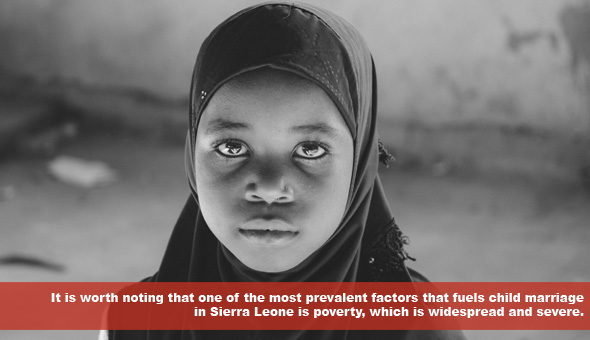
It is worth noting that one of the most prevalent factors that fuels child marriage in Sierra Leone is poverty, which is widespread and severe. Sierra Leone is one of the poorest countries in the world. An estimated 53% of the country’s 7.5 million population are living below the income poverty line (US$1.25 per day). The stark poverty ratio and huge unemployment in the Country combined to force poor families who struggle to provide for their children’s most basic food and non-food needs to marry their daughters off to receive dowry payment from the groom’s families. In essence, the practice literally serves as an escape route to ease economic burden. In most communities in rural Sierra Leone, child marriage is seen as an opportunity to reduce costs from the bride’s families associated with taking care of the child and also serve as another set of hands to work on the farm for the groom’s families.
In relation to the causal effect, it is worth pointing out that child marriage in Sierra Leone is closely linked to a low rate of attendance of girls’ at school. The educational level of girls is identified as the most important causal factor contributing to early marriage. In Sierra Leone, more than 50% of adolescents with no form of education were married off before the age of 18, compared to 10 percent of adolescents with higher education. Girls progress to secondary school at a much lower rate than boys and worrisomely drop out of secondary school at a higher rate than boys. From a broader perspective, schools in Sierra Leone lack the necessary resources needed to boost educational outcomes. School conditions are often poor and in co-educational schools, both boys and girls use the same toilet facilities which are mostly unkempt and further put the reproductive health of girls at risk. Even though there has been significant increase in school enrolment rate for girls with the commencement of the free quality education and continuous awareness of the importance of girl child education, lack of investment in girl child education is still prevalent in rural areas.
Child marriage in Sierra Leone is deeply entrenched within the cultural, structural, social, political and economic fabric of the nation’s history and enforced by patriarchal oppression, which seeks to contain the sexuality of girls and combine to enforce violence against girls. Using a children’s right based approach, this article assesses key provisions in the Prohibition of Child Marriage Act 2024 together with Sierra Leone’s regional and international commitment in prohibiting child marriage and proffer recommendations for the effective implementation of the Act.
International, regional and domestic legal framework prohibiting child marriage
Successive governments have overtime enacted legislations and made international commitments aimed at setting the minimum legal age of marriage. Sierra Leone ratified the Convention on the Elimination of All Forms of Discrimination against Women (CEDAW) in 1988 and the Convention on the Rights of the Child in 1990. These international instruments contain provisions for the prevention and ending of child marriage and also oblige States to take appropriate legislative actions to end all harmful practices against women and girls.
At the regional level, Sierra Leone also ratified the African Charter on the Rights and Welfare of the Child (ACRWC) in 2002 and the Protocol to the African Charter on Human and Peoples’ Rights on the Rights of Women in Africa (Maputo Protocol) in 2015. Like the international instruments, these regional instruments also contain provisions for the prevention and ending of child marriage and also oblige States to take appropriate legislative actions to end all harmful practices against women and girls
At the domestic level and with the optics of complying with its international obligation and the protection of children against harmful practices as contained in its international and regional obligations, Sierra Leone has adopted many laws to prevent child, early and forced marriage. These include the Child Rights Act, 2007, the Domestic Violence Act, 2007, the Sexual Offences Act, 2017 and the most recent Prohibition of Child Marriage Act 2024. Section 34(1) of the 2007 Child Rights Act set the minimum age of marriage at 18 irrespective of the manner in which the marriage is carried out (formal, customary, or religious law) in tandem with the CRC and ACRWC. While establishing the minimum age of marriage, Section 34(2) of the 2007 Child Rights Act goes further to forbid forcing a child to be the subject of a dowry transaction, betrothed, or married.
The Act further labels the practice a criminal offence and specifies a fine or prison sentence of no more than two years or both for offenders. Flowing from this, the Act also calls for the establishment of Family Support Unit (FSU) a specialised unit within the Sierra Leone Police Service comprised of Police officers and Social workers to investigate and monitor child protection cases among others. Aware of the need for the involvement of community members in ending this harmful practice, the Act also calls for the establishment of Child Welfare Committees-a close group of community members charged with the responsibility to adjudicate disputes concerning children’s rights at the village and chiefdom levels. Mindful of the essence of monitoring and providing technical advice to the government with the aim of improving children’s welfare in Sierra Leone, the Act further calls for the setting up of a National Commission for Children (NCC). Additionally, bearing in mind the importance of having a court system to specifically deal with child-protection issues, the Act established a Family Court.
Other relevant provisions include section 26(4), which requires every parent to register their children at birth in order to ensure that the mother has attained the age of adulthood. Institutions like the FSU which is established by the Act has long been operational albeit with limited capacity and funds.
These clear provisions of the Child Rights Act were contradicted by the enactment of the Registration of Customary Marriage and Divorce Act No. 1 2009. Section 2 (2) states that with the consent of the child’s parent or guardian, a child can be married off below the age of 18. Section 2(3) further states that even in situations when a parent declines to consent to their child being married off, a designated civil servant in the locality or a magistrate can give permission for that child to be married.
On its part, though not specifically addressing child marriage, section 2 of the Domestic Violence Act, 2007 forbids physical or sexual abuse, economic abuse, emotional, verbal or psychological abuse, harassment, and all conduct that in any way harm or may harm another person in a domestic relationship. Lawyers and Magistrate interviewed for a report published by Plan International ‘confirmed that child marriage is considered a form of domestic violence, subject to punishment under the Domestic Violence Act.’ Like the Child Rights Act, 2007, the Domestic Violence Act, 2007 also contains fine and prison term of not more than two years for offenders.
In 2012 the government of Sierra Leone adopted the Sexual Offences Act, which establishes 18 years as the age of sexual consent and contains penalties for offenders of this Act. Preceding the Sexual Offences Act, the Prevention of Cruelty to Children Act prohibited ‘unlawful carnal knowledge’ of children under the age of 14. It however considers a child as anyone under the age of 16. The Sexual Offences Act in order to eliminate this discrepancy harmonised the age of sexual consent with the age of consent to marriage in the ACRWC. Advocacy and campaigns led by the First Lady tagged ‘Hands off our girls’ campaign which specifically seeks to influence policy, raise awareness and eliminate early marriage led to the review of the Sexual Offence Act in 2019. The amended Sexual Offences Act increases the minimum imprisonment for a rape conviction to 15 years.
The Prohibition of Child Marriage Act 2024 addressed the contradiction between the 2007 Child Rights Act and 2009 Registration of Customary Marriage Acts and harmonises the legal framework on marriage. It stipulates a punishment of not less than 15 years imprisonment or a fine of not less than SLE 50,000 (approximately US$ 2,000) or both for violators. Section 4 of the Act criminalises the use of force, deceit or threats to induce a child marriage. Section 5 of the Act also criminalises conducting a child marriage ceremony, while section 7 criminalises attending a child marriage ceremony. This section presumes that by attending a child marriage ceremony, the attendee knows the child is under 18. Section 11 of the Act also criminalises cohabitation with a child as a spouse, while section 15 of the Act renders void ab initio, any child marriage entered into after the Act has been enacted. Section 15 further takes a backward trajectory and states that any child marriage entered into before the enactment of the Act can be the subject of a petition for annulment. Section 17 of the Act provides for the payment of compensation for child marriage victims. These compensations take into consideration the lifestyle of the child during the marriage, their needs and the income of the adult. It outlines the mode of payment as a lump sum or monthly. Section 26 encourages everyone to report any child marriage incident to the police or other law enforcement agencies.
Conclusion and recommendation
It is but prudent to note that this legislation banning child marriage marks a significant breakthrough in Sierra Leone’s quest towards gender equality and child protection and sets a solid foundation towards the elimination of child marriage. However, based on the legislations on child marriage reviewed above, it is evident that there has not been a paucity on legislations (international, regional and domestic) banning child marriage in Sierra Leone. However, analysing the trends in the practice of child marriage and studies on the reasons for its existence and prevalence, it becomes clearer that there are very few indications to show that laws and legal reforms have contributed to eliminating the practice of child marriage in Sierra Leone. In situations where decreases in the practice have been observed, they are as a result of other interventions and factors such as non-governmental organisations outreach and community programs.
It is also worthy of note that this does not imply that laws do not matter. In fact, it is my submission that enacting a strong law is a starting point and a solid foundation for the implementation of further action. Similarly, it is also my strongest submission that enacting legislation explicitly banning child marriage can be very effective when enforcement measures are in place to deter the practice.
In order to overcome the challenges of implementation, the best interests of the child should be the guiding principles of these policies and programmes. Rather than tackle the issue of child marriage in isolation, implemented policies and programmes should have a broader outlook with a view to ending other harmful societal norms that enforces discrimination against women and girls. These interventions should also address the socio-economic factors that fuels child marriage. Programmes geared towards poverty reduction, addressing gender inequality and providing economic empowerment to women so that they can be able to take care of both household food and non-food needs of their families and further enhances their decision-making ability should be encouraged and supported.
All efforts aimed at ending child marriage should adopt a well-coordinated multisectoral approach. This approach should involve the incorporation of all relevant institutional stakeholders at the national and local level in the implementation of policies and programmes that seek to end child marriage. At the community level, women’s groups, religious and community leaders should be involved in the implementation of these policies and programmes. Any strategy that seeks to side-line the role of these key societal stakeholders is bound to fail.
Finally, Sierra Leone should also work towards incorporating and providing age-appropriate, culturally relevant and evidenced-based comprehensive sexuality education and life-skills training for women and girls and ensuring that women and girls are made aware of and have the capacity to claim and exercise their rights in relation to marriage.
About the Author:
Sorie Bangura is a Project Manager at Save the Children in Sierra Leone. He holds an MPhil in Human Rights and Democratisation in Africa from the Centre for Human Rights, University of Pretoria and an MSc in Governance and Regional Integration at Pan-African University Yaounde, Cameroon.
 AfricLaw