
The Right to Consent: Reimagining Sexual Autonomy for Persons with Disabilities in Zimbabwe through S v Zidyengi
Posted: 18 October, 2024 Filed under: Neville Mupita | Tags: consensual relationship, Convention on the Rights of Persons with Disabilities, CRPD, disability rights, equal recognition, equality, expert evidence, High Court judgment, human rights, inclusion, mental capacity, mentally incompetent adults, persons with disabilities, psychosis diagnosis, right to autonomy, right to dignity, rights of persons with mental disabilities, S v Zidyengi, sexual autonomy, sexual choices, sexual conduct, Zimbabwe, Zimbabwe High Court 1 Comment Author: Neville Mupita
Centre for Human Rights, University of Pretoria
On 17 July 2024, the Zimbabwe High Court handed a landmark judgment in the case of S v Zidyengi that addresses a key interplay between mental disability and sexual autonomy. This judgment poses a topic of importance under the framework of the Convention on the Rights of Persons with Disabilities (CRPD). This piece uses a human rights-based approach to analyse the High Court judgment within the CRPD’s yardstick.
Summary of Facts
In the Zidyengi case, the accused was charged with rape under section 65(1) of the Criminal Law (Codification and Reform) Act, read with section 64(3), which pertains to sexual conduct with mentally incompetent adults. The case centred on a 33-year-old woman who was diagnosed with psychosis (a mental health condition) and had engaged in a consensual relationship with the accused. The complainant’s mother reported the sexual activity to the police after noticing changes in her daughter’s behaviour, including her refusal to take medication. The complainant’s refusal to take medication was based on the fact that she was pregnant, and she believed that medication would hurt her child.
In this case, Zidyengi was convicted by the magistrate court on the assumption that the complainant was mentally incompetent due to her psychosis diagnosis. The case was reviewed by the High Court, which questioned the validity of the conviction, noting that no expert evidence supported the notion that the complainant was incapable of consent. In a groundbreaking decision, the court acquitted the accused, emphasising the complainant’s right to sexual autonomy during lucid moments.
Human rights-based approach analysis of judgment
In 2013, Zimbabwe ratified the CRPD, which protects, promotes, and ensures that persons with disabilities enjoy the rights afforded to them equally with others. The CRPD in article 4 provides for general obligation asserting that state parties should ensure and promote the full realisation of all human rights and fundamental freedoms for all persons with disabilities without discrimination based on disability. Further, in article 12, the convention provides that persons with disabilities should enjoy equal recognition before the law, which entails the right to legal capacity. The article highlights a long-established and non-derogable human rights principle enshrined in other international human rights instruments like the International Covenant on Civil and Political Rights (ICCPR). In most cases, as in this case before the trial magistrate, persons with disabilities are denied the right to make decisions and exercise their right to autonomy on the basis that they lack mental capacity. Such arbitrary denial amounts to a violation of article 12 of the CRPD.
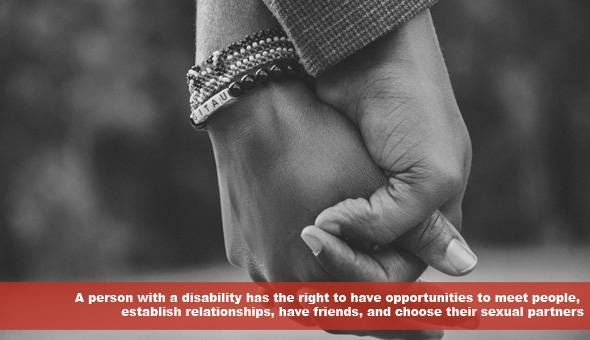
In addition to article 12, the CRPD in article 23 provides that the state should take effective and appropriate measures to eliminate discrimination against persons with disabilities in all matters related to marriage, family, parenthood and relationships. This means that a person with a disability has the right to have opportunities to meet people, establish relationships, have friends, and choose their sexual partners; to marry and found a family, which includes retaining their fertility on an equal basis with others, making their own reproductive and sexual choices.
Courts, when considering matters involving the sexual and reproductive rights of individuals with disabilities, such as in the case S v Zidyengi, must balance protection from exploitation with the right to dignity and autonomy. This aligns with the principle set in article 12, rejecting the assumption that persons with mental disabilities are automatically deemed to be incapable of making decisions on their own and consenting to sexual activities. The court in Zidyengi dispels this misconception, arguing for the need for a case-by-case assessment when it comes to intersectional matters of consent and mental disability. It contends for the need for expert evidence to determine the competency of the person with mental disability in consenting to any sexual activity, mirroring the CRPD principles in article 3 that provide that persons with disabilities are autonomous persons capable of making their own choices unless proven otherwise.
The Zidyengi decision reflects the prioritisation of human rights, particularly autonomy and dignity, through judicial activism. The High Court actively challenged preconceived notions of disability, most importantly, the intersectionality of mental incapacity and sexual consent, further disbanding the culture of blanket assumption. It notes that sexual and reproductive health rights are fundamental components of one’s quality of life and should not be denied based solely on mental health challenges unless there is clear evidence of an inability to consent. A more compassionate and rights-based judicial approach is evident in the court’s scrutiny of evidence, emphasising expert input and references to the constitutional principles of dignity and equality. Such judicial advocacy by the High Court is crucial in fostering inclusive legal standards that reflect international human rights principles enshrined in treaties like the CRPD.
Looking ahead
The High Court decision in S v Zidyengi provides a vital precedent in the protection and promotion of the rights of persons with mental disabilities regarding matters of the intersectionality of consent and sexual autonomy. Looking ahead, the Zimbabwean courts and courts around Africa must adopt a progressive jurisprudential approach which stresses a human rights-based approach in dealing with such matters. This calls for a nuanced, case-by-case analysis to avoid blanket assumptions of an individual’s incapacity based on mental disability. This determination of an individual’s ability to consent must consistently rely on expert evidence, thus bringing it in line with constitutional principles and CRPD’s standards of equality, dignity and non-discrimination.
Moreover, Zimbabwe and other African countries must ratify the African Disability Protocol, which came into force on 3 May 2024. The protocol provides an African-centric framework that supports the CRPD in contextualising the rights of persons with disabilities within local socio-cultural and legal systems. It has provisions on sexual reproductive health and protects the right to autonomy for persons with disabilities. Ratification of the ADP fortifies Zimbabwe’s commitment to promoting and protecting the rights of persons with disabilities, creating a more robust legal framework, which will guide courts when faced with matters where there is a need for balancing protection from exploitation with safeguarding equality, dignity and autonomy.
About the Author:
Neville Mupita is an advocate for social justice and human rights. He is an LLM in Human Rights and Democratisation in Africa candidate at the Centre for Human Rights, University of Pretoria. He holds a Bachelor of Arts in Law (with distinction) as well as an LLB from the University of Pretoria.
 AfricLaw
The case S v Zidyengi highlights the critical issue of sexual autonomy for persons with disabilities in Zimbabwe, emphasizing the importance of recognizing their right to consent. It challenges societal and legal barriers, advocating for a more inclusive approach to sexual rights and the recognition of agency for individuals with disabilities.