
Agency and vulnerability in the intersection of abortion law and refugee experience in Kenya
Posted: 23 September, 2024 Filed under: Pawi Fortune | Tags: abortion, abuse, Africa, Dadaab, defilement, displaced persons, Federation of Women Lawyers (Fida – Kenya) & 3 others v Attorney General & 2 others, forced prostitution, foreign domination, gang rape, health care services, healthcare services, Kakuma, Kenya, maternal deaths, mental health, Ministry of Health Guidelines on the Management of Sexual Violence in Kenya, physical trauma, rape, refugees, safe abortion services, Sexual Offences Act, sexual violence, state of unrest, unintended pregnancies, unsafe abortions, unwanted pregnancy Leave a comment Author: Pawi Fortune
Kabarak University Law School
The number of refugees in Africa has been on the rise[1] with many people being morphed into refugee status by various reasons such as a state of unrest, foreign domination and internal/external aggression.[2] In pursuit of safer grounds, ‘aspirant refugees’ flee to other countries hoping for better conditions than that from which they fled. However, even in countries of asylum, displaced persons face a precarious existence devoid of guaranteed safety or survival. Dadaab and Kakuma, critical refugee sanctuaries in Kenya, shelter a diverse population of refugees fleeing instability in countries such as Somalia, the Democratic Republic of the Congo and South Sudan.[3] Nonetheless, mistakenly believing this new land to be a haven, refugees are subjected to unimaginable sexual violence, a cruel irony that erodes their dignity and sense of self to a degree that renders their prior persecution almost preferable. This paper aims serve as a lamentation, a call for help reflecting the pain of survivors of sexual violence in refugee camps who have succumbed to the dangerous consequences of unsafe abortions or lack of it due to inaccessibility of the appropriate health care services.
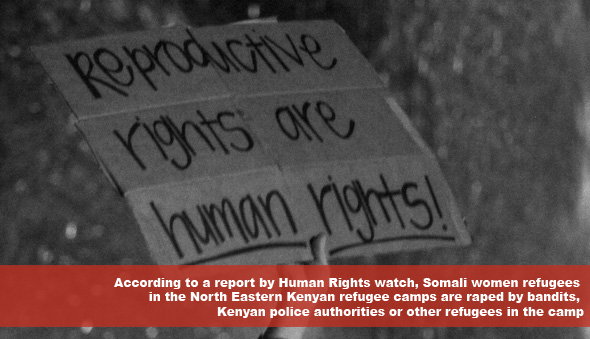
Sexual violence and abuse have become endemic within refugee settings in Kenya. Despite the plethora of legislations enacted to uphold the dignity of refugees,[4] female refugees endure a persistent crisis of sexual violence. Many women and children in refugee settings are survivors of sexual violence such as rape, gang rape,[5] defilement and forced prostitution[6] which have left behind scars of the traumatic experiences to the victims. According to a report by Human Rights watch, Somali women refugees in the North Eastern Kenyan refugee camps are raped by bandits, Kenyan police authorities or other refugees in the camp.[7] A twenty-eight year old, Halima, who fled to Kenya’s Ifo refugee camp in search of refuge narrates a gruesome account of her encounter with bandits in Kenya. She was sexually assaulted twice after which she ended up pregnant. Halima’s experience is emblematic of the pervasive sexual violence endemic to refugee camps. Her harrowing account details a brutal assault resulting in both physical trauma and unwanted pregnancy.[8] The prevalence of sexual violence within refugee camps exacerbates the crisis of unintended pregnancies.[9]
The case of Federation of Women Lawyers (Fida – Kenya) & 3 others v Attorney General & 2 others[10] ushered in a new light of hope to victims of sexual violence who were formerly prohibited by law from procuring abortion. The Constitution of Kenya provides that abortion is not permitted except in situations of emergency or when the life or health of the mother is in danger.[11] One of the issues for determination in the case was whether ‘health’ as provided for in the aforementioned provision encompassed mental health. The court, acknowledging that sexual offences such as rape and defilement are traumatic experiences, ruled that the term health[12] as used in the law included mental health. As such, in line with the constitution, the Sexual Offences Act[13] and the Ministry of Health Guidelines on the Management of Sexual Violence in Kenya,[14] the court ruled that abortion is legal in cases where pregnancy results from sexual assault.[15]
Given that nearly 50% of maternal deaths in refugee settings are due to complications of unsafe abortions,[16] and in line with the obligation of states to provide to refugees, as a minimum, the same standards of treatment enjoyed by other foreign nationals and nationals,[17] safe abortion services should be incorporated fully into all other healthcare services provided to refugees who are survivors of sexual violence. Furthermore, a comprehensive approach to advancing women’s reproductive rights necessitates a concomitant focus on the plight of refugee women within displacement contexts.
[1] Aderanti Adepoju, ‘Migration Dynamics, Refugees and Internally Displaced Persons in Africa’ United Nations, 19 September 2023 – < https://www.un.org/en/academic-impact/migration-dynamics-refugees-and-internally-displaced-persons-africa#:~:text=The%20triggers%20include%20conflicts%2C%20civil,the%20search%20for%20durable%20situations. >- on 21 June 2024.
[2] Lucianna Thuo, ‘Protection of refugees and IDPs during armed conflict’ International Humanitarian Law notes, on file with the author.
[3] ‘Refugee Camps: Kakuma and Dadaab’ Refugee Point, 30 September 2010 -< https://www.refugepoint.org/refugee-camps-kakuma-and-dadaab/ >- on 21 June 2024.
[4] Convention Relating to the Status of Refugees, 1951 and its protocol.
[5] Kenya- Urban Refugees, United Nations, 2016 -< https://youtu.be/N6LaqNtslwo?si=QAW0iootbJOvt2Oh >- on 7 August 2024.
[6] RefuSHE Kenya’s safe houses helps young women refugees, UNHCR, the UN Refugee Agency, 2020 -< https://youtu.be/ATXdrcLbr2s?si=-iyr-Ax86PhZp4QI >- on 7 August 2024.
[7] Seeking refuge, finding terror: The widespread rape of Somali women refugees in North Eastern Kenya, Africa Watch Women’s Rights Project, Vol 5, No.13, 4 October 1993, 7.
[8] Seeking Refuge, finding terror: The widespread rape of Somali women refugees in North Eastern Kenya, 12-13.
[9] Aimee Lehmann,’Safe Abortion: A Right for Refugees?’ Reproductive Health Matters, Elsevier Science Ltd, 1 May 2002, 1.
[10] Federation of Women Lawyers (Fida – Kenya) and 3 others v Attorney General and 2 others; East Africa Center for Law & Justice & 6 others (Interested Party) & Women’s Link Worldwide & 2 others (Amicus Curiae) [2019] eKLR, High Court of Kenya.
[11] Article 26(4) Constitution of Kenya, 2010.
[12] Section 2, Health Act, Cap 241 Laws of Kenya.
[13] Section 35(3) Sexual Offences Act Cap 63A Laws of Kenya.
[14] National Guidelines on the Management of Sexual Violence in Kenya, 2nd Edition 2009.
[15] Federation of Women Lawyers (Fida – Kenya) and 3 others v Attorney General and 2 others [2019] eKLR, para 415(5).
[16] Mia Foremann, ‘Improving reproductive health services for forcibly displaced women’ Resource library, 21 January 2013 -< https://www.prb.org/resources/improving-reproductive-health-services-for-forcibly-displaced-women/ >- on 25 August 2024. See also Blake Erhardt-Ohren and Sarah Lewinger, Refugee and internally displaced women’s abortion knowledge, attitudes and practices: Addressing the lack of research in low- and middle- income countries’ in International perspectives on sexual and reproductive health, 2020, Vol 46, No. Supplement 1, Focus on abortion (2020), pp 77-81.
[17] Antonio Gueterres, ‘A personal appeal from the United Nations High Commissioner for Refugees.’
About the Author:
Pawi Fortune is an LLB undergraduate at Kabarak University Law School and the current Editor in charge of the Kabarak Law Review blog.
 AfricLaw