
Celebrating the enduring legacy of the Special Rapporteur on Freedom of Expression and Access to Information in Africa
Posted: 16 September, 2024 Filed under: Nicholas Cheruiyot | Tags: Access to Information, African Commission on Human and Peoples’ Rights, African continent, Declaration of Principles of Freedom of Expression and Access to Information in Africa, democracy, false news, information laws, information legislations, international human rights standards, internet shutdowns, intimidation, online harassment, physical threats, right to freedom of expression, Securing the Effective Realization of Access to Information in Africa, sexual violence, Special Rapporteur on Freedom of Expression and Access to Information in Africa, transparency, verbal abuse, violations Leave a comment Author: Nicholas Cheruiyot
LLM Student, Centre for Human Rights
1 Introduction
The Special Rapporteur on Freedom of Expression and Access to Information in Africa (SR) was established in 2004 by the African Commission on Human and Peoples’ Rights (Commission).[1] This was following a series of events beginning in 1998 when the idea of free and open internet was conceived,[2] considering the importance of access to information in relation to the freedom of expression. The SR is one of the special mechanisms within the Commission, whose purpose is to promote and protect the freedom of expression throughout the African continent.[3] As the SR marks two decades in 2024 since its establishment, it has made significant progress in shaping Africa’s freedom of expression and access to information landscape as discussed in this article. There have however been challenges which have hampered its important role.
2 The state of freedom of expression and access to information in Africa
Africa has made progress in ensuring access to information and freedom of expression, with several African states enacting laws to protect against violations. As of 2024, up to 29 countries have enacted access to information legislations, demonstrating their commitment to improving transparency.[4] The SR and the Commission have championed these laws and assisted in reviewing some of them to ensure that they meet regional and international human rights standards.
3 Contributions of the Special Rapporteur to the African human rights on the freedom of expression and access to information space
The SR has contributed in several instances in bettering the right to access information and freedom of expression within the African continent. While appreciating that the roles are not fully quantifiable, the following sub-section discusses some of the SR’s contributions.
3.1 Drafting and adoption of a declaration of principles on freedom of expression and access to information in Africa
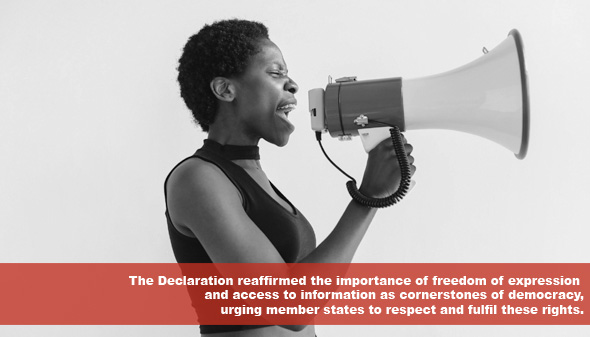
One of the major milestones of the SR is the preparation of the Declaration of Principles of Freedom of Expression and Access to Information in Africa,[5] a soft law instrument that replaced the 2002 Declaration.[6]The Commission adopted the principles in November 2019, working closely with stakeholders to ensure all voices were heard.[7] The Declaration reaffirmed the importance of freedom of expression and access to information as cornerstones of democracy,[8] urging member states to respect and fulfil these rights.[9] The adoption is commendable and enhances regional and international normative standards.[10]
3.2 Development of a model access to information law in Africa
In 2010, the Commission adopted a resolution titled ‘Securing the Effective Realization of Access to Information in Africa’ in which the SR was tasked to develop a model law on access to information in Africa,[11] as a blueprint for African states to follow in enacting municipal laws on freedom of expression and access to information.[12] After two years of collaboration with stakeholders, the SR completed the drafting process.[13] As of 2017, 21 out of 54 African countries had enacted specific access to information legislations, with the number doubling between 2012 and 2017.[14] The SR played an important role in reviewing and commenting on member states’ draft laws to ensure they comply with regional and international human rights standards.[15]
3.3 Monitoring and reporting
Among the mandates of the SR is to analyse national media policies and legislations, and to monitor compliance with the access to information and freedom of expression standards by member states.[16] In addition to reporting to the Commission, the SR has been regularly making press releases and writing letters of appeals to authorities[17] whenever there are incidences of violation of the right of access to information and freedom of expression,[18] ensuring that states abide by the law and refrain from interfering with the right of access to information and freedom of expression.
3.4 Collaboration with other bodies such as the United Nations and the Civil Service Organisations
The SR has in the past collaborated with the SR for freedom of expression in the Inter-American Commission for Human Rights, the representative on media freedom in the Organization for Security and Co-operation in Europe, and the UN SR for the promotion and protection of the right to freedom of opinion and expression.[19]
The SR has previously reported on government media control, criminal defamation, violence against journalists, and discrimination in the right to freedom of expression.[20] They have also issued a joint letter of appeal with the UN SR as a result of among others the global weakening of the media and increased online and physical attacks against journalists, harassment of media outlets and the level of control of media corporations.[21] This collaboration allows both rapporteurs and Africans to have a broader perspective on access to information and freedom of expression issues, leading to the enactment, adoption, and implementation of various legal instruments.
The SR has also collaborated with civil society organisations (CSOs) and other experts in norm development and release of reports on freedom of expression and access to information.[22] This was seen during the drafting process of the 2019 Declaration of Principles of Freedom of Expression and Access to Information, where the SR worked in close collaboration with partners from State and non-State sectors.[23]
4 The impact of the special rapporteur on the realisation of the right to the freedom of expression and access to information in Africa
The impact of the SR in the African continent in as far as the observance of the right to freedom of expression and access to information is concerned has been seen through among others the enactment of freedom of expression and access to information laws by various countries in Africa. The SR has also ensured that there is respect of the rights of information access and freedom of expression by African states. This has been done through issuance of statements and writing of reports to states in addition to other intervention mechanisms. Actions of the SR including assistance and review of Bills have gone a long way in ensuring success in drafting of laws on access to information and freedom of expression.
5 Challenges faced by the special rapporteur
Despite the positive steps that the SR has made, there have also been challenges which have threatened to cripple the functionality of the office of the SR. This section highlights some of the challenges.
5.1 Internet shutdown and criminalisation of false news publication
One of the main challenges is the acts of regressive regimes. This has manifested itself through among others internet shutdowns, especially during electioneering periods.[24] Additionally, several states still criminalise publication of false news.[25] As of 2021, 72% of African countries had cybercrime laws, imposing sanctions on false information publication.[26] This sets back the strides that have been made with regard to access to information and freedom of expression, especially when they are made with malicious intent and without adhering to regional and international standards.
5.2 Surveillance and attacks on journalists and media practitioners
There have been rising incidences of violence against journalists and media practitioners in Africa, some of which have resulted in deaths.[27] Most of the interventions made by the SR through its special mechanisms whenever there is a violation by a state have in most instances been on attacks on journalists and media practitioners.[28] This has been characterised by both physical and online violence, including physical threats, sexual violence, online harassment, intimidation and verbal abuse.[29] This not only violates the rights to freedom of expression, but also the right to access timely information.
5.3 Lack of cooperation by government officials
One of the other challenges which have been faced by the SR is lack of state cooperation. In 2022 for example, the SR issued a letter of appeal to the government of Mali concerning the abduction of three journalists, Hamadoun Nialibouly, Olivier Dubois and Moussa M’Bana Dicko.[30] The letter among others called on the government to carry out independent and impartial investigations into the allegation of these abductions and take necessary measures to provide journalists and media practitioners a conducive environment to freely do their work without fear of reprisals from the State and non-State actors.[31] Response from the government was never received on the issues raised,[32] despite the mounting tensions in the media industry in Mali with reported incidences of state-sponsored censorship[33]and kidnapping of journalists and some even killed.[34]
6 Conclusion
As discussed above, the SR’s role in Africa is crucial, as it has successfully shifted the landscape of freedom of expression and access to information. This success is shared across Africa, and it is essential for states to avoid aggression against these fundamental rights. Collaboration with the SR is also necessary to ensure full enjoyment of these rights by all African citizens, including the right to access information and freedom of expression.
[1] African Commission on Human and Peoples’ Rights (ACHPR) ‘Special Rapporteur on Freedom of Expression and Access to Information’ (African Commission on Human and Peoples’ Rights, 7 May 2001) https://achpr.au.int/en/mechanisms/special-rapporteur-freedom-expression-and-access-information.
[2] African Affairs Committee, Freedom of Expression Subcommittee ‘The Right to Freedom of Expression on the Internet as it applies to Social Media in Africa’ (2016) Association of New York City Bar 4.
[3] International Justice Resource Centre ‘Special Rapporteur on Freedom of Expression and Access to Information’ (International Justice Resource Center, 13 November 2014) https://ijrcenter.org/regional/african/special-rapporteur-on-freedom-of-expression-and-access-to-information/.
[4] Africa Freedom of Information Centre ‘Why Access to Information Matters for Africa: Exploring the Challenges and Importance of ATI Implementation – Africa Freedom of Information Centre’ (26 February 2024) https://www.africafoicentre.org/overview-of-the-current-state-of-access-to-information-in-africa/.
[5] ACHPR Declaration of Principles on Freedom of Expression and Access to Information in Africa (ACHPR Declaration) (2019).
[6] As above 3.
[7] As above 4.
[8] As above 7.
[9] S Khumalo ‘African Commission Publishes Revised Declaration of Principles of Freedom of Expression and Access to Information in Africa amid COVID-19 Crisis’ (Centre for Human Rights, 23 April 2020) https://www.chr.up.ac.za/expression-information-and-digital-rights-news/2056-african-commission-publishes-revised-declaration-of-principles-of-freedom-of-expression-and-access-to-information-in-africa-amid-covid-19-crisis.
[10] ACHPR Declaration (n 5) 3.
[11]ACHPR Declaration (n 5) 8.
[12] As above.
[13] Model Law on Access to Information for Africa 8.
[14] Africa Freedom of Information Centre ’The state of right to information in Africa report in the context of sustainable development goals’ (2017) StateOfATI_Africa_2017_FullReport_20170928.pdf 15.
[15] ACHPR ‘Special Rapporteur on Freedom of Expression and Access to Information in Africa – 51OS’ (African Commission on Human and Peoples’ Rights, 14 February 2024) https://achpr.au.int/en/intersession-activity-reports/pansy-tlakula-special-rapporteur-freedom-expression-and-access-info.
[16] ACHPR ‘Special Rapporteur on Freedom of Expression and Access to Information’ (African Commission on Human and Peoples’ Rights, 7 May 2001) https://achpr.au.int/en/mechanisms/special-rapporteur-freedom-expression-and-access-information.
[17] Special Rapporteur on Freedom of Expression and Access to Information in Africa – 75OS (2023) https://africanlii.org/akn/aa-au/statement/report/achpr/2023-05-08/special-rapporteur-on-freedom-of-expression-and-access-to-information-in-africa-75os/eng@2023-05-08.
[18] ACHPR ‘Trending’ (African Commission on Human and Peoples’ Rights, 14 February 2024) https://achpr.au.int/en/trending.
[19] ACHPR ‘Special Rapporteur on Freedom of Expression and Access to Information in Africa – 51OS’ (African Commission on Human and Peoples’ Rights, 14 February 2024) https://achpr.au.int/en/intersession-activity-reports/pansy-tlakula-special-rapporteur-freedom-expression-and-access-info.
[20] Human Rights Council report (n 32).
[21] ACHPR ‘Joint Declaration on Media Freedom and Democracy’ (African Commission on Human and Peoples’ Rights, 14 February 2024) https://achpr.au.int/en/news/press-releases/2023-05-04/joint-declaration-media-freedom-and-democracy.
[22] ACHPR ‘Special Rapporteur on Freedom of Expression and Access to Information in Africa – 77OS’ (African Commission on Human and Peoples’ Rights 14 February 2024) https://achpr.au.int/en/intersession-activity-reports/special-rapporteur-freedom-expression-and-access-information-africa-2.
[23] ACHPR Declaration (n 5) 4.
[24] ACHPR ‘Special Rapporteur on Freedom of Expression and Access to Information in Africa – 73OS’ (African Commission on Human and Peoples’ Rights, 14 February 2024) https://achpr.au.int/en/intersession-activity-reports/special-rapporteur-freedom-expression-and-access-information-africa-0.
[25] ACHPR ‘Press Statement at the Conclusion of the Promotion Mission of the African Commission on Human and Peoples’ Rights to the Kingdom of Lesotho’ (African Commission on Human and Peoples’ Rights, 14 February 2024) https://achpr.au.int/en/news/press-releases/2024-02-05/press-statement-conclusion-promotion-mission-african.
[26] UNCTAD ‘Cybercrime Legislation Worldwide | UNCTAD’ https://unctad.org/page/cybercrime-legislation-worldwide.
[27] International Press Institute ’Press freedom & safety of journalists in Africa: challenges & recommendations’ (2021) <KAS-IPI-Report-on-Safety-of-Journalist-in-Africa-final-29.11.2021.pdf>.
[28] Special Rapporteur (n 17).
[29] Special Rapporteur (n 17).
[30] ACHPR ‘Press Statement at the Conclusion of the Promotion Mission of the African Commission on Human and Peoples’ Rights to the Kingdom of Lesotho’ (African Commission on Human and Peoples’ Rights, 14 February 2024) https://achpr.au.int/en/news/press-releases/2024-02-05/press-statement-conclusion-promotion-mission-african.
[31] As above).
[32] As above.
[33] International Press Institute ‘Africa Media Monitoring November 2023: Threats to Press Freedom in Guinea, Mali and DRC’ (https://ipi.media, 15 December 2023) https://ipi.media/africa-media-monitoring-november-2023-threats-to-press-freedom-in-guinea-mali-and-drc/.
[34] Reporters Without Boarders ‘Journalist Killed in Northern Mali, Two Others Abducted | RSF’ (15 November 2023) https://rsf.org/en/journalist-killed-northern-mali-two-others-abducted.
About the Author:
Kipkoech Nicholas Cheruiyot is a Master of Laws student at the University of Pretoria’s Centre for Human Rights. He holds a Bachelor of Laws degree from Moi University and is an Advocate Trainee at the Kenya School of Law. He has previously worked at Strathmore University Law School, and with Justice Defenders (Kenya) and the Pretoria Student Law Review. Nicholas has a keen interest in human rights, constitutional law, democracy, and the rule of law. He strongly believes in the transformative power of the rights to freedom of expression and access to information in advancing human rights discourse.
 AfricLaw