
Internet Shutdowns in Sudan: From Authoritarian Tool to Weapon of War
Posted: 30 August, 2024 Filed under: Razan E H Ali | Tags: censor information, civil unrest, control, displacement, dissent, elections, electoral fraud, electronic communication services, freedom of expression and access to information on the Internet, human rights violations, humanitarian crisis, internet blackout, internet shutdowns, Model Law, national security, periods of conflict, political transition, refugees, Sudan, war-related information Leave a comment Author: Razan E H Ali
LLM Candidate, Centre for Human Rights, University of Pretoria
Introduction
Internet shutdown or blockage means the deliberate suspension or termination of internet and electronic communication services, making them inaccessible or practically inoperable for a particular group of people or geographic area, usually to control the flow of information.[1]
This exercise has been used by governments as a tool to suppress dissent, censor information, conceal serious infringements of individual rights, and evade accountability for human rights violations, especially during periods of conflict, civil unrest, and contested political transitions.[2]
The use of internet shutdowns under the pretext of national security or preventing electoral fraud has been prevalent in various African countries. For instance, in Chad, the government disrupted internet services for nearly a week in February 2021 during protests against then-president Idriss Déby, shortly after members of the presidential guard attacked a prominent opposition politician.[3] In Malawi, the Democratic Republic of Congo, and Mauritania, the authorities have enforced internet shutdowns during elections,[4] while the government of Burkina Faso cut off internet access following attempted coups d’état.[5]
Additionally, the Tigray region in Ethiopia has experienced one of the longest recorded internet shutdowns globally, where the government has suspended all public services, including electricity, banking, telecommunications, and internet access, since November 2020. This blackout coincided with the military confrontation between the Ethiopian government and its allies and the security forces of the Tigray region.[6]
Furthermore, there have been occasions where governments disrupted internet access purportedly to prevent exam cheating among students.[7] This practice has been common in North African countries, particularly Algeria.[8]These authoritarian strategies enable governments to abuse human rights under the veil of secrecy and evade responsibility for their actions.
The current situation in Sudan
Even before the current turmoil, the nation was grappling with significant challenges.[9] With over 1 million refugees, primarily from South Sudan and Northern Ethiopia, Sudan was already under strain.[10] The political upheaval, notably the military coup in 2021 that suspended the provisions related to the power-sharing agreement outlined in the constitutional document through an emergency declaration,[11] reignited ethnic tensions and economic instability.[12] Climate change-related extreme weather events, such as floods and droughts, have compounded these problems by destroying vital resources like crops and livestock, leading to widespread food insecurity.[13] The recent power struggle, culminating in a deadly war between the Sudanese Armed Forces (SAF) and the Rapid Support Forces (RSF), has further escalated the humanitarian crisis. Now, a staggering 25 million people, half of Sudan’s population, are in dire need of assistance.[14]
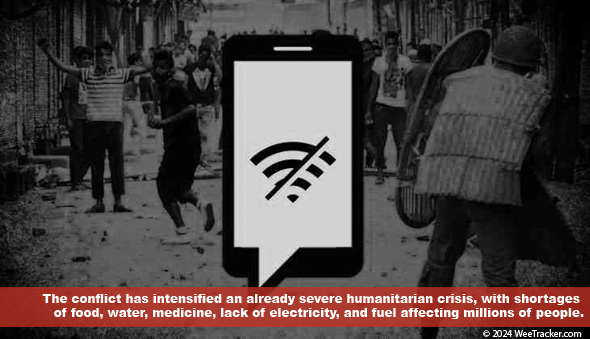
The conflict has intensified an already severe humanitarian crisis, with shortages of food, water, medicine, lack of electricity, and fuel affecting millions of people.[15] This crisis was further stretched by the resort of the two warring parties to internet shutdowns as a war tool within their respective controlled territories; exacerbating the immense suffering of the Sudanese population amidst the ongoing crisis.[16]
The current internet blackout in Sudan began on February 2, 2024, as a response to SAF initially cutting off internet access in the Darfur region. RSF retaliated by seizing control of internet service providers’ data centers in Khartoum, shutting down their switchboards, and sabotaging equipment, causing widespread internet outages nationwide.[17] This incident was not the first time a belligerent resorted to this tactic in armed conflict. In 2015, the Houthi rebels in Yemen took over the Ministry of Telecommunications and Information Technology and ultimately denied internet service. Also, in Myanmar just like in Sudan when the government shut down the internet during its conflict with the Rohingya Arakan Army it deprived the people of humanitarian aid leading to shortages of food and water.[18]
With millions relying entirely on aid from humanitarian organisations, the situation is dire in Sudan. The impact is worsened by the fact that since the outbreak of war, Sudanese people have heavily depended on the online banking system (E-wallet) for essential needs like medicine and food, as carrying cash is unsafe due to robbery by RSF troops.[19] By shutting down the internet, the ability to purchase essentials has been frustrated.
This internet outage deprives people of access to war-related information, hindering direct communication with trusted contacts for personal safety. This lack of communication often leads to life-or-death outcomes. Additionally, it severely limits the ability to locate family members, obtain crucial information about available resources and promised aid, share details on safer routes for displacement, and access other vital information essential for survival.[20]
Denial of access to information and other rights
Sudan has an obligation to uphold freedom of expression and access to information under various international and regional agreements. These include article 19 of the Universal Declaration of Human Rights,[21] and article 19(2) of the International Covenant on Civil and Political Rights (ICCPR).[22] These instruments enshrine the right to seek, receive, and impart information without interference. At the regional level, the African Charter establishes the foundation for freedom of expression and the right to information in article 9.[23] These rights are further reinforced by soft laws, such as the Model Law on Access to Information in Africa, and the Declaration on Principles of Freedom of Expression and Access to Information.
The Model Law outlines best practices for legislative drafting concerning the right to access information, serving as a blueprint for African nations, encouraging them to adopt or modify their laws accordingly to a unified standard across the continent.[24] Moreover, the 2019 Declaration on Principles of Freedom of Expression and Access to Information, dedicates part four to freedom of expression and access to information on the Internet. The declaration acknowledges that the right to access information is an enabling right, as it allows the realisation of other rights.[25] Consequently, the declaration guides states to facilitate this right by all means necessary and explicitly prohibits ‘disruption of access to the internet and any other digital technologies.’[26]
While the declaration allows for derogation from this right in cases where it is justifiable under international human rights law and standards[27], this is clearly not the case in Sudan. The recent internet shutdown in Sudan has hindered humanitarian assistance to 25 million people, obstructed financial assistance, and prevented access to crucial information exacerbating an already dire situation.[28] This amounts to a disproportionate interference with the enjoyment of fundamental rights contrary to international human rights principles.
The UN Special Rapporteur on the promotion and protection of the right to freedom of opinion and expression, in their 2011 report (A/HRC/17/27), stated that ‘[c]utting off access to the Internet, or parts of the Internet, for whole populations or segments of the public, can never be justified, including on public order or national security grounds’. [29]Additionally, the UN Human Rights Council Resolution A/HRC/RES/32/13 (2016) condemned ‘measures to intentionally prevent or disrupt access to or dissemination of information online in violation of international human rights law.’[30]
Domestically, Article 57(2) of Sudan’s 2019 Constitutional Document guarantees citizens the right to access the internet, with limitations determined by law to protect public order, safety, and morals.[31] However, this provision has not been reflected in the form of a new or amended legislative act. Currently, the applicable law in Sudan is the Information Act of 2015 which only guarantees the right of access to information held by public authorities.[32] This gap underscores the need for comprehensive legislation to ensure full protection of citizens’ rights to information and access to the internet.
In light of these international and regional obligations, as well as Sudan’s own constitutional provisions, the recent internet shutdown in the country raises significant concerns about the violation of fundamental human rights inter alia the rights to freedom of expression, access to information, right to adequate food, and the right to health.[33]
When the denial of internet access directly contributes to food insecurity, it constitutes violations under both the International Human Rights Law (IHRL) and International Humanitarian Law (IHL).[34] The Committee on Economic, Social and Cultural Rights in its General Comment No. 12 (1999) on the right to adequate food has outlined how the right to food operates in practice, emphasising three key obligations for States parties: to respect, protect, and fulfill this right. These obligations include refraining from actions that hinder access to adequate food (respect), taking measures to prevent entities or individuals from depriving others of food access (protect), and actively engaging in efforts to enhance access to resources and means for food security (fulfill).[35] As to IHL, hindering access to food could be regarded as the crime of starvation as described in the Additional Protocol of the Geneva Convention 1949 “the action of subjecting people to famine, i.e., extreme and general scarcity of food”.[36] With approximately 18 million Sudanese facing acute hunger,[37] the description applies because the aim of this provision is not to deliberately create such situations.[38]
Moreover, the Internet serves as a crucial tool for documenting human rights abuses, drawing international attention to atrocities, holding perpetrators accountable, and facilitating assistance and protection for those in need.[39] In response to reports of ongoing atrocities, the International Criminal Court (ICC) launched an investigation into Sudan in July 2023, while the UN Human Rights Council established an independent fact-finding mission.[40] However, these efforts are severely impacted by the lack internet access.
It is well accepted internationally that both parties to a conflict, states, and non-state actors are under obligation to respect both IHRL and IHL. This is evidenced by the Security Council’s resolutions urging states and non-state armed groups to adhere to IHL and IHRL duties and responsibilities.[41] This is also, reaffirmed by the Human Rights Council resolution 9/9 which emphasised that the protections guaranteed by human rights law do not cease to exist in times of armed conflict. While IHL becomes the lex specialis governing armed conflicts, it operates in conjunction with human rights law, and the two bodies of law mutually complement and strengthen each other’s application.[42]
Conclusion and recommendations
In conclusion, the denial of internet access during war as evidenced by the situation in Sudan, constitutes a severe violation of multiple human rights. While IHL lacks precise provisions protecting internet access, IHRL is applicable at times of war as it complements and strengthens the enforcement of IHL. However, considering the critical role of the internet in preserving human rights, a comprehensive legal framework explicitly safeguarding internet access during wartime is urgently needed to deter governments and armed groups from implementing internet shutdowns as a tactic of war, holding perpetrators accountable for violations of human rights. Lastly, the two warring parties in Sudan must adhere to their obligations under IHRL and IHL, and refrain from obstructing the internet connection within their respective controlled territories and allow for humanitarian relief activities to continue aiding people.
[1]https://www.accessnow.org/guide/internet-shutdowns-and-elections-handbook/#:~:text=An%20internet%20shutdown%20or%20an,over%20the%20flow%20of%20information (accessed 15 April 2024)
[2] J Rowe S Mah’derom (2023). ‘Weaponizing internet shutdowns to evade accountability for rights violations’ https://www.openglobalrights.org/weaponizing-internet-shutdowns-evade-accountability-rights-violations/](https://www.openglobalrights.org/weaponizing-internet-shutdowns-evade-accountability-rights-violations/) (Accessed 7 April 2024).
[3] n 2 above.
[4] MA Simyu ‘Freedom of expression and African elections: Mitigating the insidious effect of emerging approaches to addressing the false news threat’ (2022) 22 African Human Rights Law Journal 76-107
[5] J Fisher and I Hassan ‘The Politics of Internet Shutdowns in Africa’ 13 November 2023 https://www.cips-cepi.ca/2023/11/13/the-politics-of-internet-shutdowns-in-africa/ (accessed 20 April 2024).
[6] Rowe (n 2 above).
[7] https://www.accessnow.org/campaign/no-exam-shutdown-2023/ (accessed 20 April 2024)
[8] R Mitchell ‘Algeria Exam Season 2023 Internet Shutdowns’ 15 June 2023 https://pulse.internetsociety.org/blog/algeria-exam-season-2023-internet-shutdowns (accessed 27 April)
[9] https://www.unrefugees.org/news/sudan-crisis-explained/#:~:text=The%20ongoing%20humanitarian%20crisis%20in,%2C%20including%20intimate%2Dpartner%20violence. (accessed 7 April 2024)
[10] n 9 above.
[11] SA Saeed ‘Sudan’s Constitutional Dissecting the Coup Declaration’ 3 November 2021
https://www.justsecurity.org/78848/sudans-constitutional-crisis-dissecting-the-coup-declaration/ (accessed 28 April)
[12] n 9 above.
[13] n 9 above.
[14] International Rescue Committee ‘Crisis in Sudan: What is happening and how to help’ 25 March 2024
https://www.rescue.org/article/fighting-sudan-what-you-need-know-about-crisis (accessed 5 April 2024)
[15] UNHCR The UN Refugee Agency ‘Sudan Situation’ https://reporting.unhcr.org/operational/situations/sudan-situation (accessed 5 April 2024)
[16] EFF Electronic Frontier Foundation ‘Internet Access Shouldn’t Be a Bargaining Chip in Geopolitical Battles’ 20 October 2023 https://www.eff.org/deeplinks/2023/10/internet-access-shouldnt-be-bargaining-chip-geopolitical-battles (accessed 3 April 2024)
[17] accessnow ‘KeepItOn in times of war: Sudan’s communications shutdown must be reserved urgently’ 13 February 2024 https://www.accessnow.org/press-release/keepiton-sudan-shutdown/ (accessed 6 April 2024)
[18] T Emerson Hutchins ‘Safeguarding Civilian Internet Access During Armed Conflict: Protecting Humanity’s Most Important Resources in War’ (2020) 22 Science and Technology Law Review
Safeguarding civilian internet interest
[19] K Hamad ‘The Socio Economic Impact of Shutdowns in Sudan’
[20] n 16 above.
[21] The Universal Declaration of Human Rights (UDHR) art 19.
[22] International Covenant on Civil and Political Rights (ICCPR) art 19(2).
[23] African Charter on Human and People’s Rights art 9.
[24] Model Law on Access to Information for Africa
[25] the 2019 Declaration on Principles of Freedom of Expression and Access to Information principle 37 (2)
[26] the 2019 Declaration on Principles of Freedom of Expression and Access to Information principle 38 (2)
[27] the 2019 Declaration on Principles of Freedom of Expression and Access to Information principle 38 (1)
[28] K Mnejja ‘The Sudan Conflict:how internet shutdowns deepen a humanitarian crisis’ 21 March 2024
https://www.accessnow.org/the-sudan-conflict-how-internet-shutdowns-deepen-a-humanitarian-crisis/ (accessed 2 April 2024)
[29] ‘The UN Special Rapporteur on the promotion and protection of the right to freedom of opinion and expression’ 2011 (A/HRC/17/27)
[30] UN Human Rights Council Resolution A/HRC/RES/32/13 (2016)
[31] The Sudanese Constitutional Document (2019) art 57(2) .
[32] Sudan Information Act 2015 sec 3(1)
[33] https://www.wfp.org/emergencies/sudan-emergency (accessed 3 April 2024)
[34] Amnesty International ‘Distruction and Violence in Sudan’ https://www.amnesty.org/en/projects/sudan-conflict/#:~:text=People%20in%20Sudan%20are%20facing,survive%20without%20food%20or%20water
(accessed 4 April)
[35] UN Committe on Economic, Social and Cultural Rights provided General comment No. 12 (1999) on the right to adequate food, para. 15
[36] Protocol II to the Geneva Convention 1949 Commentary (1987), p ara.1455
[37] Health Policy Watch ’18 Million Sudanese Facing Acute Hunger as Civil War Shows no Signs of Ending’ 20 February 2024 https://healthpolicy-watch.news/18-million-sudanese-facing-acute-hunger-as-civil-war-shows-no-signs-of ending/#:~:text=Nearly%2018%20million%20people%20face,of%20hunger%2C%20including%20700%2C000%20children (accessed 5 April 2024)
[38] n above 34
[39] United Nations Academic Impact ‘Harnessing the Power of the Internet to Support Human Rights’
https://www.un.org/en/academic-impact/harnessing-power-internet-support-human-rights (accessed 5 April 2024)
[40] accessnow ‘KeepItOn in times of war: Sudan’s communications shutdown must be reserved urgently’ 13 February 2024 https://www.accessnow.org/press-release/keepiton-sudan-shutdown/ (accessed 6 April 2024)
[41] United Nations Human Rights Office of the High Commissioner International Legal Protection of Human Rights in Armed Conflict (2012 ) p 24
[42] Human Rights Council Resolution 9/9 Protection of the human rights of civilians in armed conflict
About the Author:
Razan E H Ali is a legal professional with a diverse educational background and work experience in human rights. She earned her LLB with honors from the University of Khartoum and an LLM with honors from Trinity College Dublin in Ireland. Currently, she is pursuing another LLM in Human Rights and Democratisation in Africa at the University of Pretoria. Razan’s professional experience includes working as a human rights officer for UNDP’s Human Rights and Rule of Law Portfolio in Darfur, western Sudan. Prior to that, she served as a legal officer with the Norwegian Refugee Council in Gadaref, eastern Sudan. She is licensed to practice law in Sudan and is in the process of obtaining her legal qualification in the UK through the Solicitors Qualifying Examination (SQE).
 AfricLaw