
The injustice of climate mitigation strategies on pastoralist communities in Kenya: An international law perspective
Posted: 19 August, 2024 Filed under: George Njogu | Tags: carbon trading, climate change framework policy, climate change mitigation strategies, climate finance, disease management, environmental justice, Food and Agriculture Organisation, global development objectives, global warming, government, greenhouse gas (GHG) emissions, injustice, international environmental law, international law, Kenya, Kenya Wildlife Conservancy Association (KWCA), Kenya's State Department of Livestock and Fisheries, Kyoto Protocol, livelihood diversification, livestock, Nationally Appropriate Mitigation Action (NAMA), policies Leave a comment Author: George Njogu
Kabarak University School of Law
Pastoralist communities in Kenya, whose livelihoods depend on livestock, are increasingly being required to reduce their herds as part of climate change mitigation strategies. While the intention behind these measures is to combat global warming and climate change, they disproportionately affect these communities, whose contributions to climate change are minimal compared to industrial activities in developed countries. This disparity raises significant concerns about fairness and equity under international law. This article seeks to explore the reason behind these mitigation practices and recommends a solution to the predicament.
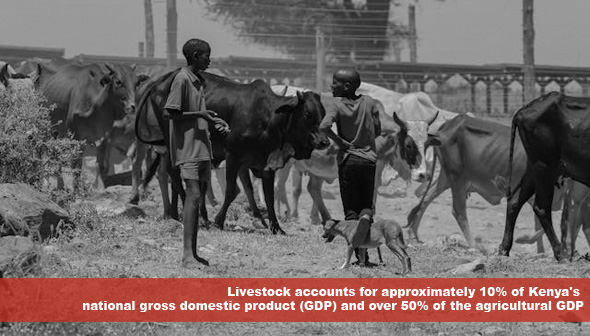
Livestock accounts for approximately 10% of Kenya’s national gross domestic product (GDP) and over 50% of the agricultural GDP. The sector employs half of the agricultural labour force.[1] The primary stakeholders in this subsector are pastoralists and farmers, who primarily raise animals for food and income generation. For pastoralists, however, livestock also serves as a symbol of self-esteem and wealth within their communities.[2]
Kenya’s dairy industry makes up about 14% of the agricultural GDP and 3.5% of the overall GDP. However, dairy cattle are responsible for roughly 8% of the nation’s greenhouse gas emissions.[3] The livestock industry in sub-Saharan Africa contributes up to 3% of global warming.[4] Kenya’s 2016 climate change framework policy identifies the agricultural sector as a major contributor to the nations greenhouse gas (GHG) emissions, primarily due to methane from livestock and changes in land use.[5]
Consequently, Kenya is enhancing its Nationally Determined Contribution (NDC) goals by committing to a 32% reduction in greenhouse gas emissions by 2030, while covering 21% of the associated costs. One strategy it plans to employ in order to achieve this is Climate Smart Agricultural practices, which includes adopting better livestock management systems to minimize emissions.[6] Its climate change framework policy notes that the agricultural sector can also lower GHG emissions by adopting agroforestry, improving pasture and rangeland management, practicing conservation agriculture, implementing efficient dairy production systems, and enhancing manure management.[7]
Other adaptation strategies it seeks to employ include climate information services and livelihood diversification. Additionally, it aims to enhance livestock breeds by promoting locally adapted or exotic breeds is highlighted in some of Kenya’s climate and livestock policies, as well as in the national Spatial Plan of 2015. Reducing the number of livestock and focusing on maintaining a smaller, healthier herd is also becoming a requirement as it is considered to be an effective strategy for mitigating global warming in member states of the Intergovernmental Authority on Development (IGAD). IGAD also advocates for animal husbandry practices and the adoption of sustainable and efficient livestock production systems. Some experts even argue that reducing livestock numbers should become a mandatory measure to support climate change mitigation.[8] Additionally, others propose that pastoralists should diversify their herds to spread risk more effectively.[9]
To leverage opportunities for climate finance and private sector investment in dairy development, Kenya’s State Department of Livestock and Fisheries has created a Nationally Appropriate Mitigation Action (NAMA).[10] The NAMA concept note seeks to boost cattle productivity through methods such as enhanced feed and disease management, resulting in fewer cows that can produce a greater amount of milk.[11] This is also among Kenya’s mitigation strategies. The Food and Agriculture Organisation (FAO) and International Livestock Research Institute (ILRI) will apply their smallholder dairy methodology to evaluate the effects of NAMA initiatives on greenhouse gas emissions.[12]
Evidently, Kenya’s climate policies showcase traces of global influence seeing as they align effectively with global development objectives. Notably, the National Climate Change Response Strategy (NCCRS) emphasises on adaptation and mitigation but also heavily focus on the livestock sector by measures such as proposing budgets and plans for relevant ministries, with around USD 100 million annually allocated for adaptation and mitigation efforts in the agriculture sector.[13]
All of these measures are put in place despite the fact that Kenya accounts for less than 0.1 percent of the world’s annual greenhouse gas (GHG) emissions.[14] Why then should Kenya adopt all of these policies if its contribution to climate change is negligible? The answer to this question is complex. It takes us back to the 1997 International Climate Change Treaty (the Kyoto protocol).
The Kyoto Protocol introduced the system of ‘cap and trade’ as the world’s core intervention in addressing greenhouse gas emissions. How ‘cap and trade’ works is that the government via regulatory bodies sets caps on the amount of greenhouse gases that can be emitted by players in the economy. The cap is then split into credits which are then sold to firms. The government through this generates a pool for funding.[15] Carbon credit markets have since gained momentum across the world because they offer an incredible opportunity to unlock the climate finance needs of African economies. [16] IMF’s Resilience and Sustainability Facility (RSF) is among the resource envelopes in the growing pool of financing mechanisms designed to help countries bolster resilience in the wake of climate related shocks.[17]
The core issue with emissions trading however, is its propensity to perpetuate and exacerbate environmental injustice by establishing a property rights system over the atmosphere, predominantly controlled by wealthy and politically influential polluters[18] which Kenya cannot be classified as.
Nonetheless, carbon trading has led to the establishment of carbon markets in Kenya. These Carbon credit markets require conservancies. This need has led to the emergence of bodies like The Kenya Wildlife Conservancy Association (KWCA) that work to create an enabling environment for conservancies to thrive in Kenya by advocating for enabling policies. These conservancies are predominantly found in the rangelands, featuring arid and semi-arid climatic conditions[19] where the pastoralists herd their cattle.
In Kenya and surrounding nations, pastoralists have been forced out of their traditional grazing areas, resulting in the permanent loss of their land and the erosion of their land rights. This displacement often results from conservation efforts, with numerous protected zones established on former pastoral lands, adversely affecting these communities.[20] The exclusion of land from pastoral use significantly affects pastoral production when crucial grazing areas and water sources are removed from their access.
Kenya has made significant strides nonetheless in the development of a legal and regulatory framework, like the Climate Change Act 2023, to enhance its engagement in the carbon credit markets and further solidify the practice in Kenya.[21] This is despite the little knowledge it has on the consequences of the said carbon markets and is also in disregard of the rights of the Pastoralists who are affected by the same.
It is now more evident that the climate change mitigation policies in Kenya are heavily influenced by international bodies and other developed countries. This is highly inconsiderate of the native pastoralists who are affected by the policies. Additionally, it goes against various human rights including the right for everyone to take part in cultural life[22] as livestock plays a key role in the cultural lives of pastoralists.
The policies violate the international environmental law principle of common but differentiated responsibilities (CBDR). CBDR is established as a fundamental principle in article 3(1) of the 1992 United Nations Framework Convention on Climate Change (UNFCCC). It recognizes that the burden of addressing climate change is unevenly shared among countries, based on their historical contributions to the problem and their different economic capacities.[23] Based on this, Kenya ought not to be required to apply such inconsiderate climate mitigation policies.
Their influence also disregards the principle of environmental justice. Environmental justice is described as the equitable treatment and meaningful engagement of all individuals concerning the creation, implementation, and enforcement of environmental laws, regulations, and policies.[24] Environmental justice also includes the right to access natural resources, to not bear an unfair burden from environmental policies, laws, and regulations.[25] In an international context, environmental injustice refers to the disparities inflicted by powerful, industrialized nations on poorer, developing countries.[26] Pastoralists are insufficiently involved in the development of national climate change policies, and these policies are often crafted without considering their interests, violating the principle of environmental justice.[27]
Environmental justice is achieved when all individuals, especially disadvantaged groups, have an equal opportunity to participate in environmental decision-making processes. The communities should thus be properly informed about environmental decisions that might affect them. They should also have access to information about potential environmental risks, impacts on their health, and the implications for their local environment and resources. Pastoralists ought to be involved in discussions and decisions about environmental matters. This means giving them a platform to voice their concerns and opinions[28] and also seeking mitigation strategies that are less detrimental to their lives.
It can be inferred that Kenya has developed climate change mitigation policies and taken actions largely due to foreign influence and financial aid. This approach allows corrupt officials to create laws primarily to secure funding rather than to address genuine needs. A possible solution to these perils would be to impose a limit on the financial aid provided and also demand leaders to involve those impacted by climate change policies in the policy-making process.
[1] Kenyan embassy Berlin, ‘Livestock farming’ Kenyan embassy Berlin, -< http://www.kenyaembassyberlin.de/Livestock-Farming.54.0.html>- on 5 August 2024.
[2] Kenya Agricultural & Livestock Research organisation, ‘Livestock’ Kenya Agricultural & Livestock Research organisation, 2024 -< https://www.kalro.org/divisions/livestock/#:~:text=About%20the%20Department,50%25%20of%20the%20agricultural%20GDP.>- on 5 August 2024.
[3] Climate & Clean Air Coalition, ‘Kenya’s greenhouse inventory for livestock emissions’ Climate & Clean Air Coalition, 2016 -< https://www.ccacoalition.org/projects/kenyas-greenhouse-gas-inventory-livestock-emissions>- on 2 August 2024.
[4] Jacob Walter, ‘Unpacking global methane pledge to pastoralist community’ Nation, 19 April 2024 -< https://nation.africa/kenya/health/unpacking-global-methane-pledge-to-pastoralist-communities-4532776>- .
[5] Laurie Ashley, ‘Climate and Livestock policy coherence analysis in Kenya, Ethiopia and Uganda’ Working Paper No. 268, 2019, 28.
[6] Climate & Clean Air Coalition, ‘Kenya aims to reduce livestock methane emissions without sacrificing productivity’ Climate & Clean Air Coalition, 29 December 2021 -< https://www.ccacoalition.org/news/kenya-aims-reduce-livestock-methane-emissions-without-sacrificing-productivity>- on 2 August 2024.
[7] Laurie Ashley, ‘Climate and Livestock policy coherence analysis in Kenya, Ethiopia and Uganda’ Working Paper No. 268, 2019, 28.
[8] Jacob Walter, ‘Unpacking global methane pledge to pastoralist community’ Nation, 19 April 2024 -< https://nation.africa/kenya/health/unpacking-global-methane-pledge-to-pastoralist-communities-4532776>- .
[9] Jacob Walter, ‘Unpacking global methane pledge to pastoralist community’ Nation, 19 April 2024 -< https://nation.africa/kenya/health/unpacking-global-methane-pledge-to-pastoralist-communities-4532776>- .
[10] Climate & Clean Air Coalition, ‘Kenya’s greenhouse inventory for livestock emissions’ Climate & Clean Air Coalition, 2016 -< https://www.ccacoalition.org/projects/kenyas-greenhouse-gas-inventory-livestock-emissions>- on 2 August 2024.
[11] Climate & Clean Air Coalition, ‘Kenya aims to reduce livestock methane emissions without sacrificing productivity’ Climate & Clean Air Coalition, 29 December 2021 -< https://www.ccacoalition.org/news/kenya-aims-reduce-livestock-methane-emissions-without-sacrificing-productivity>- on 2 August 2024.
[12] Laurie Ashley, ‘Climate and Livestock policy coherence analysis in Kenya, Ethiopia and Uganda’ Working Paper No. 268, 2019, 28.
[13] Laurie Ashley, ‘Climate and Livestock policy coherence analysis in Kenya, Ethiopia and Uganda’ Working Paper No. 268, 2019, 34.
[14] USAID, ‘Kenya Climate Change Country Profile’ USAID, 29 November 2023 -< https://www.usaid.gov/climate/country-profiles/kenya#:~:text=USAID%20supports%20Kenya%20in%20building,early%20warning%20and%20action%20systems.>- on 1 August 2024.
[15] Julians Amboko, ‘Kenya’s plan to unlock carbon credit market’ Business Daily, 3 September 2023.
[16] KWCA, ‘Consultancy Opportunity: Development of KWCA Carbon Credits Projects Engagement Strategy’ KWCA, 21 February 2024 -< https://kwcakenya.com/consultancy-opportunity-development-of-kwca-carbon-credits-projects-engagement-strategy/#:~:text=The%20overall%20objective%20of%20this,network%20on%20carbon%20projects%20development.&text=Hold%20an%20inception%20meeting%20with,and%20expectations%20of%20the%20assignment.>- on 2 August 2024.
[17] Julians Amboko, ‘Kenya’s plan to unlock carbon credit market’ Business Daily, 3 September 2023.
[18] Ndethiu, Maureen, ‘Environmental justice in Kenya: a critical analysis’ University of South Africa, 2018, 112.
[19] KWCA, ‘Consultancy Opportunity: Development of KWCA Carbon Credits Projects Engagement Strategy’ KWCA, 21 February 2024 -< https://kwcakenya.com/consultancy-opportunity-development-of-kwca-carbon-credits-projects-engagement-strategy/#:~:text=The%20overall%20objective%20of%20this,network%20on%20carbon%20projects%20development.&text=Hold%20an%20inception%20meeting%20with,and%20expectations%20of%20the%20assignment.>- on 2 August 2024.
[20] Kariuki Muigua, ‘Natural Resource Conflicts: Addressing Inter-Ethnic Strife through Environmental Justice in Kenya’ 11(2) ADR Journal (2023) 195.
[21] KWCA, ‘Consultancy Opportunity: Development of KWCA Carbon Credits Projects Engagement Strategy’ KWCA, 21 February 2024 -< https://kwcakenya.com/consultancy-opportunity-development-of-kwca-carbon-credits-projects-engagement-strategy/#:~:text=The%20overall%20objective%20of%20this,network%20on%20carbon%20projects%20development.&text=Hold%20an%20inception%20meeting%20with,and%20expectations%20of%20the%20assignment.>- on 2 August 2024.
[22] International Covenant on Economic, Social and Cultural Rights, 16 December 1966, 999/171, Article 15.
[23] DGAP, ‘Common But Differentiated Responsibility German Council on Foreign relations’ Internationale Politik Quarterly, -< https://dgap.org/en/research/glossary/climate-foreign-policy/common-differentiated-responsibilities-cbdr>- on 2 August 2024.
[24] Ndethiu, Maureen, ‘Environmental justice in Kenya: a critical analysis’ University of South Africa, 2018, 112.
[25]. Kariuki Muigua, ‘Putting the Concept of Environmental Justice in Context’ The Lawyer, 10 October 2023.
[26] Ndethiu, Maureen, ‘Environmental justice in Kenya: a critical analysis’ University of South Africa, 2018, 107.
[27] Kariuki Muigua, ‘Natural Resource Conflicts: Addressing Inter-Ethnic Strife through Environmental Justice in Kenya’ 11(2) ADR Journal (2023) 9.
[28] Ndethiu, Maureen, ‘Environmental justice in Kenya: a critical analysis’ University of South Africa, 2018, 130.
About the Author:
George Njogu is the Editor in Chief of the Kabarak Law Review blog and an undergraduate student at Kabarak University School of Law. He has a keen interest in climate law, with a particular focus on climate change from a Global South perspective.
 AfricLaw