
The National Security Bill of 2024: A threat to freedom of expression in South Sudan
Posted: 22 July, 2024 Filed under: Akot Makur Chuot, Yeabsira Teferi | Tags: African Charter on Human and Peoples’ Rights, arbitrary arrest, basic human right, Code of Criminal Procedure, democratic transition, fair trial, freedom of expression, freedom to express views freely, international human rights instrument, National Elections Commission, national security, National Security Bill, National Security Services, political consciousness, Public Prosecution Attorney, South Sudan, South Sudan military, warrant of arrest Leave a comment Author: Akot Makur Chuot
LLM Candidate, Human Rights and Democratisation in Africa, University of Pretoria
Introduction
On 3 July 2024, the Revitalised National Transitional Legislative Assembly of South Sudan passed the controversial National Security Bill, which among others empowers (sections 54 & 55) the National Security Services to make arrests and detain anyone suspected of having committed an offence against the state without a warrant of arrest. The Bill was controversially passed by a vote of 274 in favour and 114 against, with 3 abstentions. This is in the face of a democratic transition as South Sudan heads to poll on 22 in December 2024 as per the announcement of the National Elections Commission. If the President does not sign the Bill within 30 days from the day it was passed, it will automatically become law.
Legal arguments
The Bill undermines the ethos of a democratic society like civic space for freedom of expression. While the Bill is intended to protect the national security of South Sudan as argued by the proponents, it will curtail the freedom of expression and be used to repress those expressing their views, especially views that are critical of the government. Arresting without a warrant violates the principle of fair trial (Article 19) and the right to freedom of expression (Article 24) as envisaged in the Transitional Constitution of South Sudan of 2011. For instance, in particular, Article 19(2) of the Constitution provides that the person should be informed of the reasons for their arrest and charges against them at the time of arrest. All these should be indicated in the arrest warrant. Section 82 of the Code of Criminal Procedure of 2008 requires that any person named in the arrest warrant should be notified of the reasons for arrest and be shown a copy of the arrest warrant.
According to sections 75 & 76 of the Code of Criminal Procedure, the Public Prosecution Attorney, Judge and Police can only arrest without a warrant when the person commits an offence in their presence. For investigation, the police can arrest a person without a warrant if there is a reasonable belief that the person is planning to commit an offence. However, according to section 91(3) of the Code of Criminal Procedure, a person arrested without a warrant should immediately be taken to the Public Prosecution Attorney or officer in charge of a police station to take note of the case.
In addition, the Bill is a deviation by South Sudan from its obligations under international human rights instruments like the African Charter on Human and Peoples’ Rights which guarantees protection from arbitrary arrest and freedom to express views freely. The African Commission affirmed the importance of free speech in Constitutional Rights Project and Others v Nigeria, where the Commission held that ‘freedom of expression is a basic human right, vital to an individual’s personal development and political consciousness, and participation in the conduct of the public affairs of his country’.
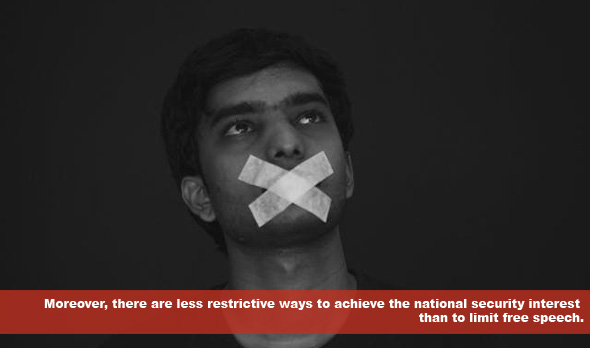
The only limitations for freedom of expression are those that meet the African Court’s jurisprudence in the Konate v. Burkina Faso case. First, the limitation must be provided by law. Secondly, it must serve a legitimate purpose; thirdly, it must be of necessity and proportionate to the harms it seeks to address. Although the National Security Bill is provided by domestic law and serves a legitimate purpose (protecting the national security of South Sudan), it does not meet the test of necessity and proportionality. On the one hand, the Bill is not proportional because it does not balance the right to freedom of expression and the legitimate aim pursued, that is the national security of South Sudan. Furthermore, the Bill will eliminate or render the right to freedom of expression ineffective, especially on views that criticise the performance of the government. Moreover, there are less restrictive ways to achieve the national security interest than to limit free speech. One of the ways to protect the national security interest is by following the due process of law such as arresting with a warrant of arrest not as the Bill proposes to arrest without a warrant of arrest. On the other hand, the Bill is not necessary for two reasons. First, it will impede the society from functioning democratically. Secondly, the government has failed to show a clear ‘direct and immediate’ link between the freedom of expression and the national security threat.
Therefore, this article argues that the National Security Bill violates the foregoing principles of fair trial and freedom of expression.
Possible implications
The Bill will shrink civic space as the country heads to polls in December 2024. This will limit the citizens’ ability to participate meaningfully in the democratisation process and consequently affect them in making informed decisions about the candidate they wish to elect because there will be no conducive environment for candidates to express themselves freely. Moreover, the Bill will suppress the democratic aspirations that South Sudan is aiming to achieve. Lastly, the Bill will likely be misused to repress dissidents and arbitrarily arrest them. In so doing, the Bill will be used to silence government critics or views that the government may deem oppositional, thus shutting the democratic space and consequently limiting the constitutional right of free speech of citizens to question their government if it fails to deliver services. This will lead to arrests that are not justified by due process of law.
Conclusions
South Sudan has obligations under the African Charter and other relevant human rights instruments to ensure that limitations of rights satisfy the tests of legality, legitimate purpose, necessity and proportionality, failing which such limitations would be unjustified. The article illustrates that the Bill fails the necessity and proportionality test and therefore an unjustified limitation of rights, which could have significant consequences for freedom of expression and may be used to intimidate and harass critics of the government leading to further shrinking of the civic space. Against this background, this article calls on President Salva Kiir Mayardit to decline to sign the Bill and return it to the parliament for review and reconsideration. Conducive democratic civic space is necessary for nation-building.
About the Author:
Akot Makur Chuot holds an LLB (First Class Honours) from the University of Juba. He is currently an LLM Candidate in Human Rights and Democratisation in Africa, at the University of Pretoria. He teaches law as Assistant Lecturer and serves as a Moot Court Coach at the School of Law, the University of Juba, South Sudan. He holds a Certificate in Legal Practice (LP), from the South Sudan Bar Association and is an Associate at City Law & Co. Advocates, South Sudan.
 AfricLaw