
Climate change and the 2024-2025 South Sudan National Budget Discourse: A call for the inclusion of climate adaptation budget
Posted: 15 July, 2024 Filed under: Justin Monyping Ater | Tags: adaptation strategies, climate adaptation, climate change, Climate change and the 2024-2025 South Sudan National Budget Discourse: A call for the inclusion of climate adaptation budget, climate mitigation, education, health, human rights, human rights treaties, national budget, national human rights frameworks, National Legislature, Paris Agreement, right to life, South Sudan, UNFCCC, United Nations Framework Convention on Climate Change Leave a comment Author: Justin Monyping Ater
Law lecturer, School of Law, University of Juba, South Sudan
Introduction
On 30 June 2024, the first Undersecretary of the National Ministry of Finance and Planning of South Sudan issued a public notice announcing the end of the ‘Fiscal Year 2023/2024’. The Undersecretary further noted that the:
‘Ministry of Finance and Planning will not receive new claims until the 2024/2025 Budget is passed by the National Legislature and assented into law’.
As indicated in the notice itself, whatever is contained in it, was to be effective immediately considering the date it was issued. This is because under section 15(5) of the Public Financial Management and Accountability Act, 2011:
‘The Financial Year shall cover a period of 12 months, which shall run from 1st July to 30th June each year’.
Generally, the Public Financial Management and Accountability Act 2011, under section 26, in relation to the passing of the national budget, tasks the Minister of Finance and Planning to present to the President an estimated budget. In turn, the President is to submit to the Legislature the estimated budget for deliberation. However, if this is not achieved ‘within forty-five (45) days of the submission’, the President has authority to:
Issue a Presidential Decree on the Budget for that year, and such Budget shall be deemed to have been passed by the Assembly in accordance with the provisions of the Constitution.
Since the national budget for 2024/2025 has not been deliberated, passed, and assented into law, it is likely that the President will invoke his powers and issue a Presidential decree to this effect. Furthermore, it is important to highlight that South Sudan Legislature has recently echoed and/or clarified impliedly the call for the President to issue a Presidential decree in relation to budget matters. This article therefore argues that there should be an inclusion of the climate adaptation budget in the national budget that will be decreed by the President.
The basis for the call for the inclusion of climate adaptation budget
(a) Legal basis
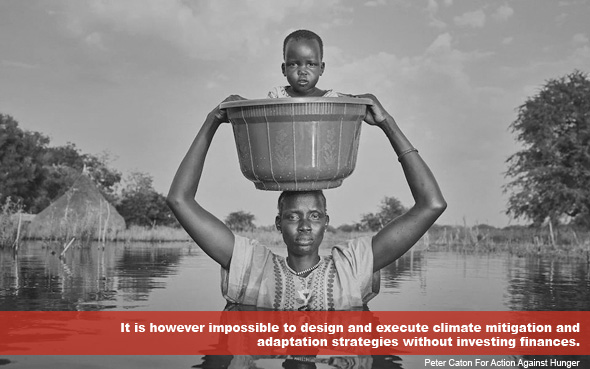
South Sudan is a state party to various climate change treaties such as the United Nations Framework Convention on Climate Change (UNFCCC) and the Paris Agreement (PA). These treaties oblige the government of South Sudan to take measures to address climate change within its territory. For example, Articles 6 and 12 of the UNFCCC and PA respectively require state parties to initiate and develop educational programmes relevant to climate mitigation and adaptation. It is however impossible to design and execute climate mitigation and adaptation strategies without investing finances. Hence, the need for the government of South Sudan to allocate a national budget for climate mitigation and adaptation strategies.
Furthermore, there is considerable literature establishing the link between climate change and human rights. Climate change affects various human rights such as the right to life, education, and health. In this respect, it should be noted that South Sudan has ratified many human rights treaties that have entrenched various rights that continue to be impacted by climate change. In this context, the country has an obligation to protect and promote the rights of South Sudanese and other people resident within its territory. The obligations are further provided in the regional human rights instruments such as the African Charter on Human and Peoples’ Rights (ACHPRs) and under the national human rights frameworks such as the Bill of Rights entrenched in the Constitution of the Republic of South Sudan. Of important notice is that there is no hierarchy between the international, regional, and national human rights norms. This is because Article 9 of the Constitution provides that all human rights instruments ratified by the government of South Sudan are an integral part of the national Constitution and are therefore directly applicable before human rights institutions and/or courts. This shows that human rights provisions embedded within the Constitution have the same status as international and regional human rights norms. To ensure that all human rights enshrined in the international, regional, and national human rights frameworks are protected and promoted, the government of South Sudan must allocate a budget for climate mitigation and adaptation, particularly the latter since South Sudan contributes less to climate change.
(b) Impact basis
Climate change impacts continue to be disastrously felt by the people of South Sudan particularly the vulnerable group such as children. For example on 15 April 2024, the government of South Sudan closed down schools because the heatwaves were too severe to the extent that many children lost their lives. It is argued that if adaptive measures are not taken, the situation will get desperate. The government of South Sudan has an obligation to alleviate the situation through utilising the budgeting process to allocate funds for climate adaptation. The climate adaptation budget must be used for, for example, in ‘constructing climate resilient classrooms’ and hospitals.
Conclusion and Recommendations
Precisely as shown throughout this article, the impacts of climate change are severe and require the government of South Sudan to act immediately and effectively. South Sudan has an obligation under climate change and human rights treaties it has ratified to ensure that it takes measures to address climate change. These measures it is argued include but are not limited to allocating a national budget for climate adaptation and mitigation strategies. In this respect, this article calls on the government of South Sudan to act immediately by including a climate change budget in the 2024/2025 national budget.
About the Author:
Justin Monyping Ater is a Doctor of Laws (LLD) Candidate at the Faculty of Law, University of Pretoria, South Africa. He holds an LLM degree from the University of Pretoria, an LLB (Hons) degree from the School of Law, University of Juba and a Certificate of Legal Practice from the South Sudan Bar Association. Justin is a Law Lecturer at the School of Law, University of Juba and Starford International University and a Managing Partner of Advanced Attorneys & Legal Consultants. His research interests relate to human rights law and international humanitarian law.
 AfricLaw