
Analysing Ethiopia’s Adherence with the Guidelines on Access to Information and Elections in Africa: A Spotlight on the 2021 National Election
Posted: 8 July, 2024 Filed under: Reda Benkhadra, Yeabsira Teferi | Tags: Access to Information, African Charter on Human and People’s Rights, African Commission, democracy, elections, electoral boundaries, Electoral Proclamation, Ethiopia, Guidelines on Access to Information and Elections in Africa, June 2021 national elections, National Electoral Board of Ethiopia, NEBE Leave a comment Author: Yeabsira Teferi
Lecturer of law, School of Law, Dilla University, Ethiopia
Introduction
A fundamental element of democracy is the freedom to choose political leaders through elections. As envisaged under Article 13 of the African Charter on Human and People’s Rights (the African Charter), for elections to be free, fair and credible, the electorate must have access to information at all stages of the electoral process.
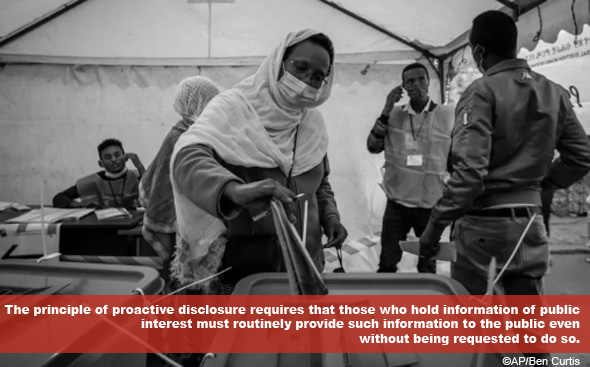
The Special Rapporteur on Freedom of Expression, a special mechanism established by the African Commission, with the specific mandate of monitoring member states’ compliance with article 9 of the African Charter adopted the Guidelines on Access to Information and Elections in Africa (hereinafter, the Guidelines), in 2017.[i] The Guidelines provide directions on access to information in the electoral process as a means of strengthening democratic governance in Africa and specifically incorporates the principle of proactive disclosure of information. The principle of proactive disclosure requires that those who hold information of public interest must routinely provide such information to the public even without being requested to do so.
In line with article 1 of the African Charter, the domestic implementation of the Guidelines requires member states to adopt legislative and other measures to improve the landscape of access to information in the electoral process. This article focuses on how Ethiopia’s legal framework adequately promotes proactive information disclosure and to what extent Ethiopia’s electoral management body, i.e., National Electoral Board of Ethiopia (NEBE), proactively disclosed vital information before, during, and after the June 2021 national elections.
Ethiopia’s electoral processes are governed by the FDRE Constitution, 1995; the NEBE Establishment Proclamation No. 1133/2019 (hereinafter the Establishment Proclamation); the Ethiopian Electoral, Political Parties Registration and Election’s Code of Conduct Proclamation No. 1162/2019 (hereinafter the Electoral proclamation) and several directives adopted by NEBE.
Pre-election proactive disclosure
Guideline 17 sets out certain categories of information that must be proactively disclosed prior to the conduct of elections, namely: detailed electoral calendar; criteria, process and results for the delimitation of electoral boundaries; list of constituencies or voting districts; full details of the voter registration process; criteria and requirements for registration of political parties; details of political parties registered as participants in the electoral process; qualification, rules, and procedure for nomination of candidates by political parties and others.[ii] Below, I briefly assess how the authorities in Ethiopia complied with these requirements.
- Electoral calendar: The Establishment proclamation requires the Board to prepare election schedules taking place at all levels, approve, and as needed amend and follow up its implementation.[iii]
A detailed electoral calendar, for the 2021 general elections was published on the NEBE website, including information’s updates on the adjournments of the election timeline; due to COVID pandemic and circumstances related with distribution of materials, security issue, and geography.[iv]
- Delimitation of electoral boundaries: The Electoral proclamation tasks the House of Federation with the demarcation of constituencies based on the study submitted to it by the Board.[v] The Board tasked with establishing nationwide the electoral regions and determining the number of polling stations necessary to carry out an election.[vi] The list of Regions and City Administrations, and the number of constituencies and polling stations in each electoral regions, has been published on NEBE’s website.[vii]
- Voter registration and compilation of voters registers: The voter registration exercise by the NEBE in Ethiopia is regulated by the Electoral Proclamation and some directives released by the NEBE. The Electoral proclamation mandates each polling stations to register voters and ensure proper completion, safeguarding and dispatching of election documents and materials to the constituency.[viii]
- Inspection of voters register: The Electoral proclamation provides that the electoral roll shall be officially displayed to the public in the premises of the polling station for 10 days upon conclusion of voter registration.[ix] As such, even though the proclamation allows those who are interested to inspect the electoral roll, it does not provide the manner and procedures according to which such electoral rolls can be subject to inspection. It is also important to note that the NEBE website should have a voter locator or voter search portal where a registered voter can cross check or confirm their voter status including their polling station. However, the national voters register used during the 2021 general elections was not available on the NEBE website for inspection.
- Special voting: For the purpose of enfranchising those living far from their constituency, the Electoral Proclamation empowers the Board to establish special polling stations at or near the place where the voters are to be found.[x] Furthermore, the NEBE developed and published in its website, Directive No. 13/2020, which requires the establishment of special polling stations for Internally Displaced Persons, university students, and the military to facilitate their registration as voters.
- Registration of political parties: Any political party in Ethiopia can only act as a political party after it has registered with the Board in accordance with Electoral Proclamation and obtained a certificate confirming its legal personality.
The NEBE website has detailed procedures on how to register a political party in Ethiopia in accordance with the relevant legal framework.[xi] It contains details of political parties registered, and the party’s denied registration, as participants in the electoral process, specifying their number and names.
- Nomination of candidates: Article 31 and 32 of the Electoral Proclamation and Directive on Candidate Registration, Collection of Endorsement Signatures and Selection of Symbols no. 7/2021 provides the qualifications, rules and procedures for candidates’ nominations for both independent and political party candidates.
The NEBE website provides list of candidates for the 6th General Election in each Constituencies of Regions and City Administrations for seats on Regional Council (RC) and for House of People’s Representatives (HoPR) and basic requirements for nomination as a candidate.[xii]
Election day and result announcements
Guideline 18 requires proactive disclosure of the following information up on conclusion of election.[xiii]
- Voting stations: The NEBE is required to publish, by notice in the Gazette, a list of the polling stations in each constituency at least 14 days before nomination. Voting hours in Ethiopia shall run from 6:00 am to 6:00 pm. However, the Board may extend the voting time beyond 6:00 pm where there are any voters in the polling station, or where it is convinced that election’s freeness and fairness will be further promoted. Where the Board decides special voting hours, it shall announce to the public the special voting hours at least two days prior to the voting day.[xiv]
- Information flow from close of voting to results declaration: As per Ethiopia’s electoral laws, information flow starts with the vote counting at each polling station and a declaration by the presiding officer. The subsequent processes are the filling in of the declaration of results forms at each polling station witnessed by the agents of the candidates, collection of results from the polling stations at collection centres by the returning officer, tallying of results by the returning officer, and the declaration by the returning officer of the total number of votes obtained by each candidate, including the winner.[xv]
- Complaints and petitions: A candidate or any voter present may raise any objection during the counting of the votes, and each presiding officer is required to keep a record, in the report book, of every objection made to any ballot paper found in the ballot box; and thereafter, decide every question arising out of the objection. We cannot find complaints and petitions that are disclosed by the NEBE proactively to the public. The complaints received by the NEBE from political parties, the public and candidates are recorded internally and may be made available upon request at any of the NEBE regional offices or headquarters in Addis Abeba.
Post-election
As per Guideline 19, an Election Management Body shall proactively disclose the following information up on the completion of elections:[xvi]
- Timelines and result declaration: The Electoral Proclamation requires the Board to ascertain, publish and declare in writing under its seal the results of the election. Voting results from each polling station shall be posted on a notice board of the polling station within an hour after the conclusion of ballot counting and upon receiving the results of the elections from each polling stations, the constituency electoral officers shall, in the presence of candidates or their agents, add up and announce the elections results to the public within five days of the conclusion of ballots unless prevented by circumstances that are evidently beyond their control. Finally, the final results are transmitted to the NEBE by the returning officer and the Board shall announce the final official results within 10 days.[xvii]
The general election results were declared by the Chairperson of the NEBE, Birtukan Mideksa. These presidential election results are available on the NEBE’s website.[xviii]
- Seat allocations: The seat allocations in Ethiopia for the HPR and SC are premised on political parties which sponsor candidates who participate in the general elections. These seat allocations are calculated by the NEBE when the results for all the polling stations across the country have been tallied and declared. The NEBE then makes a public declaration of the results highlighting the seat allocations in the media and on its website.
- Evaluation reports: The Establishment Proclamation requires the Board to produce and submit to the HPR reports on its work.[xix] The NEBE’s report on 2021 election result released on 18 July 2021 highlights the fact that the roadmap to the general elections was wholly funded by the government, election planning and preparation, registration of candidates and participation parties, voter registration, challenges and success, and final results.[xx]
Conclusion
In conclusion, the above brief writings indicate that Ethiopia largely complied with the guidelines by addressing the issue with sufficient legal framework and information disclosure with its central election management body, NEBE. However, there are still several limitations in addressing the problem of access to information by members of the public. Almost all the electoral information’s released by NEBE were written or spoken with English and Amharic language, although there are millions of people in Ethiopia who do not understand these languages. Also, most information platforms used by NEBE including websites and social medias has created a problem of access to the information by the most marginalized people, who do not have access to internet such as people living in rural areas.
Hence, Ethiopia needs to integrate convenient and inclusive electoral information disclosure mechanisms to increase public participation in electoral processes.
[i] The Guidelines on Access to Information and Elections in Africa, Adopted in November 2017.
[ii] Ibid, Guideline 17
[iii] The National Election Board of Ethiopia (NEBE) Establishment Proclamation No. 1133/2019, Art.7(22).
[iv] The NEBE, https://nebe.org.et/index.php/en/election-timeline Accessed on 3 September 2023
[v] The Ethiopian Electoral, Political Parties Registration and Election’s Code of Conduct Proclamation No. 1162/2019, Art 139(1)(e).
[vi] n(i), Art. 7, 13 and 14.
[vii] The NEBE https://nebe.org.et/en/polling-stations Accessed on 4 September 2023
[viii] n(iii), Art.16.
[ix] Ibid, Art 26 (1).
[x] Ibid, Art 17(1).
[xi] The NEBE, https://nebe.org.et/en/political-parties, Accessed on 8 September 2023
[xii] The NEBE, https://nebe.org.et/en/candidate-list, Accessed on 12 September 2023
[xiii] n(i), Guideline 18
[xiv] n(iii), Art. 49.
[xv] Ibid, Art. 58-61.
[xvi] n(i), Guideline 19.
[xvii] Ibid, Art. 58-61.
[xviii] The NEBE, https://nebe.org.et/index.php/en/electionresult, Accessed on 14 September 2023
[xix] n(iii), Art 7(23).
[xx] The NEBE, Sixth General Election Result, 10 July 2021, https://nebe.org.et/sites/default/files/Final%20Report%20English.pdf, Accessed on 15 September 2023.
About the Author:
Yeabsira Teferi graduated from Dilla University with an LLB in 2016 and subsequently earned an LLM in International Law from Addis Abeba University in 2021. Currently, he serves as a Lecturer of law at Dilla University, School of Law, while also practicing as a first-class attorney and legal consultant in Dilla, Ethiopia.
 AfricLaw