
The National Sex Offenders Registry: Offenders’ Right to Privacy v The Safety of Potential Victims
Posted: 3 June, 2024 Filed under: Livhuwani Malelelo | Tags: convicted sex offender, gender-based violence, National Register for Sex Offenders, NRSO, POPIA, potential victims, pursuit of justice, right to privacy, sex offender, sexual crimes, sexual crimes against children, victimisation 1 Comment Author: Livhuwani Malelelo
LLB candidate, University of Johannesburg
The National Register for Sex Offenders (NRSO) is a list of convicted sexual offenders and although South Africa has an alarming rate of gender-based violence, this list only contains the names of offenders of sexual crimes against children and mentally disabled persons, meaning that the main purpose of this registry is to protect children and mentally disabled persons from these types of offenders. This list is not open to the public but is only open to institutions such as preschools, schools, hospitals etc so they can check if an employee or potential employee is a convicted sex offender. This is so as to protect the offenders right to privacy. Unfortunately, the NRSO seemingly prioritises the right to privacy of the offenders instead of protecting potential victims of said offender.
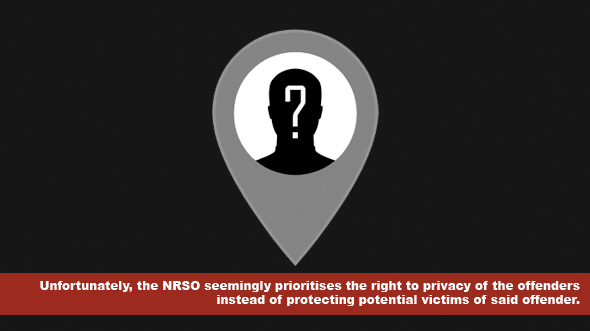
One thing preventing the National Sex Offenders Registry from being publicised and open for the public to search up possible sex offenders in close proximity to them for the sake of one’s own protection, is section 14 of the Constitution which reads, “Everyone has the right to privacy, which includes the right not to have their person or home searched, their property searched, their possession seized or the privacy of their communications infringed”. Also, giving effect to this right is the POPIA as this act is “an attempt to balance the right to privacy with the rights of others including the right to access information.” This, overall means that the publicising of one’s private information may be illegal and an infringement of one of their fundamental rights in some instances.
Nonetheless, the right to privacy is not absolute and therefore can be limited under section 36 of the constitution of the Republic of South Africa, 1996. This, of course is subjected to a criterion found under the same section of the constitution ( Limitation Clause) which states that the limitation of any right must take into account, “the nature of the right, the importance of the purpose of the limitation, the nature and extent of the limitation, the relation between the limitation and its purpose and less restrictive means to achieve the purpose.” Legitimate limitations of this right for instance, includes police searches, and seizures of suspects’ items without a warrant as provided by section 22 of Criminal Procedure Act 51 of 1977 as it is believed that doing so would assist the pursuit of justice. One might argue that these are two completely different instances of limitation, as the infringement of the right to privacy by police does not involve the publicising of one’s information like the suggestion made by this article. However, what the instance shows is the necessity for the limitation of this right in order to succeed in the pursuit of justice, which in this case is protecting children and mentally disabled people from being victims of sexual offenders.
The constitution contains both the rights of victims and perpetrators but it “does not explicitly guarantee the rights of victims in the criminal justice system. This omission has created the misperception amongst the public that there is undue emphasis on the rights of the alleged criminals and this statutory protection of their rights facilitates crime. These narratives put the rights of the accused against these victims.” The law must thus strike a fair balance between the rights of the alleged perpetrators and the rights of victims as well as potential victims. The rights of the beneficiaries of the NRSO are enshrined in the constitution and therefore the legislature is tasked with the positive duty to enact laws that give effect to these rights. This positive duty includes making sure that these laws will certainly protect its beneficiaries to the full extent.
Overall, this article suggests that in order to fully protect the beneficiaries of the NRSO, this registry must be made available to the public as the limitation of the offenders’ right to privacy is visibly a reasonable as well as justified one under section 36 of the constitution. Furthermore, “South Africa needs a legislative framework that provides for an integrated set of services and prevent violence and increase women’s and children’s access to justice and support services to help them heal and to prevent further victimisation.” Since the South African criminal justice system entails both the interests of the perpetrators and victims, the relevant laws should reflect a well balanced system that prioritises both their rights and not just the rights of the perpetrators.
About the Author:
Livhuwani Malelelo is a Bachelor of Law (LLB) candidate at the University of Johannesburg. She is a human rights activist who writes about issues related to human rights and social justice.
 AfricLaw
Balancing offenders’ privacy with public safety is crucial ⚖️. NRSO must prioritize victims’ protection 🛡️ while upholding rights thoughtfully.<a href=”https://sites.google.com/view/ashikakhurana/home”>Ashikakhurana </a>