
It’s not just you and me, and that’s okay
Posted: 20 May, 2024 Filed under: David Ikpo, Victoria Amaechi | Tags: African continent, Beverley Ditsie, Coming out, Coming out vs Coming home, fight against discrimination, gay, gender expression, heteronormative standards, homonormative, homophobia, Justice Edwin Cameron, lgbtq, Mark Gevisser, multi-institutional relationships, political incorrectness, queer, queer inclusivity, queer persons, queer rights, queer visibility, Sassoi of Ghana, sexuality, Simon Nkoli, The Pink Line, Zachie Achmat 1 Comment |
Author: Victoria Amaechi Centre for Human Rights, University of Pretoria |
 |
Author: David Ikpo Centre for Human Rights, University of Pretoria |
Queer visibility, and what it accomplishes, turns the social, cultural and legal wheels towards queer inclusivity in society, and is a great complement to the advancement of queer rights on the African continent and globally.
On the African continent, South Africa sets the tone for the merits of queer visibility, through the openly politicised lives of queer icons such as Simon Nkoli, Beverley Ditsie, Justice Edwin Cameron and Zachie Achmat. Other African queer icons have also emerged through their great work, such as Caine Youngman of Botswana; David Kato, Kasha Jaqueline, Richard Lusimbo and Frank Mugisha of Uganda; Abdellah Taia of Morocco; Rev Jide Macaulay and Uyai Ikpe-Etim of Nigeria; Alex Donkor of Ghana and Eric Lembembe of Cameroon. This list does no justice to the infinite number of queer persons within and outside of civil society and government, in the full glare of public visibility, who work tirelessly for queer inclusion on the African continent. This work is no mean feat, and for the most part makes the difference between whether or not a person returns at night to their families after a day’s work, or whether or not there is a family to return to. However, this is not true for all of us.
Mark Gevisser, the South African author and journalist, discusses in his book The Pink Line that parallel to the rise in global queer visibility and media representation, there also exists frontiers where queerness is not a basis of identity or politicisation.[1] Across these frontiers, queerness is what someone does, not who someone is. Occasionally, in these frontiers, queerness can appear to be worn and taken off like a shirt – contrary to the openly ‘born this way’ narrative that most global queer politics is based on, suggesting that one’s queerness must be displayed for the public gaze. For some queerness is not a mandatory point of visibility for several reasons which may not necessarily include internalised homophobia. For some of us, our queerness has never been grounds for exclusions, and as such it has never grounds for visibility or for even hiding. For some of us it is what it is: another indistinct part of what contributes to the complex fabric of personhood.
For instance, as discussed by Godfried Asante, there are the Sassoi of Ghana.[2] People whose queerness exist in parallel to their social and cultural integration as opposed to being a basis for their being ostracised. Similarly, as discussed by Gaudio, there are the ‘Yan Daudu Riga of Northern Nigeria, whose queer gender expression exists in harmony with their roles in providing for their families.[3] There are also the after-niners of Johannesburg, who only court persons of the same-sex when the sun goes down.[4] These identities, although still queer and still exposed to disproportionate hardship, are often considered as outliers within queer communities. Occasionally, they are perceived as responsible for political setbacks and often suffer attacks at the hands of other queer persons and institutions on the basis of their not conforming with traditional approaches to queer visibility.
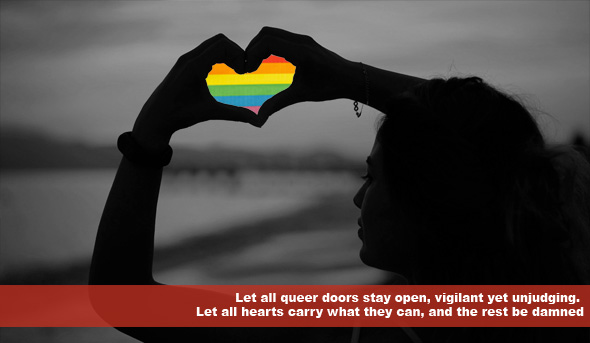
This perception is not totally unfounded because hiding is often considered a parallel to shame and internalised hate. This internalised hate has also demonstrated itself as destructive to other queer persons when it is projected. However, it is okay for that accountant to be lesbian in her heart and not tell anyone. It is okay for that dad to be a flaming queen when the lights are out and still be a responsible father to his kids and husband to his wife (should he choose to have one). It is okay for that person to choose to pass as one gender on one day and another the next, wear heels to work and canvas shoes to church. It is okay for that gay pastor, to be at peace with his interest in men, without surrendering his clergy collar. Let all queer doors stay open, vigilant yet unjudging. Let all hearts carry what they can, and the rest be damned.
The conformity of the closet vs the conformity of coming out of the closet
All queer persons, whether or not they are visibly queer and whether or not they choose to politicise their queerness, have a right to dignity, bodily integrity and privacy. As such, the same arguments and structures that protect queer persons from conforming to heteronormative standards also defend queer people from being forced into queer-normative standards. Queer normative standards include: coming out at work meetings; attending pride events; being part of queer civil society; keeping only queer friends; performative queerness; being hypervigilant about political incorrectness towards the queer community, gate keeping queerness and setting unreasonably high standards of ‘wokeness’.
Political, social and cultural visibility, while celebrated and urgently needed, should not become a currency for acceptance or legitimacy as part of the queer community. Persons who are known to express or live their queerness, however discreetly, should not be stigmatised because they do not align with certain forms of homonormative or queer-normative forms of visibility. Every person’s journey is different and should be allowed its logical and natural course and pace, even if it never transitions into the sort of visibilities that become activism.
Using a poststructuralist queer theory of self-actualisation, there is a need to consider multi-institutional relationships a (queer) person may have and acknowledge that they can be often conflicting. We need to consider their relationships (and dependencies) amongst families, states, markets, and various important institutions and how one’s role in society is connected to other institutions in which gender identities, sexualities, practices and relationships are performed.[5] In James Baldwin’s Go Tell It on the Mountain, he acknowledges the importance of deconstructing heritage, language and culture but also iterates that in the struggle for authenticity and visibility, we may fetishize our shared commonality – we begin to operate in a monolithic system that does not cater to the individual positionalities of queer persons. For example, in the fragmentations of the identity signifiers of a black gay man, making his gay and black experiences synonymous poses a danger of ignoring the consequences of his colour in a homophobic, white supremacist society.[6]
Coming out is seen as a form of currency, legitimising one’s queerness. To fight against discrimination, queer movements insist on the necessity of visibility through coming out to ascribe value to one’s queerness.[7] However, we argue that coming out is a norm that promotes an assimilationist model of queer representation which often overshadows and, in extreme cases, harms queer lives that are not or cannot be visible due to their societal role or purpose that transcends mere sexuality.[8]
Coming out propagates a western culture of “authenticity”, forfeiting the right to individual privacy in the name of community and accountability.[9] One is only authentically queer through visibilising one’s queerness. We then see a situation where the power relations that this fragmented subject is meant to deconstruct or contest are often replicated within heteronormative queer models of visibility.[10] Coming out imposes a homonormative culture of peer pressure to legitimise one’s connection to the queer community.
Coming out vs Coming home
Our human bodies are never completely silent, our expressions, our roles, often speak for us.[11] So to what end should we amplify the obvious?. `Against the numerous visibility campaigns on sexual identity and freedom, we make a plea for combining fighting for political visibility with understanding the struggle located within the private lives of queer individuals. They are engaged in precarious, ongoing, negotiations within their families, churches and nuclear communities.[12]
Queer people want to be able to come home to these spaces. Queer persons continue to exist in multiplicity of identities, and modern queer politics should go beyond homonormative and heteronormative forms of visibility that is confrontational and oppositional to a haven of choices on how to define one’s sexuality, and one’s relationship to family, community and self.[13]
[1] M Gevisser ‘The Pink Line: Journeys Across the World’s Queer Frontiers’ (2020) 14.
[2] G Asante ‘You can be gay and straight at the same time’: contextually contingent negotiations of gay and bisexual identifications among same-gender loving men in Ghana’ (2023) 90(4) Communication Monographs 417.
[3] RP Gaudio ‘Allah Made Us: Sexual Outlaws in an Islamic African City’ (2009) 9 86.
[4] K Ncube ‘Taverning after nine’ (2023).
[5] A Doucet & R Lee ‘Fathering, Feminism(s), Gender, and Sexualities: Connections, Tensions, and New Pathways’ (2014) 6.
[6] b hooks ‘Talking Back: Thinking Feminist, Thinking Black’ (1989) 125.
[7] J Cage ‘Silence: Lectures and Writings’ (1967) 10.
[8] L Gregory & P Matthews ‘Social Policy and Queer Lives: Coming out of the Closet?’ (2022) Journal of Social Policy 606.
[9] L Gross ‘The contested closet: The Ethics and Politics of Outing’ (1991) University of Minnesota.
[10] LM Walker ‘How to Recognise a Lesbian: The Cultural Politics of Looking Like What You Are’ (1993). Signs Journal of Women in Culture and Society 870.
[11] J Cage (n 7 above) 11.
[12] S Huang & DC Brouwer ‘Coming out, coming home, coming with: Models of queer sexuality in contemporary China’ (2018) Journal of International and Intercultural Communication 100.
[13] S Huang &DC Brouwer (n 12 above) 100.
About the Authors
Victoria Amaechi is a communications and advocacy associate and researcher at the Centre for Human Rights, University of Pretoria
David Ikpo is a postdoctoral fellow and communications officer at the Centre for Human Rights, University of Pretoria, South Africa
 AfricLaw
Authentic. Awesome. You guys should formally publish this. Well done Ikpo and Amechi