
Beyond obligation: The more reasons why States should keep reporting to the African Committee of Experts on the Rights and Welfare of the Child
Posted: 15 April, 2024 Filed under: Adiam Zemenfes Tsighe | Tags: advancement of children’s rights, African Charter on the Rights and Welfare of the Child, children’s rights, concluding observations, follow-up visits, National Human Rights Institutions, periodic reports, recommendations, State Party reporting Leave a comment Author: Adiam Zemenfes Tsighe
Technical Expert, African Committee of Experts on the Rights and Welfare of the Child (ACERWC).
Adopted in 1990 by the then Organisation of African Unity (OAU), the African Charter on the Rights and Welfare of the Child (the Charter), as of March 2024, has been ratified by 50 Member States of the African Union; Morocco, Saharawi Arab Republic, Somalia, South Sudan, and Tunisia are yet to ratify. Pursuant to article 43 of the Charter, Countries that have ratified the Charter are required to submit reports on the status of the implementation of the provisions of the Charter two years after ratification and every three years thereafter. The African Committee of Experts on the Rights and Welfare of the Child (ACERWC/Committee), established under article 32 of the Charter, assumes the mandate to receive and consider such reports. As of February 2024, 42 State Parties have reported to the Committee at least once while 8 State Parties have not submitted any report namely, Cape Verde, Central African Republic, Democratic Republic of Congo, Equatorial Guinea, Gambia, Libya, Mauritius, and Sao Tome and Principe. Among the 42 State Parties that have reported, 23 of them have submitted periodic reports of which 6 State Parties have submitted their second periodic reports. These 6 Countries are Burkina Faso, Kenya, Niger, Rwanda, Senegal, and South Africa. Rwanda has the highest number of reports by submitting its third periodic report to the Committee.
The State Party reporting has various stages and processes. Once States submit their reports, civil society coalitions working on children’s rights in the State under review may submit complementary reports to the Committee. Moreover, National Human Rights Institutions (NHRIs) could also submit alternative reports. The Committee convenes a pre-session to undertake a preliminary examination of the State Party report and draw a list of issues that require clarification from the State. The Committee sends the list of issues to the respective State, and the State submits its replies to the list of issues which will pave the way for better engagement during the constructive dialogue. The Committee then invites States to one of its Sessions where it will hold constructive dialogue with the representatives of the States. Following the conclusion of the consideration of the report, the Committee issues concluding observations and recommendations to the States whereby it highlights the main commendable progress achieved and concerns that it has on the implementation of the Charter and provides recommendations for enhanced implementation of the Charter. Furthermore, the Committee undertakes follow-up visits to the States to monitor the implementation of its concluding observations and recommendations.
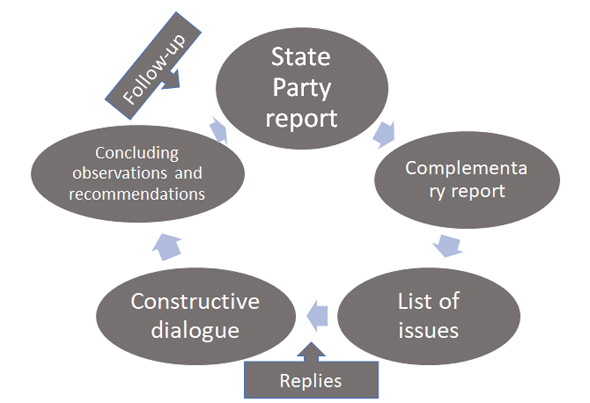
Summary of the State Party reporting cycle
The State Party Reporting Procedure is indeed time and resource intensive. The information that should be captured in the State Party report is mostly scattered among the various sectors; hence, needs to be gathered and analysed. Issues of children’s rights are multi-sectoral, involving multiple ministries and government organs in the process of implementation. Therefore, the State Party reporting process entails efforts to systematically analyse the information gathered from the various sectors and ensure that the information feeds into the clusters for State Party Reporting to the Committee. State Parties ought to follow a consultative process whereby States consult with children and various stakeholders on the issues to be reported so that more accurate reports can be submitted to the Committee. Subsequent to the submission of the report, State Parties send a high-level Delegation for the consideration of their reports by the Committee during one of its sessions. This begs the question as to why State Parties invest this much human and financial resources towards the preparation and submission of reports on the implementation of the Charter to the Committee on a periodic basis.
The obvious response is that it is State Parties’ obligation to submit reports according to article 43 of the Charter. However, it is also important to understand the objectives behind this obligation of State Party reporting to ensure that the objectives of the requirement are met on one hand and to ensure that reporting is not a mere obligation but a process from which State Parties benefit on the other hand.
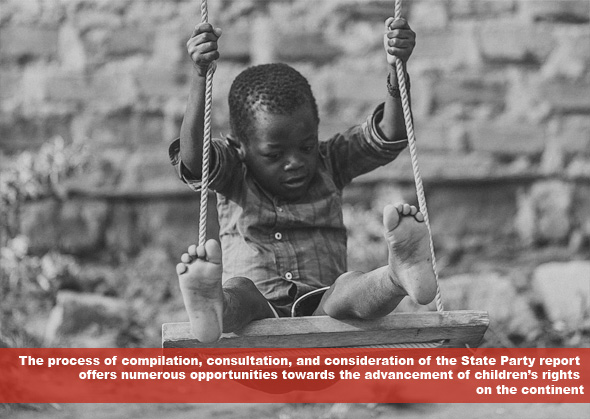
The process of compilation, consultation, and consideration of the State Party report offers numerous opportunities towards the advancement of children’s rights on the continent, including those highlighted below.
- Raising awareness about the Charter and the Committee at the domestic level among stakeholders: The preparation of State Party reports on the implementation of the Charter creates an opportunity to prompt conversations about the Charter itself and how it can be domesticated and implemented at the country level. Such consultations further create an opportunity to raise awareness about the provisions of the Charter as well as the mandate of the Committee.
- Mainstreaming children’s Rights: child-rights based approach in the crafting and implementation of legislation and policies is key to achieving enhanced protection and promotion of children’s rights. However, children’s rights are not mainstreamed in all sectors and not all stakeholders adopt child rights approach in their undertakings. The preparation of State Party reports involves gathering information from various sectors including how children’s issues are prioritized in their budgeting and activities. In this process, various sectors will have to assess how they have mainstreamed children’s issues in their planning and executions, thereby alerting them to give such emphasis in their future activities. This will eventually create a space for mainstreaming children’s issues in various sectors.
- Monitoring and evaluation: A regular assessment of how children’s rights are being implemented at the domestic level is crucial, yet children’s rights issues are mostly neglected across sectors. Therefore, the State Party reporting is one mechanism for States to assess their laws, policies, and implementation activities and how they speak to the internationally recognized child rights standards. If done properly, the State Party reports are dynamic resources in evaluating the level of the realisation of children’s rights. State actors and other stakeholders can utilise the information provided in the reports to identify priority areas of investment on children’s issues.
- Resource mobilisation: The findings of the State Party reports provide information about where more investment is needed. The achievements of the State Party within its available resources and the gaps identified in terms of the various clusters attracts the attention of possible funders on how to invest on children’s issues as well as which areas to prioritise. The Government can also rely on the concluding observations and recommendations of the Committee to mobilise resources.
- Experience sharing among other countries: Through the submission of their State Party reports, countries are sharing their best experiences with others and showcasing how they are addressing some of the challenges they are facing in implementing the Charter. The Committee makes all State Party reports publicly available on its website to facilitate the utilisation of the reports by other countries and stakeholders.
- Participation of stakeholders and children: State Parties often undertake consultation with children, CSOs and other stakeholders while preparing their reports. Such consultations encourage various stakeholders to be part takers in the implementation of the Charter. As there is often limited room for children’s and stakeholders’ engagement, the process of developing State Party reports offers platforms for enhanced participation. Leveraging on this gateway, the participation of children and stakeholders can further be nurtured and enhanced by building on the momentum.
- Commitment and high-level attention for children’s rights: In availing resources for the development of State Party reports as well as the consideration of the report by the Committee, State Parties are portraying their commitment and high-level attention to children’s rights. The Consideration of State Reports gets attention from various high-level officials and Ministries in a State Party that determine the budget allocated for children’s rights, legal reform, and other issues. Moreover, the consideration of any State Party report is reported to the Executive Council of the African Union by the Committee. Therefore, State Party reports and their consideration by the Committee can be an entry way to raise critical issues of children’s rights among decision-makers at the highest level possible.
- Receiving guidance and recommendations from the Committee and the Executive Council: Following the consideration of State Party reports, the Committee issues concluding observations and recommendations where it highlights the main progress achieved, challenges faced and provides recommendations on the measures that should be undertaken to overcome the challenges. The Committee further includes its main findings of the consideration of a State Party report in its activity report to the Executive Council of the AU. The Executive Council also provides recommendations to the States concerned based on the issues identified by the Committee. These recommendations provide law and policymakers as well as implementers the various measures that should be adopted to enhance child protection. The recommendations also provide focus areas for other stakeholders and a basis to hold governments accountable.
Finally, it is paramount that the Committee also makes the State Party reporting procedure less burdensome and more worthwhile to encourage States to report and benefit from the process. The Committee has taken a step by allowing States to adapt the report they submitted to the UN Committee on the Rights of the Child to the context of the Charter. In addition, the Committee has to ensure that the Consideration of the State Party report provides States with an opportunity to benefit from the expertise of its members as well as the best practices documented by other States.
About the Author:
Adiam Zemenfes Tsighe is a legal professional with a focus on human rights and child rights with over 9 years of experience working on children’s rights within the African human rights mechanisms. She holds a Master of Laws in Human Rights and Democratisation in Africa from Center for Human Rights, University of Pretoria. She is currently working as a Technical Expert at the African Committee of Experts on the Rights and Welfare of the Child (ACERWC).
 AfricLaw