
Why Uganda’s LGBTQ court ruling is a stain on the country and the continent
Posted: 11 April, 2024 Filed under: Nimrod Muhumuza | Tags: constitutional principles, democracy, equality, homosexuality, human dignity, LGBTQ community, LGBTQ persons, mental health, right to health, right to housing, sexual orientation, social justice, Uganda, Uganda Constitutional Court Leave a comment Author: Nimrod Muhumuza
Doctoral researcher
Introduction
Stories about “trials by ordeal” abound in Africa and worldwide. In some parts of the continent, these “trials” still exist – with predictably unjust and sometimes fatal results. Trials by ordeal are capricious and unscientific, and the overall system is poor in evaluating evidence, reasoning, and arguments and arriving at a solid judgment. Today, we have a system of courts that is supposed to bring a certain sobriety, meticulousness, reasoning, and coherent judicial philosophy that rises above the occasional hot-headedness of the legislature or the overzealousness of the executive. Regularly, the system works as it should. Other times, it does not. Careful and solid judicial reasoning can still lead to a regressive and disputed decision, and a progressive ruling may come from poor and shaky rationale. Sometimes, a regressive decision may be founded on porous, incoherent, contradictory reasoning, as illustrated by the Uganda Constitutional Court’s (Con-Court) decision on the constitutionality of the Anti-Homosexuality Act, 2023 (AHA), delivered on 3 April 2024.
The Con-Court decision is one of the most cynical exercises of judicial power in recent times, often contorting legal logic and evidence out of shape to arrive at its conclusions. The Con-Court upheld the bulk of the AHA on grounds that it was necessary to protect Ugandan culture and the country’s values, that the law was required to protect the family and to prevent the “recruitment” of children and “gullible adults” into homosexuality. The Con-Court also found that the inherent and inalienable rights of LGBTQ persons – save for the right to health – were subordinate to those of the wider public, the so-called communitarian interests. It upheld the law’s punitive provisions, including the death penalty, for so-called “aggravated homosexuality.” A summary of the ruling can be found here.
On the protection of “Ugandan values.”
The issue before the Con-Court was a weighty but simple one, in my view: to determine the constitutional and citizenship rights of members of the LGBTQ community. The Con-Court needed to develop or rely on a coherent judicial philosophy to help us understand its reasons and decisions. The justices paid short shrift to the rights, dignity, and humanity of the individuals and communities this law tries to erase. It would have been beneficial if the Con-Court had helped us understand and articulate the “Ugandan values and culture” against which the law was upheld. Instead, the Con-Court deferred to the legislature’s vociferous approval of the law as evidence that Ugandans had, through their representatives, expressed their views on the matter. The Con-Court chose to ignore the voluminous binding and persuasive jurisprudence to the effect that constitutions and courts, as their handmaidens, exist to protect minorities from majoritarian tyrannies. The fact that Uganda’s parliament overwhelmingly passed the AHA did not give anyone carte-blanche to run roughshod over the rights protected by the Constitution. It certainly is not evidence of Uganda’s values. In selectively citing the Constitution’s Preamble, the Con-Court did not recount Ugandan’s recognition of “tyranny and oppression” as we strive towards a society based on the principles of “unity, peace, equality, democracy, freedom, social justice and progress.” [emphasis added]. This decision completely turns these constitutional principles on their head.
Individual rights and communitarian interests
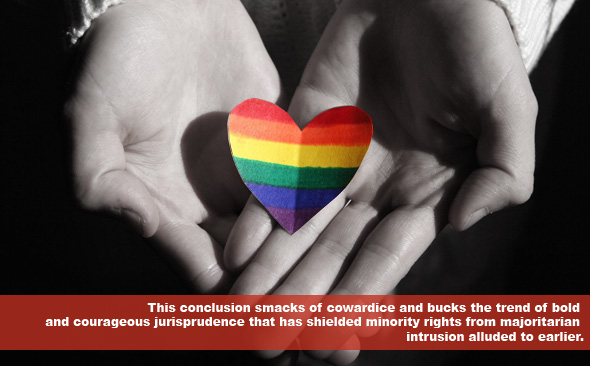
The Con-Court’s specious reasoning continued in its attempts to draw a mutually exclusive dichotomy between individual rights and communitarian interests when it comes to LGBTQ persons. It argued that the right to human dignity and all other inalienable and inherent rights were “pitted against communal rights and interests.” [emphasis added]. The Con-Court did not attempt to explain why these ostensibly competing rights could not co-exist or, indeed, why these rights could not strengthen each other instead of cancelling each other out when it came to LGBTQ persons. Aren’t LGBTQ persons subscribers to existing culture, religion, tradition, and customs in Uganda? Are they not part of the family that Parliament and the Con-Court were so eager to protect? To extend this spurious logic to its conclusion, would that mean atheists/blasphemers have no place in Ugandan society due to its passionate reverence for faith and religion? The Con-Court alluded to the need to forestall social upheaval should the law be struck down in its entirety. This conclusion smacks of cowardice and bucks the trend of bold and courageous jurisprudence that has shielded minority rights from majoritarian intrusion alluded to earlier.
Nature v nurture
There has been significant “debate” about the nature and origins of one’s sexual orientation in Uganda. This was one of the questions that the Con-Court had to contend with. Given its importance to the debate on the AHA’s constitutionality, particularly its implication on the right to dignity and equality, one would have expected the Con-Court to spend considerable time examining the issue – canvassing the best evidence available before reaching its conclusion. The Con-Court relied primarily on affidavit testimony from a renowned homophobic pastor who claimed to have counselled some individuals who were previously homosexual but were no longer of the orientation as a result. This was in addition to the testimony of another individual who claimed to be “ex-gay.” Ignoring the totality of credible scientific evidence, academic literature or expert reports to the contrary, the Con-Court settled a hotly contested issue (in Uganda, at least) on this dubious evidence, finding that it “unraveled the proposition that homosexuality is innate.” [emphasis added] It also chose to selectively cite and deliberately misinterpret the work of Prof Sylvia Tamale, one of the petitioners against the legislation for its conclusion that sexual orientation is not innate.
On the right to health
Court annulled some of the law’s provisions on the grounds that it would violate LGBTQ persons’ right to health and the right to the highest attainable standard of living. It is baffling that the Con-Court reasoned that breaching professional privileges and denying LGBTQ persons the right to housing would exacerbate the communities’ “established vulnerabilities” concerning mental health. The Con-Court displays a brazen lack of self-awareness as to the effects of its own decision to uphold the bulk of the AHA, including its findings that the law did not violate the dignity, humanity, right to equality, freedom from discrimination and other protections, on the mental health of LGBTQ persons. Why would the learned justices of the Con-Court presume LGBTQ persons would be safe anywhere and everywhere else in Uganda except the doctor’s office? There is plenty of credible evidence to the contrary. The Court does not convincingly explain this selective application of constitutional rights – but a theory is explored in the next section.
The fig leaf: partial annulment of the law and other absurdities
Nullifying some provisions of the law that violate the right to health, having earlier ruled that LGBTQ persons do not enjoy rights to dignity, equality, freedom from discrimination, or other rights protections, does not make sense. Not until you realise that this was probably a ruse by the Con-Court and the government to forestall potential financial sanctions and to unfreeze donor funding, particularly to the Ministry of Health. The Con-Court brazenly admits as much in paragraph 527 of the ruling, observing that richer nations would do well to extend support to HIV/AIDS prevention strategies proposed by UNAIDS, coincidentally the only amicus curiae it granted audience to. The ruling, engineered as it was to balance between satiating the legislature’s homophobia on the one hand and fulfilling the conditions set by the Uganda government’s foreign partners/donors on the other, is a cautionary tale of what is likely to happen if international solidarity for vulnerable groups is reduced to a box-ticking exercise. Governments will ensure the boxes are checked without meaningful changes for constituent and beneficiary communities.
Several other absurdities will arise from this ruling, but allow me to highlight and conclude with a few. In paragraph 396, the Con-Court ruled that freedom of expression does not extend to the demonstration of sexual intimacy, likely both in the public and private spheres. This is presumably due to Ugandan’s aversion to homosexual displays of affection, even in the safety of their private dwellings. Unwittingly, given the broad and uncalibrated nature of the Con-Court’s finding on this issue, it could potentially outlaw public displays of the expression of affection among heterosexual couples as well. Secondly, one of the most egregious opinions of the Con-Court was its comparison of sexual orientation to crimes, particularly incest, bestiality, and rape. The Con-Court reasoned that permitting the expression of sexual autonomy among consenting LGBTQ adults is a slippery slope that could potentially lead to the agitation for the “normalisation” of these crimes. The Con-Court, of course, offered no evidence for this assertion, especially from countries in Africa and abroad where LGBTQ rights have been guaranteed, to indicate if these fears have been realised. The court’s argument was and will continue to be speculative.
Conclusion
The Con-Court’s decision is a regressive one for societies that are as diverse as Uganda and will no doubt be a setback for sexual and gender-diverse persons in the country. The petitioners have indicated their desire to appeal – and they should, given the paucity of the Con-Court’s reasoning on these issues, as I’m sure will be further highlighted in the days and weeks to come.
About the Author:
Nimrod Muhumuza is a researcher in sexual and reproductive health and rights. He is also one of the applicants challenging the AHA at the East African Court of Justice.
 AfricLaw