
Perpetuating Patriarchy via Polygamy: Gaps in Legal Pluralism, the case of Afar and Somali regions of Ethiopia
Posted: 15 March, 2024 Filed under: Rehim Baharu Elala | Tags: child marriage, Civil Code, Deputy Chief Commissioner for Women and Children Affairs, discrimination against women, Ethiopian Constitution, Ethiopian Human Rights Commission (EHRC), family relations, Federal Family Law, fundamental rights, Harmful practices, human rights, human rights violations, polygamy, right to equality, right to health, the right to bodily integrity, traditional practices, women’s marital rights, women’s rights Leave a comment Author: Rehim Baharu Elala
Human rights attorney and women’s rights advocate
A Somali man should at least have three wives: one to raise the children; a second woman for the housework; and a third one whom he can beat as a warning to the others – An old Somali proverb
The above proverb reflects the societal mindset towards polygamy and the wrong perception towards women’s marital rights. This is besides the cultural and religious influences on women to engage in polygamous marriage both in the Afar and Somali regions. Inequality in the family underlines all other aspects of discrimination against women and is often justified in the name of custom or religion. To eliminate discrimination against women in all matters relating to marriage and family relations, states are expected to take all appropriate measures.[1]
The 1995 Ethiopian Constitution guarantees equal rights for women with men in marital, personal, and family matters under article 34. The frequent mention of equality of men and women in all family relations arises from the need to combat traditional practices based on customary or religious notions that perpetuate discrimination against women.[2]
The Federal Family Law was also revised to make it compatible with Ethiopia’s obligations under international instruments as well as the Constitution. Regional governments followed the footsteps of the federal government and adopted their own family laws apart from Afar and Somali regions. As a result, the two regions continue to settle family disputes on the basis of the outdated provisions of the Civil Code. In addition to the discriminatory provisions of the Civil Code. The civil code makes the husband the maker and breaker of everything in relation to the marital union.[3] The woman’s role is limited to obeying him and discharging her duties on the domestic sphere i.e., rearing and raising of children whereas the husband is considered as the family’s bread winner and the only source of income. Women have a very limited role in the management and decision-making in relation to the family. The Code clearly states that women are required to participate under the guidance of the husband for the interest of the family, to ensure the moral and material direction of the family.[4] The upbringing of children and establishment of their common residence is also determined by the husband.[5] Moreover, the husband was assigned as the wife’s protector under the civil code.[6] This is an extension of the subordinate status of the woman in marriage built on the Islamic and Christian teachings that requires the woman to submit to their husband.[7] Under the code, the husband is expected to watch over her relations and guide her in her conduct, provided this is in the interest of the household, without being arbitrary and without vexatious or other abuses.[8] This equates the woman with a minor child and goes against the rights given to a capable person that entered into a marriage based on her free and full consent. In situations when the husband is unable to provide for a servant that can discharge household duties, the wife is bound to attend the household duties by herself.[9] This is against the equal rights of the spouses in marriage as it makes the woman dependent on her husband and limits her opportunity to take part in a gainful employment. The 1995 Ethiopian Constitution under article 34(5) leaves the door open to the application of religious and customary norms in deciding disputes relating to personal and family matters with the prior consent of the parties. As part ensuring gender equality, Ethiopia is expected explore ways to redefine cultural and religious norms in ways that reflect its commitment for women’s rights.
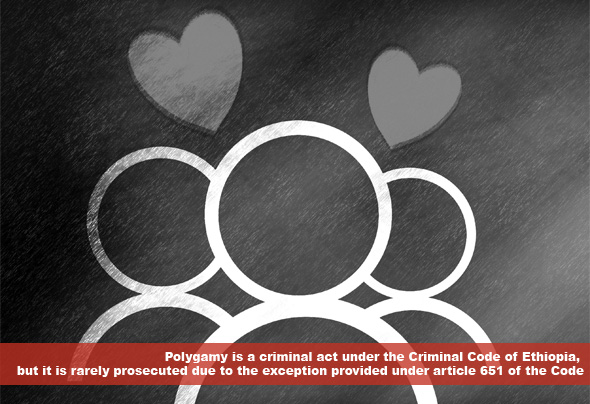
Polygamy is a criminal act under the Criminal Code of Ethiopia[10], but it is rarely prosecuted due to the exception provided under article 651 of the Code.[11] This makes Afar and Somali regional governments lenient in tackling polygamy and coming up with a new family law that ensures marital equality for women.[12] As a result women in those regions continue to face discrimination mainly in personal and family affairs. What makes the scenario worse is that both regions contain predominantly Muslim communities and practice polygamy at a very high rate.
Legal pluralism and the negative human rights Implications of the 1960 Civil Code
As stated above, the Constitution permits the parallel application of religious Shari’a Law simultaneously with the secular state law. But there is a substantial difference and conflict between the two systems that mainly undermines women’s fundamental rights. Polygamy has several human rights consequences for both Afar and Somali women. It violates the basic rights women including the right to equality, life, the right to bodily integrity, the right to health and privacy.[13] The failure of the two regional states to enact a new family law has a significant negative effect on the protection as well promotion of women’s rights. Courts are resolving personal and family disputes by applying the 1960 Civil Code. As a result, harmful practices like child marriage and polygamy are still widely persistent in the two regions.
Lobbying and Advocacy Efforts for a New Family law
- Ethiopian Human Rights Commission
The Ethiopian Human Rights Commission (EHRC) was established pursuant to article 55(14) of the Constitution. Its main duty is to ensure that human rights are respected by all citizens, organs of state, political organisations as well as by their respective officials.[14] It has also a responsibility to make sure that laws, regulations, government decisions and orders do not contravene the human rights of citizens guaranteed by the Constitution.[15] In addition to the role to protect human rights, the commission has the duty to promote human rights.
In relation to protecting and promoting women’s rights the Commission had established a women’s and children unit headed by the Deputy Chief Commissioner for Women and Children Affairs,[16] which is responsible for investigating alleged human rights violations involving women and make recommendation for the concerned authorities to take corrective measures.[17] In its promotional role, the unit is responsible to make accessible human rights instruments related to women in local languages and organise human rights awareness raising events.[18] The Commission has the mandate to challenge the application of the 1960 Civil Code in Afar and Somali regions and can require the two regional governments to come up with the version of the Revised Family Code.[19]
The Commission works closely with UN women in different projects by involving key stakeholders that work in government, Civil Society Organisations (CSOs), and religious leaders for the adoption of a new family law in both regions.[20] But the progress so far is very slow, this is mainly due to the strong resistance and challenge that comes from the religious and customary leaders as well as top government officials.[21] In the consultative events that I was part of, religious leaders identified major areas of disagreement between the Shari’a law and proposed that the future draft family law should recognise polygamy.[22]
- Ethiopian Women’s Lawyers Association (EWLA)
The Ethiopian Women Lawyers Association is a prominent non-profit organisation established in 1996.[23] It was founded by the former President of the Federal Supreme Court Meaza Ashenafi, who served as its first executive director for a decade.[24] The Association has actively engaged in influencing laws and policies since the time of its inception. The association has been playing an instrumental role in increasing access to justice for women, representing them in court matters and advocating for women’s right to equality in every aspect. EWLA and its members played an active role during the adoption of the Revised Family Code and the 2004 criminal code of Ethiopia.[25]
EWLA was involved in a very famous inheritance case that went all the way to the House of Federation for Constitutional interpretation.[26] The case was between Mrs. Kedija, a mother of three who lost her husband, who was from a polygamous marriage.[27] She was sued by the children at the Shari’a court over inheritance of a house. Mrs. Kedija invoked her constitutional right under Article 34(5), refused to submit to the authority of the Shari’a court and opted to settle the case before a secular court of law. But the Shari’a courts defied the consent requirement and decided to try the matter. Mrs. Kedija then took the matter to High and Supreme Courts of Shari’a, which reaffirmed the decision of the lower court. Finally, EWLA decided to take the matter before the House of Federation, which is the ultimate organ to deal with issues of constitutional interpretation. EWLA alleged that the Shari’a Court’s interpretation of Article 34(5) of the Constitution set a bad precedent that could lead to a violation of Muslim women’s human rights.[28] The House of Federation acknowledged the basic error in constitutional interpretation by the Shari’a courts and gave a judgment in favor of Mrs. Kedija to take her case to a secular court of law.[29]
- The UN Women Ethiopia Country Office (ECO)
The UN Women Ethiopia Country Office is actively working with the Ethiopian Human Rights Commission and other governmental agencies towards the adoption of family laws in Afar and Somali regions. The office has a primary responsibility of helping Ethiopia to meet its responsibility of ensuring gender equality outlined in both the national policy directions and the Sustainable Development Goals (SDGs).[30] In order to facilitate the adoption of a family law, the office developed a three year project which was implemented in both Afar and Somali regions. In collaboration with Ministry of Women and Children Affairs, it had also conducted a survey that assessed the socioeconomic status of women and factors that are hindering the participation of women in social, political and economic levels.[31]
Ways forward for optimum social change and substantive equality in Afar and Somali Regions
- Enacting new family laws
In order to achieve substantive equality, the first step is taking legislative measures. To that end both Afar and Somali regional governments should adopt and implement a version of the Revised Family Code to promote equality in marriage and dissolution. While promoting monogamy, both regional governments need to adopt measures that can protect the rights of women in de facto polygamous unions, as encouraged by the Maputo Protocol. The best strategy to that end will be developing a regional action plan that enhances the effort to adopt a new family laws in Afar and Somali regions.
- Interpreting the Holy Quran in a way that protects the Rights of women
Polygamy in both regions is deeply rooted and is mostly justified on the basis of the wrong interpretation of the Holy Qu’ran. The two regions must devise a strategy to address polygamy in a way that can foster the gradual eradication of the practice by looking for women-centric interpretation and application of the Holy Qu’ran, which is more consistent with women’s rights.
- The need for a consistent precedent by the Federal Supreme Court on polygamous marriage
The rule setting practice by courts in dealing with polygamous union is thus far inconsistent and violates women’s rights. As a result, there should be a for clear guidance from the courts. In most family disputes involving co-wives, the courts allocate a lesser share for the women i.e., a quarter for each woman (in cases where the husband has more than two wives) while the husband or his heirs get half of the common property. This is clearly against the principle of equality and encourages men to engage in polygamous relations.
- Adopting measures to protect the rights of women in de facto polygamous marriage in Afar and Somali regions
Both the Constitution and CEDAW require Afar and Somali regions to promote monogamy. In doing so, they should also adopt measures that can protect the rights of women in de facto polygamous unions. The Maputo Protocol under article 6(c) requires states to encourage monogamy but at the same time it takes into account the practical reality of many African States and allows them to protect such women. As change is gradual, it will be very difficult to impose monogamy immediately on the society. It would be ideal to draft a law that takes into consideration the existing reality and protect those who are already in polygamous unions.
- Increased promotional roles of National Human rights Institutions
The Ethiopian Human Rights Commission needs to exercise its mandate to recommend the enactment of family laws in both regions. The commission must facilitate and enhance its efforts to lobby and advocacy efforts together with EWLA, UN-Women and other governmental and NGOs. It should also effectively utilise its promotional mandates to create awareness about the impact of polygamy on women’s rights among customary and religious leaders in Afar and Somali women. Promoting the rights of women recognised under the international, regional and national instruments will enable women to invoke and seek redress when they face a violation.
Apart from the role in the promotion of human rights, the Commission should advise the Federal Government to remove the reservation to article 6(C) of the Maputo Protocol, a provision that perfectly fits into protecting women living in already de facto polygamous unions across the country. This can be easily achieved by recognising the rights of women in de facto polygamous unions in the legal framework.
The Regional Councils should also take the initiation to organise stakeholders’ consultations at regional level that can bringing together diverse regional actors, including federal ministerial offices, regional bureaus and NGOs. The State Councils should also utilise religious and customary leaders as agents of change both in the adoption process of the family laws and to interpret the religious tenets in a way consistent with the human rights of women provided under the secular law. Finally, Regional Councils should ensure that the consultations include an equal representation of women from the various institutions and organisations to ensure that an enable environment is established that allows women to participate alongside men in decision-making at all levels.[32]
[1] Article 16 of the Convention on the Elimination of all forms of Discrimination Against Women, available at https://www.un.org/womenwatch/daw/cedaw/text/econvention.htm
[2] See Articles 25, 34(1), and 35(1) of the Constitution.
[3] As per article 635(1) of the Civil Code the husband is the head of the household. The wife was also expected to owe him obedience in all lawful things which he orders.
[4] See Article 637(1) of the Civil Code.
[5] See Article 637(1) of the Civil Code.
[6] Article 644(1) states that “The husband owes protection to his wife”.
[7] See Ephesians 5:23, which reads “For the husband is the head of the wife as Christ is the head of the church; and He is the Savior of the body”. Therefore, just as the church is subject to Christ, so let the wives to their own husbands in everything.
İn Islam, Surah An-Nisa verse 34 provides: “Men are caretakers of women, since Allah has made some of them excel the others, and because of the wealth they have spent. So, the righteous women are obedient, (and) guard (the property and honor of their husbands) in (their) absence with the protection given by Allah. As for women of whom you fear rebellion, convince them, and leave them apart in beds, and beat them”.
[8] See 644(2).
[9] See article 646 of the Civil Code.
[10] Article 650(1) of the Criminal Code provides:
Whoever, being tied by the bond of a valid marriage, intentionally contracts another marriage before the first union has been dissolved or annulled, is punishable with simple imprisonment, or, in grave cases, and especially where the criminal has knowingly misled his partner in the second union as to his true state, with rigorous imprisonment not exceeding five years.
[11] When polygamy is committed in conformity with religious or traditional practices recognised by law it will not be a criminal act [emphasis added].
[12] The first promise that states make in joining CEDAW and other international instruments to take legislative measures so as to make the national norms compatible with their international obligation.
[13] OHCHR | Sexual and reproductive health and rights. It covers all sets of rights that are covered under the major Human Rights instruments including the ICCPR, ICESCR, and CEDAW. Available at https://www.ohchr.org/en/issues/women/wrgs/pages/healthrights.aspx
[14] Article 6(1) of the Ethiopian Human Rights establishment proclamation 210/2000.
[15] Id.
[16] Article 8(2)(c) of the Ethiopian Human Rights Commission establishment proclamation 210/2000 and Article 2(1) of the amendment proclamation1224/2020.
[17] Directive issued by the Commission regarding the power and responsibilities of each unit in 2002.
[18] Proclamation 210/2000 at article 6(8). One of the powers of the Commission is to translate into local vernaculars, international human rights instruments adopted by Ethiopia and disperse the same.
[19] Id, art.6(5).
[20] As I was a member of the Commission since 2015, there were many workshops, consultations and advocacy efforts by the Commission and other stakeholders.
[21] Polygamy, inheritance and adoption are the major areas of disparity between the secular and Sharia prcepts that are raised by religious leaders in the consultative events between 2015-1018 in both Afar and Somali regions.
[22] As a member of the Ethiopian Human rights Commission team, I have participated in workshops and consultative engagements with Afar and Somali religious, customary, political leaders, women’s group organisations and scholars for three consecutive years.
[23] Article 31 of the 1995 Constitution is the first law that recognises the right to association for any cause or purpose.
[24] She is currently serving as the Chief Justice of the Federal Supreme Court. She also played a very active role in the adoption of the 1995 Constitution, the Revised Family Code and the Criminal Code of 2004.
[25] Mehari Redae, Some Points in Understanding the Revised Family Code , 1, 150 (2003) [Amharic Version]. EWLA strongly insisted for the criminalisation of marital rape but due to the patriarchal set up of the drafting commission their proposal was rejected and marriage is still a license to rape in Ethiopian context. Ewla also succeeded in raising the penalties for crimes of rape, abduction, early marriage and FGM practices.
[26] Meaza Ashenafi and Zenebework Taddesse, Women, HIV/AIDS, Property and Inheritance Rights: The Case of Ethiopia 22 (2005), available at https://www.undp.org/content/dam/aplaws/publication/en/publications/hiv-aids/women-hiv-aids-property-and-inheritance-rights-the-case-of-ethiopia/23.pdf
[27] Id.
[28] See article 83 of the Constitution that give House of Federation the power on constitutional disputes.
[29] Meaza Ashenafi and Zenebework Taddesse, Women, HIV/AIDS, Property and Inheritance Rights: The Case of Ethiopia 22 (2005), available at https://www.undp.org/content/dam/aplaws/publication/en/publications/hiv-aids/women-hiv-aids-property-and-inheritance-rights-the-case-of-ethiopia/23.pdf
[30] https://africa.unwomen.org/en/where-we-are/eastern-and-southern-africa/ethiopia
[31] Ministry of women and Children Affairs and UN Women Ethiopia Office, Assessment of the General Socio-Economic Status of Women and Girls in Afar and Somali Regions: Barriers hindering the Adoption of Family Law, 1-93 (2020).
[32] Ministry of women and Children Affairs and UN Women Ethiopia Office, Assessment of the General Socio-Economic Status of Women and Girls in Afar and Somali Regions: Barriers hindering the Adoption of Family Law,1, 69 (2020).
About the Author
Rehim Baharu Elala is a human rights attorney and women’s rights advocate based in Ethiopia. Before obtaining his law Master of Laws degree from Georgetown University in 2021, he was already dedicated to challenging local norms surrounding men’s involvement (or lack thereof) in feminist organising. First advocating for gender equality at his school’s legal aid office, Rehim went on to assist in landmark cases that established more equitable approaches in divorce proceedings in Ethiopia. His commitment to improving Ethiopia’s legal and cultural protections for women and children continues today. In addition to litigating cases on behalf of survivors in his community, Rehim’s role at the Ethiopian Human Rights Commission involves monitoring the living conditions of children forced to live in prison with their incarcerated mothers. Rehim is currently working as Resettlement Expert with UHNCR Cairo. His current role involves conducting resettlement interviews, undertaking Best Interest Assessment for children for third country durable solutions, drafting resettlement referral forms (RRFs) and reviewing RRFs when needed.
 AfricLaw