
Unpacking the Race to Zero Campaign and its Impact on the realisation of the right to development in Africa
Posted: 2 February, 2024 Filed under: Elim Shanko | Tags: African Charter of Human and Peoples Rights, climate challenges, climate justice, cyclones, decarbonisation strategy, devastating droughts, development goals, Disaster Risk Reduction reports, energy justice, energy-poor zones, GHG emissions, global crisis, Just Transition, over-consumers, Paris Agreement, Race to Zero Campaign, renewable sources, right to development, sustainable development, sustainable future Leave a comment Author: Elim Shanko
Sustainable development consultant, RA Consulting
Introduction
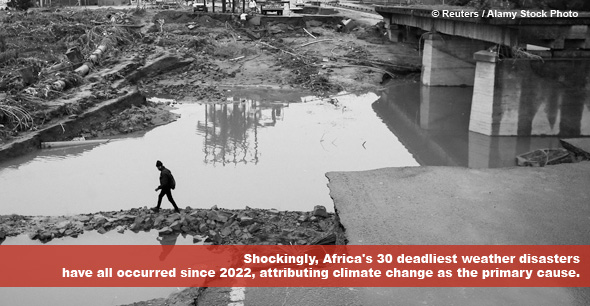
The African continent, recently grappling with unprecedented climate challenges, finds itself at the forefront of a global crisis. From devastating droughts to intense cyclones, the impacts have been severe, costing lives and disrupting economies. The United Nations Office for Disaster Risk Reduction reports that climate catastrophes cost Africa 12.3% of its GDP between 2015 and 2021. Shockingly, Africa’s 30 deadliest weather disasters have all occurred since 2022, attributing climate change as the primary cause. Thus, the Race to Zero (RtZ) campaign emerges as a key player in the pursuit of a sustainable future. This article critically examines the campaign’s structure and its implications for Africa’s unique challenges, questioning its alignment with principles of climate justice, energy justice, and a just transition and ultimately assessing its impact on the realisation of the right to development.
Frameworks for evaluation
‘Net Zero’ is a carbon neutrality target that aims for all greenhouse gas (GHG) emissions to be reduced to zero, with any additional emissions being reabsorbed by the year 2050. Underneath its umbrella is the ‘Race to Zero Campaign’, a UN-led global campaign for a healthy zero-carbon recovery. The ‘Climate Justice’ movement acknowledges the disproportionate climate impacts on the Global South and the culpability of states from the Global North for predominately causing the crisis to begin with. Energy Justice advocates for the just distribution of responsibilities, burdens, and privileges in energy consumption and production; while the ‘Just Transition’ calls for an equitable shift to renewable energy sources that ‘affirms Africa’s right to development and industrialisation based on the […] language of equity and the principle of common but different responsibilities and […] capabilities’.
Two prominent international norms buttress Africans’ rights to sustainable development and a healthy environment, the Paris Agreement (PA) and the African Charter of Human and Peoples Rights (Charter). The PA, underscores the importance of human rights, health, and development considerations in climate actions. Emphasising equity, it acknowledges ‘common and different responsibilities and respective capabilities in light of different national circumstances’. The Charter, however, explicitly reinforces rights to equitable and sustainable development, positioning Africa as a progressive force in advocating for inclusivity amidst climate challenges.
Current Progress and African Participation
Globally, 193 states, the EU, businesses, and CSOs participate in the RtZ. However, current global net zero targets only account for a future reduction of approximately 76% of global emissions, while actual national climate plans would lead to an increase of almost 11% in GHG emissions. Although 49 African countries signed the Paris Agreement, only South Africa and Malawi have committed to achieving net zero by 2050. The temptation to slate African countries for a tepid investment in global net zero efforts must be tempered by questioning the campaign’s alignment with Africa’s priorities and capabilities to begin with. The reality is that 50% of the world’s GHG emissions come from seven nation-states: China, the United States, India, the EU, Indonesia, the Russian Federation and Brazil, while the entire African continent is responsible for only 2-3%. Thus, a closer look at the RtZ’s incompatibilities with African priorities can provide a clearer picture as to why African states are poor participators.
RtZ Gaps: Unravelling the Challenges
One glaring gap of the RtZ campaign lies in its inability to resonate with the energy poverty crisis faced by over 640 million Africans, the lowest energy penetration rate globally. Fixated on a global transition to renewable sources, the RtZ seemingly ignores that many African nations are not burdened with energy overconsumption but rather struggle to meet basic energy needs. A climate justice and human rights approach requires a shift from a universal transition to targeted initiatives, prioritising the electrification of energy-poor zones and urging over-consumers to reduce their consumption.
Inadequate Africa-specific data also poses a significant challenge to planning the clean energy transition. Current data practices either clump African countries together, or with Middle Eastern nations, overlooking resource and socio-economic differences. Considering Africa’s development goals, the continent is likely to increase GHG emissions over time, not reduce them. Since most models focus on decarbonisation as the main goal and fail to lay out strategies for low-emissions industrialisation, they are irrelevant to the African trajectory, and ultimately endanger the realisation of the right to sustainable development and the success of the net zero agenda. This dearth of African-specific data not only underscores the global approach’s exclusivity but also fails to meet the requirements of a climate justice approach.
Additionally, the RtZ campaign lacks a clear cooperative plan for development, particularly concerning Africa’s industrialisation and development needs. Divergent views among African leaders on adaptation financing, compensation for loss and damage, and energy source portfolios reveal a lack of consensus on the continent’s priorities. The absence of an inclusive decarbonisation strategy enables disparate approaches that may perpetuate underdevelopment, and climate injustice, and hinders the achievement of global GHG mitigation goals.
Threats to Africa’s Development Trajectory:
A critical oversight of the RtZ is its lack of acknowledgment concerning the economic impact on Africa’s exportation market. Hydrocarbon exports constitute 48.5% of exports. Since the RtZ fails to provide an economic strategy for such vulnerable markets, it risks the fiscal stability of the region. Instead, as hydrocarbon exports decrease, the RtZ ought to promote a regional pivot towards sourcing and refining minerals and metals that are instrumental in facilitating the global shift to renewable energy.
As Africa grapples with the challenge of green industrialisation, a significant debate centres around the role of natural gas in powering the continent’s development. While natural gas emits less CO2 and GHG than traditional sources it is still not recognised as a renewable energy source. The abundance of natural gas reserves in Africa, coupled with the necessity to industrialise, has sparked a debate on its classification. Several States in the Global North have committed to end funding for fossil fuels (including natural gas), which has left African countries at a crossroads, unable to exercise the potential economic benefits of natural gas due to funding constraints and international pressure to divest. Moreover, successfully transitioning to 100% recognized renewable energy sources is estimated to cost the continent $1.7 trillion USD by 2030 alone. Today, the region’s energy sector only receives 4% of global electricity investment, despite housing 17% of the world’s population and the continued divestment of development finance institutions has established additional financial barriers for the continent.
A stark reality surfaces when examining the pressures imposed on Africa by the RtZ. Developed nations have, at times, applied disproportionate and hypocritical pressure on African countries to transition to clean energy sources. This is evident in instances where developed nations criticise African fossil fuel initiatives while maintaining extensive usage of such resources themselves.
The RtZ’s failure to proportionately hold developed states accountable raises concerns about genuine motivations, urging a fair transition and equitable climate action approach. African leaders advocate for a fair transition timeline and assert developed nations’ responsibility to lead by example, emphasising the need for a more equitable approach to climate action.
Focusing on the Right to Development
The RtZ’s implications on Africa’s right to development are evident in the gaps identified. The neglect of energy poverty and lack of an inclusive development plan jeopardise Africa’s progress. The undue burden imposed by global commitments against fossil fuel funding and the financial challenge of transitioning to 100% renewable sources hinder the realisation of Africa’s right to development.
Forging an Inclusive and Sustainable Path Forward
For RtZ and other climate related measures to be just and serve the developmental needs of Africa, the following recommendations are made:
- Make the RtZ more inclusive: Reconvene global leaders to redraft RtZ principles through climate justice and just transition, incorporating climate and adaptation financing, green industrialisation, and clean energy investment.
- Invest in Africa-centred research and better modelling: Increase investment in research led by African experts to collect relevant and contextualised data for effective planning.
- Increase finance for renewable energy sources on the continent: Redirect funding from non-renewable projects to finance clean energy development in Africa, ensuring a fair transition aligned with the right to development.
- Rich states first: Developed nations should expedite their energy transition, acknowledging historical contributions and mitigating impacts on vulnerable regions.
- Promote economic opportunities and international partnerships:
- Leapfrog to clean energy: Facilitate a leapfrog to clean energy in Africa, allowing states to address energy poverty and realise the right to development.
- Pivot trading investments: African countries should pivot trading investments to minerals supporting the global shift to renewables, particularly in electric transport.
About the Author:
Elim Shanko is a sustainable development consultant at RA Consulting. She is a 2022 Mandela Rhodes Scholar, and recently completed a fellowship at Greening Youth Foundation (USA) as an International Climate Fellow. Elim holds an MPhil in Human Rights and Democratisation from University of Pretoria (South Africa) and a BA in International Relations from Wheaton College (USA).
 AfricLaw