
A year on: Thulani Maseko’s unforgiving legacy in The Kingdom of Eswatini
Posted: 22 January, 2024 Filed under: Lakshita Kanhiya | Tags: #JusticeForThulani, assassination, call for democracy, democratic reforms, Eswatini, human rights, monarchy, oppressive laws, police brutality, pursuit of justice, Tanele Maseko, Thulani Maseko, unchecked state violence Leave a comment Author: Lakshita Kanhiya
Human Rights Advocate
Twelve months ago, within the silent confines of his home, Thulani Maseko, a valiant advocate for human rights in Eswatini, was mercilessly assassinated before his family’s eyes. His crime? Speaking truth to power and daring to challenge the oppressive laws and unchecked state violence in the Kingdom. Reflecting on this tragic event not only underscores the absence of accountability for Thulani’s murder but also emphasises the urgent call for democracy amid the persistent fear of assassination that lingers in the air. At the heart of Africa’s struggles lies the fractured relationship between democracy and human rights, where the rule of law should stand as an unwavering guardian. Thulani Maseko, through his advocacy, embodied the essence of these principles and in reflecting on his tragic demise, it becomes apparent that Eswatini is at a crossroads, grappling with the repercussions of his absence and the persistent suppression of dissent by an unyielding monarchy.
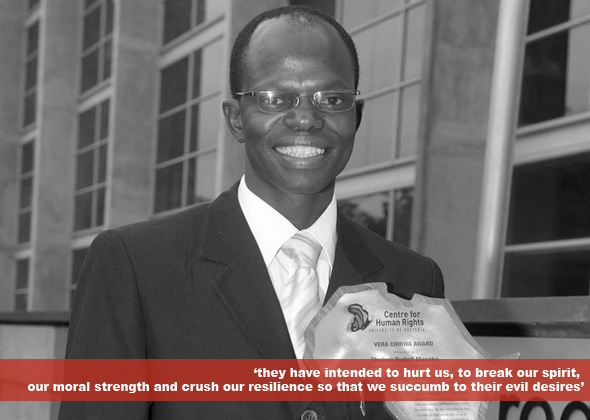
In a heartfelt open letter from prison in 2015, Thulani exposed the perpetrators’: ‘they have intended to hurt us, to break our spirit, our moral strength and crush our resilience so that we succumb to their evil desires’.[1] Unfortunately, on 21 January 2023, Thulani Maseko’s life was extinguished in a brazen act of violence at his home, an act that sent shockwaves through Eswatini and beyond. His murder, a cold-blooded response to his vocal calls for democratic reforms, occurred mere hours after King Mswati III issued ominous warnings, promising the ruthless intervention of hired mercenaries against dissenting voices.[2] Maseko was clearly assassinated; as evidenced by the gunfire that penetrated his living room window. Remarkably, the assailant or assailants refrained from entering the residence or engaging in any theft. The orchestrator behind this hit is currently under fervent speculation.
To recall, The Kingdom of Eswatini, one of the world’s last absolute monarchies, has been gripped by protests since mid-2021, with pro-democracy movements demanding democratic reforms and an end to the monarchy’s excesses. Protests, initially against police brutality, evolved into a relentless demand for democratic reforms and an end to the monarchy’s opulence.[3] In response, the government unleashed a wave of repression, leading to over 80 deaths, more than 200 injuries, and the arrest of thousands.[4] Political figures face trumped-up charges, lawyers and judges endure threats, and citizens live in perpetual fear.[5] Today, despite international pleas and efforts, King Mswati III remains unyielding, escalating the crackdown on dissent and allegedly employing mercenaries to quash opposition voices. Thulani Maseko’s assassination is a testament to the grave reality of state-sponsored violence.
Behind the scenes, Thulani’s widow, Tanele Maseko, is left in limbo. Her cries for answers echo in the void, met with a deafening silence from the authorities. In her pursuit of justice, she faces not only the unbearable grief of losing her husband but also the weight of false accusations and defamatory remarks.[6] Thulani’s legacy lives on through her determination, embodied in the #JusticeForThulani campaign.[7] Along with the shattered promise of democracy, Eswatini’s citizens find themselves trapped in a paradoxical reality, denied political participation rights by a system that suppresses opposition. Since the abrogation of the National Constitution in 1973, political parties have been banned, stifling the voice of the people.[8] The promise of democracy remains elusive, replaced by a governance system that thrives on arbitrary arrests, torture, and a culture of fear. Maseko’s role as the head of the Multi-Stakeholder Forum (MSF), a coalition of opposition parties and activists, was pivotal in unifying a fragmented political opposition. However, since his death, the MSF has struggled to maintain its force and cohesion.[9] Mswati’s divide-and-rule strategy becomes apparent as he stalls the national political dialogue agreed upon under Southern Africa Development Community (SADC) pressure, framing it within the constraints of ‘Sibaya’ – the traditional engagement of the king with his people.[10]
One year has elapsed since Maseko’s unfortunate death, and the perpetrators of the crime are still not apprehended. Despite a government declaration on 29 December 2023, expressing the police’s dedication to prioritising the cases of Maseko’s murder and other associated killings resulting from the civil unrest in June 2021, there is no apparent progress in conducting a credible inquiry.[11] The unresolved mystery of Maseko’s assassination adds to the turmoil in Eswatini. While the state remains a prime suspect, suspicions also linger about internal divisions within the opposition and the government’s potential role in orchestrating the hit. Maseko’s commitment to peaceful dialogue and non-violent approaches may have made him a target for those seeking to escalate tensions.
One year later, in the face of Eswatini’s escalating human rights crisis, the world is left grappling with the haunting memory of Thulani Maseko’s assassination. As advocates for justice, one must not waver in their pursuit of accountability and democratic reforms. The international community must stand together to hold the Eswatini government accountable, ensuring a transparent and impartial investigation. It is time for SADC to act decisively, invoking its principles to bring about meaningful change and pave the way for a democratic and just Eswatini. Thulani Maseko’s legacy must not be forgotten, and the fight for justice and human rights in Eswatini continues unabated. The absence of this human rights advocate has weakened the nation’s prospects for genuine transition. It is a collective responsibility to ensure that Maseko’s sacrifice becomes a catalyst for positive change, heralding a democratic and just future for the Kingdom of Eswatini.
[1] F Nicole ‘Human rights lawyer Thulani Maseko’ available at <https://ifex.org/faces/human-rights-lawyer-thulani-maseko/ > accessed 21 January 2024.
[2] See <https://twitter.com/SwaziNews/status/1616908559752597504?s=20&t=VGK6nRJvHNEirWDMRh_MIg >.
[3] ‘Centre for Human Rights calls on Eswatini to establish political dialogue and independent investigations of human rights violations’ (Centre for Human Rights, 30 May 2023) <https://www.chr.up.ac.za/press-statements/3445-centre-for-human-rights-calls-on-eswatini-to-establish-political-dialogue-and-independent-investigations-of-human-rights-violations >.
[4] ‘Centre for Human Rights calls on Eswatini to establish political dialogue and independent investigations of human rights violations’ (Centre for Human Rights, 30 May 2023) <https://www.chr.up.ac.za/press-statements/3445-centre-for-human-rights-calls-on-eswatini-to-establish-political-dialogue-and-independent-investigations-of-human-rights-violations >.
[5] ‘Centre for Human Rights calls on Eswatini to establish political dialogue and independent investigations of human rights violations’ (Centre for Human Rights, 30 May 2023) <https://www.chr.up.ac.za/press-statements/3445-centre-for-human-rights-calls-on-eswatini-to-establish-political-dialogue-and-independent-investigations-of-human-rights-violations >.
[6] N Masiko-Mpaka ‘No Justice for Murder of Eswatini Activist’ (Human Rights Watch, 19 January 2024) <https://www.hrw.org/news/2024/01/19/no-justice-murder-eswatini-activist >.
[7] ‘Demand justice for Thulani Maseko’ (Amnesty International) <https://www.amnesty.org/en/petition/demand-justice-for-thulani-maseko/ >.
[8] ‘Centre for Human Rights calls on Eswatini to establish political dialogue and independent investigations of human rights violations’ (Centre for Human Rights, 30 May 2023) <https://www.chr.up.ac.za/press-statements/3445-centre-for-human-rights-calls-on-eswatini-to-establish-political-dialogue-and-independent-investigations-of-human-rights-violations >.
[9] P Fabricius ‘Thulani Maseko’s absence weakens Eswatini’s struggle for democracy’ (Institute for Security Studies, 18 August 2023) <https://issafrica.org/iss-today/thulani-masekos-absence-weakens-eswatinis-struggle-for-democracy >.
[10] P Fabricius ‘Thulani Maseko’s absence weakens Eswatini’s struggle for democracy’ (Institute for Security Studies, 18 August 2023) <https://issafrica.org/iss-today/thulani-masekos-absence-weakens-eswatinis-struggle-for-democracy >.
[11] See < https://twitter.com/EswatiniGovern1/status/1740749738184790120>.
About the Author:
Lakshita Kanhiya is a dedicated, resilient and strategic human rights advocate. Her activism is grounded on a community-centred, critical-thought, human rights and social justice approach. Her academic background spans human rights law, political science, mass communication, journalism and international relations. Her professional experiences include engagement with civil society organisations, government institutions, and donor agencies. Her research interests include human rights and democratisation, digital surveillance, religion, decolonial theory and transformative constitutionalism with a focus on sexual and gender minority rights.
 AfricLaw