
Struggles and Triumphs: A close look at sexual and gender minority rights in Benin
Posted: 28 November, 2023 Filed under: Lakshita Kanhiya | Tags: Benin, bodily harm, discrimination, Freedom House Report, fundamental rights, gender minorities, harassment, human rights, national unity, non-discrimination, same-sex relations, sexual and gender minority rights, sexual assault, social stigma, violence, Working Group on Benin’s Universal Periodic Review Leave a comment Author: Lakshita Kanhiya
Human Rights Advocate
The Republic of Benin has long been considered a beacon of democracy in West Africa.[1] However, between 2016 to 2021, the country witnessed a concerning regression in human rights, as noted in the Freedom House Report of 2021.[2] Benin transitioned from a ‘free state’ to a ‘partly free state’ during this period, in terms of its democratic credentials. Despite this regression, Benin has taken significant strides in protecting the rights of sexual and gender minorities,[3] marking a notable contrast to its neighbouring countries namely Togo, Ghana, Cameroon, and Nigeria.
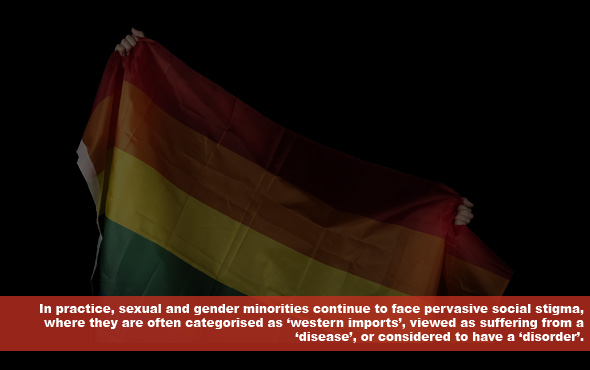
In theory, same-sex relations are not criminalised in Benin.[4] The 1990 Constitution, as amended in 2019, protects the rights of sexual and gender minorities under its articles 15, 16, and 36, which respectively guarantees the rights of everyone to life, liberty, security and personal integrity; prohibition of criminal sanctions not imposed by law at the time of the alleged conduct; and the duty of every citizen to respect others ‘without discrimination and to maintain relations with others that that safeguard, strengthen and promote mutual respect, dialogue and mutual tolerance for peace and national unity’. This constitutional framework provides a foundation for the legal protection of sexual and gender minorities. In practice, sexual and gender minorities continue to face pervasive social stigma, where they are often categorised as ‘western imports’, viewed as suffering from a ‘disease’, or considered to have a ‘disorder’.[5] Despite the absence of explicit anti-rights rhetoric, discrimination, harassment, and violence[6] against sexual and gender minorities remain prevalent in both their communities and within their families.
The international community has not overlooked the situation of sexual and gender minorities in Benin. At the 42nd meeting of the Working Group on Benin’s Universal Periodic Review and during the 53rd session of the United Nations Human Rights Council, several countries expressed concern about the challenges faced by sexual and gender minorities in Benin.[7]
According to the 1990 Constitution of Benin, the Constitutional Court serves as the highest jurisdiction for constitutional matters, responsible for safeguarding fundamental rights and freedoms.[8] Despite increasing hostility towards sexual and gender minorities in the country, the Constitutional Court has consistently reaffirmed its commitment to equality and non-discrimination for all individuals.
In 2021, Benin’s Constitutional Court made history within the Economic Community of West African States (ECOWAS) by delivering a landmark judgment in the case of Djoue, Padonou, Dossou & Public Prosecutor v Hounsinou.[9] The case involved a young man who had assaulted and subjected a transgender woman, known by her preferred name ‘Nina’, to inhuman and degrading treatment. Nina experienced discrimination based on her sexual orientation and was subjected to an attempted sexual assault by a group of men, leading to public humiliation and physical violence resulting in bodily harm and psychological distress. These events were captured on video and circulated on social media. The Constitutional Court determined that these actions constituted violations of not only article 15 and 18 of the Benin’s Constitution, but also international instruments, including article 2, 4, 5, and 12(1) of the African Charter, as well as articles 2, 3, 4, and 5 of the protocol to the African Charter on the Rights of Women in Africa.[10] This landmark judgment served as a significant step forward in the protection of sexual and gender minority rights in Benin.
Despite the country democratic setbacks, Benin continues to be a unique example in West Africa concerning the legal protection of sexual and gender minority rights. While social stigma and discrimination persist, the Constitutional Court’s unwavering commitment to equality and non-discrimination, as demonstrated in the Djoue, Padonou, Dossou & Public Prosecutor v Hounsinou case, displays the country’s potential for progress in this critical area. As international scrutiny and recommendations continue to shape the narrative, Benin stands at the crossroads of challenges and triumphs in the realm of sexual and gender minority rights.
[1] J Campbell ‘Benin’s Democracy Continues its Downward Spiral’ (Council on Foreign Relations, 30 April 2021) < https://www.cfr.org/blog/benins-democracy-continues-its-downward-spiral > accessed 3 November 2023.
[2] Freedom House ‘Democracy under siege’ (2021).
[3] The term ‘sexual and gender minority’ encompass individuals who identify as lesbian, gay, bisexual, transgender, queer, or intersex (LGBTQI+), among other gender diverse identities.
[4] For further reading, see ‘Ilga world database’ available at < https://database.ilga.org/benin-lgbti >.
[5] ‘18 000 homosexuels au Bénin : Regard de la société’ (24hauBenin) <https://www.24haubenin.info/?18-000-homosexuels-au-Benin-Regard-de-la-societe> accessed 2 November 2023.
[6] See for example ‘Benin: Threat on transgender people and their defenders following the assault on three of them’ (Amnesty International, 13 May 2021) < https://www.amnesty.org/en/latest/news/2021/05/benin-threat-on-transgender-people-and-their-defenders/ > accessed 2 November 2023.
[7] SB Agbon ‘Lgbtq+, le Bénin fait le dos rond’ (Benin Intelligent, 12 July 2023) <https://www.beninintelligent.com/lgbtq-le-benin-interpele-a-lonu-lors-du-4eme-epu/> accessed 2 November 2023.
[8] Article 114 of the 1990 Constitution of Republic of Benin.
[9] Djoue, Padonou, Dossou & Public Prosecutor v Hounsinou (2021) judgment 370-1FD-21 (Constitutional Court of Benin).
[10] Djoue, Padonou, Dossou & Public Prosecutor v Hounsinou (2021) judgment 370-1FD-21 (Constitutional Court of Benin).
About the Author:
Lakshita Kanhiya is a dedicated, resilient and strategic human rights advocate. Her activism is grounded on a community-centred, critical-thought, human rights and social justice approach. Her academic background spans human rights law, political science, mass communication, journalism and international relations. Her professional experiences include engagement with civil society organisations, government institutions, and donor agencies. Her research interests include human rights and democratisation, digital surveillance, religion, decolonial theory and transformative constitutionalism with a focus on sexual and gender minority rights.
 AfricLaw