
Men are Human Too: Challenging Existing Perceptions and Definitions of Masculinities
Posted: 30 October, 2023 Filed under: Athini Magodla | Tags: crime levels, Fatherhood, Fatherlessness, gender equality, gender liberation, gender norms, identity, Masculinities, Men, mental health, quality of life, suicide, violence, youth 1 Comment Author: Athini Magodla
Gender Programme Fellow, Centre for the Study of Violence and Reconciliation (CSVR).
Although June was Men’s Mental Health Month, noticeably, very few people know about it. This speaks volumes and shows the general disregard by society, of the issues that men face. There are limited platforms for men to engage their mental health experiences as a result of fear that holding space for men negates feminism.
The South African Society of Psychiatrists (SASOP) emphasises that suicide is one of the leading causes of death globally and the mortality rate amongst men is considerably higher compared to women. The death of local South African male celebrities such as Riky Rick, Patrick Shai and Jabu Christopher shone the spotlight on the prevalence of suicide amongst men, which sparked up debates on Twitter. The South African Depression and Anxiety Group (SADAG) reported that South African men are four times more likely to commit suicide than women – depression, anxiety and trauma are some of the contributing factors that lead men to suicide.
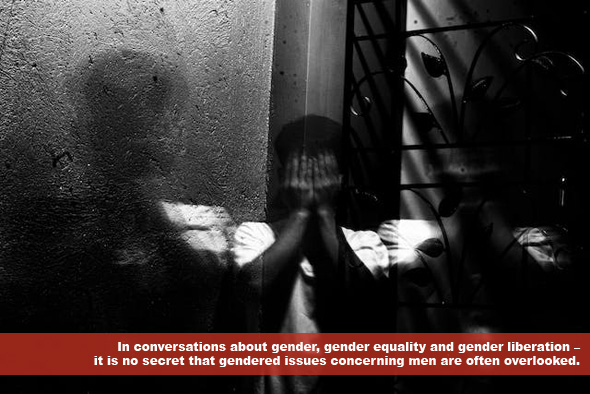
In conversations about gender, gender equality and gender liberation – it is no secret that gendered issues concerning men are often overlooked. When vaguely discussed, men are monolithically portrayed as universal perpetrators. This approach not only vilifies men but also overlooks intersectional issues that have devastating effects on men and boys, issues such as the paucity of access to economic opportunities, fatherlessness, the gruesome levels of violence that confronts the average South African – including men and young boys – and concomitantly the mental health impact of all the above mentioned has the potential to reduce the quality of life for men and boys – thus ultimately leading to suicide. The effect of these issues is not limited to a psychological/mental health damage but can also corrode one’s construction of their masculinity – essentially their own identity.
Historically, academic scholars have theorised men as being inextricably linked to violence. This skewed perception is dangerous as it not only reduces the complexities, nuances and variations of masculinities that exist outside of notions of violence. Moreover, this stereotypical perception also rehearses historical racist ideas of race and gender, particularly regarding Black men. The nexus between Black men and violence dates back to colonial times. Our commitment to continuously understand Black men only within the context of violence is dehumanising, and this uncritically perpetuates racist misconceptions of Black men. Continuously choosing to understand Black men only within the contexts of violence is dangerous as it conflates how Black men can exist as men, as fathers, as brothers, husbands, as friends – and as humans. It is easy to categorise men as perpetrators but to fully immerse ourselves in the struggles faced by men and young boys; we need to approach men as gendered beings just as much as women are. The acknowledgement of boys and men as gendered beings who are, in their own way affected by gender, does not erase women’s struggles, nor does it negate women’s liberation struggles – it simply pluralises the conversation on gender issues. This acknowledgement is essential as it can invite inclusivity, diversity and allyship from men regarding the struggle for gender equality and equity.
South Africa has a long history of (political) violence, and most young boys grew up amidst this violence – whether in private or public spaces. It is said that young boys who witnessed violence from their parents are likely to mimic this behaviour in their adult life. This emphasises the importance of viewing young boys and men as socialised gendered beings and not as merely innately violent figures.
In challenging gender norms and championing a more humanised approach towards gendered issues faced by men and young boys, there is a dire need to reevaluate language usage and be critical of existing definitions of masculinities. The current language captures men as ‘providers’, ‘head of the household’, ‘strong’ etc. These adjectives often convey men as inseparable from violence and power – further casting them as criminals. This discursive current is embedded in an essentialist epistemology and values a single kind of manhood. It devalues men who proudly exist outside of these descriptions – this can lead to discrimination and other forms of violence as they may be seen as ‘not man enough’ or/and as outsiders. Furthermore, these definitions not only come with the pressure of conforming to a single dominant idea of what it means to be a man, but it also comes with the pressures of living up to the expectations of being a ‘provider’, as an example, which means one is expected to take care of their family financially. This may be somewhat challenging for a typical South African man considering the devastating unemployment rates that overcast South Africa, especially the youth. The pressures of being seen as a provider coupled with the unemployment rate may lead most South African young boys towards crime as a means of sustainability. Thus, increasing crime levels, violence and death rates altogether.
There is a need to hone and celebrate alternative forms of masculinities that are non-violent and are free from pressure. To better understand the state of masculinity and manhood in South Africa, we must be prepared to deconstruct ideas of masculinities in the most humane way possible and be willing to move forward while reconstructing new ideas of masculinities.
About the Author:
Athini Magodla is a Gender Programme Fellow at the Centre for the Study of Violence and Reconciliation (CSVR). CSVR promotes peaceful, equal and violence-free societies. Our mission is to promote sustainable peace at community, national, regional and global levels by understanding, preventing and addressing these effects of violence and inequality.
 AfricLaw
Men are Human Too is a powerful and necessary piece. It forces us to question the way we talk about masculinity and highlights the urgent need to create spaces where men can be vulnerable without fear of judgment. I walked away from it with a lot to think about, and I truly believe that if more people engaged with these ideas, we could start making real progress toward a healthier, more balanced society.