
The relative success of fact checking services in combatting fake news – a quick patch for a systemic problem?
Posted: 26 July, 2023 Filed under: Mihail Stojanoski | Tags: accessible information, Deutsche Welle, education system, election periods, fact-checking, Fake News, independent fact-checkers, intermediary regulation, lack of rationality, logical assumption, media literacy, monetary gain, research, social media, tech companies, time-limit Leave a comment Author: Mihail Stojanoski
Human rights lawyer, Macedonia
There is little need to introduce the buzzword “fake news” and the risks associated with it. The phenomenon is nothing new but its re-emergence during the second half of the past decade is attributed in large part to the massive proliferation of news on social media and the overall lower barriers for entry into the field of news distribution.[1]
Responses were numerous and quick to appear – from the introduction of an interim take-down measure available during election periods in France to outsourcing the problem by introducing intermediary responsibility of the platforms which transmit the content in question in Germany. Setting aside the latter, which rapidly gained global popularity ,[2] an initial antidote to fake news, which was introduced swiftly and to public acclaim in many countries, was fact-checking.
It seemed like a natural response – if something is manifestly false, the most logical thing to do is to have (and finance) someone independent who will debunk the falsity and lay open the truth for everyone to see, preferably on the same medium that broadcasted the initial falsity. This inherent logic to the approach of fact-checking inspired many initiatives which undertook proactive monitoring of (fake) news online, checked the content in question and published retorts and clarifications.[3]
But can such a quick and simple fix be applied to resolve the problems brought upon by fake news? Private (and public) fact checkers have undeniably done some great work throughout the past years. It was first and foremost fact-checkers that rebutted some of former US President Trump’s statements[4] as well as inaccuracies surrounding the rollout of vaccines for Covid-19.[5] Assuming that there is will as well as sufficient means, it stands to reason that a non-negligeable part of news can be fact-checked within a reasonable time-limit. If this is so, then why is there so little overall progress in our fight against fake news? To borrow an answer to this question from Deutsche Welle, fact checking (sort of) works, but its impact is often very limited, especially on the groups which are most exposed to fake news.[6] Why is this so?
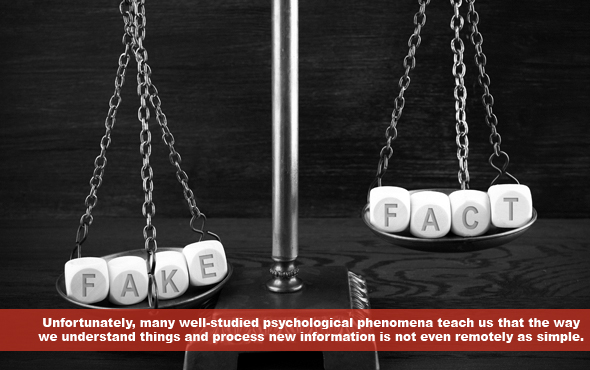
Fact-checking was initially set up in a way that assumes that people are inherently rational: when someone’s understanding of reality is proven to be false, the logical assumption is that that person would simply change their mind. Unfortunately, many well-studied psychological phenomena teach us that the way we understand things and process new information is not even remotely as simple.[7] This makes the aim of fact-checkers much more difficult to achieve. The first problem with fact-checking is reach: fact-checked posts are often shared much fewer times than the original fake post and may never reach the same audience that saw or shared the initial piece of fake news.[8] A second, (and possibly bigger problem) is the lack of rationality of the average individual discussed above. Confirmation bias, for example, plays an important part in how we pick and choose what to believe. The same applies to the sources supporting or refuting those beliefs. This problem can often lead to having legitimate arguments refused flat out by seemingly reasonable individuals.
Having said that, what can be done? Obviously work on more fronts simultaneously is needed to counteract such a complex problem.
Some fact checkers have expanded the scope of their work to include working with more stakeholders, lobbying for the change of school curricula by including media literacy, investing in research, submitting requests for corrections and working along other axes to improve their reach and influence.[9] It appears that this approach has had an increased impact,[10] but closed filter bubbles of information existing in online communities are difficult to penetrate. It might even be the case that a generational change may be required to make a great step forward, assuming that resolution is possible at all.
A lot of attention is dedicated to the approach of intermediary regulation, which includes the idea that patrolling the streets of the Internet should be first and foremost the task of the Internet’s biggest corporations.[11] This idea seems propelled by its simplicity, namely that responding to complaints and (at least initially) adjudicating them should be done by those who profit most from the technological revolution. However, adjudicating on the falsity of claims made online still relies on a significant level of fact-checking that needs to be done in the background by qualified experts.[12] The ultimate marriage of convenience in this regard would be the hiring of fact-checkers by tech giants as part of social media’s efforts to curb fake news. This approach brings new concerns, such as questions surrounding the fact-checkers’ independence but it certainly represents a change for the better overall.[13]
Media literacy has been yet another avenue which is being explored. Numerous school curricula in Europe and around the world now contain some form of media literacy education with the hope that the generations of the future will be better prepared for the struggles we are facing today. A lot of hope is being put in promoting media literacy for the young (and some adults), as there appears to be a correlation between a good education system and overall societal resilience to fake news.[14] To assess whether there is a causal relationship as well will take time, but the underlying presumption that prompted governments to invest time and effort in media literacy is based on that presumed causality. In any event, fact checking will still form an essential element of free expression in any society resilient to fake news, as there will always be outliers attempting to make use of fake news for political or monetary gain. Moreover, societies are not isolated islands and information, for better or for worse, crosses borders with ease like never before. Lastly, even the most resilient of societies are not immune to the instrumentalisation of fake news in new and unforeseen ways, by domestic or foreign actors. This means that despite the success and role of media literacy, fact-checking nonetheless has an essential role, namely to provide swift, reliable and accessible information in the case of such an event.
Some countries have relied on old-school courts ordering takedowns in procedures which in theory, should cause only the briefest of delays. In France where such a system was put in place, the mechanism requires that a judge would be requested to order a takedown of a published falsity (which may have an impact on election outcomes), and the medium in question, would, under the threat of penalties, abide by the takedown order.[15] This system, which has questionable long-term applicability, nonetheless relies on fact-finding and fact-checking, by the judge, or by independent staff specialising in fact checking. If this process is externalised to an existing fact-checking service which would serve the role of an external expert lending its expertise to the court, again, fact-checking remains at the heart of the procedure.
We can conclude that on its face, simple fact-checking has limited potential on account of various internal and external factors. However, taken as a part of a broader anti-fake news policy it has an essential role to play. Inherent limitations to fact-checking such as its limited reach should not discourage societies and private entities from pursuing this approach further. Whether this should be done through continued support for independent fact-checking organisations or by mandating large tech companies to conduct some kind of initial fact-checking is an open question at the moment,.
For independent fact-checkers, verifying and publishing the corrected information is only the most elemental role that they can play. This role can be (and is being) expanded in various ways as discussed above and can be an interesting service that third parties who do not possess the necessary skills might seek to procure. In any event, fact-checking has its place in the modern world, because it is only by using an all-encompassing long-term policy approach where fact-checking plays a significant role, that we can hope to build up resilience against modern-day challenges. In spite of the setbacks discussed above, fact-checking would be essential in any holistic approach aimed at tackling fake news.
[1] Linda Weiser Friedman and Hershey H Friedman, ‘The New Media Technologies: Overview and Research Framework’ [2008] SSRN Electronic Journal 2 <http://www.ssrn.com/abstract=1116771> accessed 26 September 2021.
[2] See for example, Oreste Pollicino, ‘Fundamental Rights as Bycatch – Russia’s Anti-Fake News Legislation’ (28 March 2019) <verfassungsblog.de/fundamental-rights-as-bycatch-russias-anti-fake-news-legislation/> accessed 2 June 2021.
[3] Among many others, Les Décodeurs in France, Politifact in the United States, BBC reality check in the United Kingdom, Africa Check in South Africa etc.
[4] Politifact found that only about 3% of his statements were true in total, and a total of 11% were true or mostly true. See https://www.politifact.com/personalities/donald-trump/
[5] See Anjana Susarla, ‘Big tech has a vaccine misinformation problem – here’s what a social media expert recommends‘ The Conversation, 29 July 2021, available at https://theconversation.com/big-tech-has-a-vaccine-misinformation-problem-heres-what-a-social-media-expert-recommends-164987
[6] ‘Is fact-checking effective? A critical review of what works – and what doesn’t’, Deutsche Welle, 12 October 2020, available on https://akademie.dw.com/en/is-fact-checking-effective-a-critical-review-of-what-works-and-what-doesnt/a-55248257
[7] For example, confirmation bias and cognitive dissonance.
[8] See, for example, Mihail Stojanoski, ‘Fake News, Child-Kidnapping Gangs and Violence against the Roma Community in France: Making Social Media Accountable’, International Journal of Rule of Law, Transitional Justice and Human Rights (Konrad-Adenauer-Stiftung eV 2020) 57.
[9] This is sometimes referred to as ‘second generation fact-checking.’ See ‘Fact checking doesn’t work (the way you think it does)’, Full Fact blog, 20 June 2019, available on https://fullfact.org/blog/2019/jun/how-fact-checking-works/
[10] Ibid.
[11] For an extensive analysis on the issue, see Aleksandra Kuczerawy, Intermediary Liability and Freedom of Expression in the EU: From Concepts to Safeguards (KU Leuven Centre for IT&IP Law Series, Intersentia 2018).
[12] This observation knowingly leaves aside key concerns about this approach, such as issues arising from the privatisation of justice and the conflict between the (imposed) obligation to adjudicate on such conflicts with the companies’ freedom to do business.
[13] The approach taken by Twitter, for example, to add context to posts through users’ contributions seems a welcome innovation. It should be said that the context added through these ‘community notes’ is highly reliant on the “wisdom of the masses” which has its obvious drawbacks, but nonetheless is an approach which does not rely on takedowns and is therefore on the face of it, seems to impose a lesser interference with users’ freedom of expression.
[14] The example discussed here is from the Nordic countries in Europe, where the education systems are consistently ranked as some of the best in the world. At the same time these societies are some of the most resilient to fake news. See John Henley, How Finland starts its fight against fake news in primary schools (The Guardian, 29 January 2020) available on https://www.theguardian.com/world/2020/jan/28/fact-from-fiction-finlands-new-lessons-in-combating-fake-news
[15] See Michael-Ross Fiorentino, ‘France passes controversial ‘fake news’ law’, Euronews, 22 November 2018, available on https://www.euronews.com/2018/11/22/france-passes-controversial-fake-news-law
About the Author:
Mihail Stojanoski is a Macedonian human rights lawyer working as an administrator in the secretariat of the monitoring mechanisms of the Istanbul Convention at the Council of Europe in Strasbourg. In the past, he has worked as a case-processing lawyer at the European Court of Human Rights in Strasbourg, France and he was the assistant manager and human rights adviser of the European Roma Rights Centre in Brussels, Belgium. He writes and publishes in the field of European human rights, in particular their digital dimension.
 AfricLaw