
‘Afrofuturism’, Pop Culture & Mainstreaming TWAIL
Posted: 13 July, 2023 Filed under: Adithya Variath | Tags: academic exploration, Afrofuturism, Black Panther, hierarchical problems, human rights, imperialism, international law, Karal Vašák, nanotechnology, political legitimacy, popular culture, technology, theoretical frameworks, TWAIL Leave a comment Author: Adithya Variath
Assistant Professor, Maharashtra National Law University Mumbai, India
Despite Africa’s growing geopolitical significance, its under-representation and under-participation in the discourse of international law-making is a paradox. The absence of local contexts and an indigenous approach to law has been bedevilling the culture of academic exploration and human rights law research in third-world countries. For the first world global academic circle, any effort to provide an alternative structure (like TWAIL or Afrofuturism) face hostility and resistance from European counterparts. This is also because imperialism, as a post-colonial leftover of defining the context and content of international law has penetrated the understanding and pedagogies of human rights law in Africa.
The ignorance of global north academia towards African identity and African literature becomes more relevant in the debates of human rights. While academic discourses have attempted to mainstream African identity and ontological beliefs, popular culture has also played a very interesting role. Afrofuturism and technoculture became a buzzword in pop culture movement with the success of Black Panther. Afrofuturism is a contemporary movement to mainstream the local context of the African diaspora through art, music, philosophy and various forms of media. It can also be considered as an alternative interpretative analysis of a social context in human rights regime. While recent advances in technology have accelerated social developments in the region, technology has also accelerated the development of unprecedented forms of rights moving ahead of Karal Vašák’s three generations.
The neologism ‘Right’, has two moral and political notions: ‘rectitude’ and ‘entitlement’. What makes the ‘right’ reactive is that violations of rights are a particular kind of injustice with a distinctive force and remedial logic. For Jack Donnelly, ’[i]n its social interaction, rights crystallise in three forms – assertive exercise, active respect and objective enjoyment.’ However, to qualify as a human right, ‘rights’ have to be realised as social practices and social values and become the norm of political legitimacy. This developmental shift has also given rise to fifth-generation rights, of which ‘governmentality’ is the crudest test to interweave the relationship between man and technology.
The fifth generation of human rights is a product of the interlinking of the fourth industrial revolution and tech-regulated rights. The fifth generation of human rights is a result of the orientation of the disoriented third and fourth generations of human rights reading through the prism of third-world approaches to human rights. Fifth-generation rights can be described as a techno-economic identity or ideology. Through this spectrum, Afrofuturism can view the present and future of these rights.
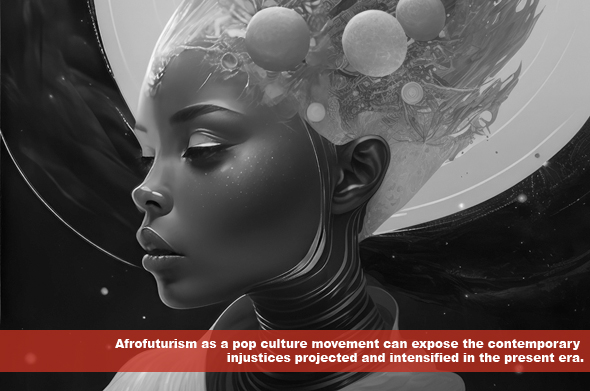
Afrofuturism is an all-inclusive approach with an academic potential to encapsulate aesthetics and the future of law vis-à-vis science, technology and its social theory through experiences and perspectives of African diasporic communities. Afrofuturism as a pop culture movement can expose the contemporary injustices projected and intensified in the present era. The afrofuturist notion of law and technology unsettles the gaps in technoculture and posthumanism. Afrofuturism as a pedagogical movement can encapsulate ‘other stories of African communities’ and ‘mainstream socio-legal approaches to culture, technology, and things to come’.
Fifth-generation human rights in the African context results from inequality and oppression. Afrofuturistic notions use real-world history and imagery and connect the future and technology with history. Afrofuturism challenges the ideas of law and its intersection with local contexts of race, gender, science, and technology. To tackle the violation of the technologically motivated fifth-generation of human rights, Afrodiasporic culture and aesthetic values have to become a part of legal pedagogy. There has to be an academic intervention to understand the impact of new technologies on human rights. The fifth generation of rights suffers from a lack of holistic legal attention to its impact. As the continent suffers from a social crisis like technophobia and technological illiteracy, a pedagogical framework has to be developed to sensitise the citizenry.
A subaltern world order pins its hopes on the conscience of the society, however, the subalterns have remained elusive to local propositions and contexts to defend their worldviews and relative ideas. The rapid development of technology in areas like cyberspace, nanotechnology, and space technologies are restructuring the traditional models of law in the digital realm. This mandates a new social contract to demystify the deterministic views of the legal system and bridge the gaps created by inadequate socio-legal theoretical frameworks.
Adoption of any new approach to the law requires its acclimatization into patterns of teaching models of law (including human rights) in the domestic legal system. These new approaches should have a local context. However, these local contexts often come from indigenous thoughts that face resistance from universalism. In this context, this pessimism about alternative identities like African culture also exposes the hierarchical problems of teaching human rights. One such alternative identity that has the potential to radically transform the human rights culture is “Afrofuturism”.
Afrofuturism can trickle down to ‘non-colonialism and international law’, ‘critical approaches to international law’ and ‘post-coloniality and decoloniality’ becoming a part of international law syllabus and pedagogy in Africa. Teaching Afrofuturism in international law can create a greater normative structure of justice and freedom in the future or alternative places, times, or realities to accommodate new technologies.
Restructuring the pedagogy of reading and researching critical legal studies in international law can evolve a ‘fifth generation’ human rights approach. Afrofuturism can solve the crisis of identity of the fifth generation of rights. This would accelerate cross-disciplinary discussion about the opportunities and challenges of technology in the unexplored realms of international law. Afrofuturism can provide an alternative framework to techno-economic approaches of ‘third world-ism’ and ‘international human rights’. Legal education can be employed as an appropriate tool to revise and re-examine law from the perspective of science fiction in order to recast ideas on the past, present, and future of the cultural aesthetics of Africa.
About the Author:
Adithya Variath is an Assistant Professor of Law and Coordinator of the Centre for Research in Air and Space Law at Maharashtra National Law University Mumbai, India. He is also a Research Fellow at the Information Society Law Center, University of Milan, Italy. He previously served as a Research Assistant to the Government of India Ministry of Commerce and Industry’s Department for Promotion of Industry and Internal Trade (DPIIT) – IPR Chair. As a researcher, his work focuses on International Law, R2P, TWAIL and AI. He was a Research Group Member at the Center for AI and Digital Policy, USA.
 AfricLaw