
ICTs and Access to judicial remedies during the COVID-19 era
Posted: 6 July, 2023 Filed under: Namatirayi Ngwasha | Tags: African countries, CaseLines, COVID-19, e-filing systems, Electronic Case Management System, ICT functions, ICT technologies, IECMS, lack of consistency, legislation, lockdown measures, National Judicial Council Guidelines, teleconferencing, videoconferencing Leave a comment Author: Namatirayi Ngwasha
Lawyer
COVID-19 and access to the courts
The increase in the number of COVID-19 cases in 2020 forced many countries in Africa to resort to the adoption of lockdown measures. Operational changes that were made included amending court rules and operating procedures. Technological methods used include video conferencing and live broadcast to ensure public access to hearings. In some instances, the number of staff coming to work was cut or staff had to work on rotational bases at the courts to enable social distancing. As a result, some of the cases fell off the court system and there was lack of consistency of handling cases due to the rotation of court staff.
The paper seeks to investigate how access to the courts was affected by the COVID-19 pandemic and how the different courts adapted.
How African countries have fared
In South Africa measures taken included restriction of entry into the courts save for urgent and essential matters. The South African courts were made accessible with the use of ICT functions such as the CaseLines, an online court evidence management application. Through the system the litigants could file and upload pleadings and other documents electronically and present their cases and arguments during Court proceedings. CaseLines allowed Judges and legal teams the opportunity to prepare, collate, redact, share, and present evidence/ legal bundles, documentary, and video evidence in a single online system efficiently and securely.
In Botswana when the lockdown was declared the Chief Justice issued a Practice Directive No 2 of 2020. The directive stopped court hearings except for urgent cases. The Botswana judiciary introduced a duty roster system for Magistrates, judges, and Registrar. Litigants would send in their applications to the court official on duty. The court official would then decide if the application was urgent and then register it to be heard.
In Namibia all criminal cases were postponed and the High court of Namibia was only open for urgent matters and bail applications. Staff such as the assistant Registrar worked from home utilising platforms such as court electronic case management, document filing system and e-justice systems.
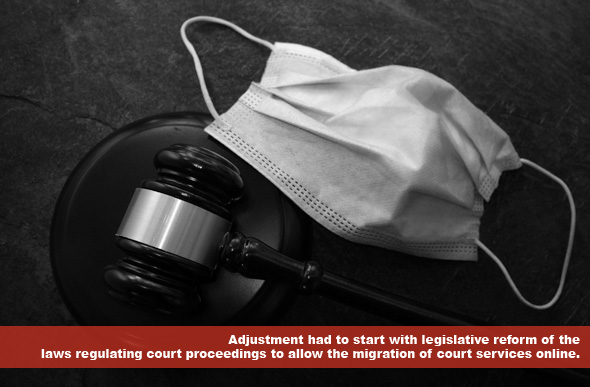
The Zimbabwean Government announced a total lockdown and the courts took a similar approach with most courts operating at limited capacity. Unfortunately, in Zimbabwe there had not been much development of technology enabled means for access to courts. Adjustment had to start with legislative reform of the laws regulating court proceedings to allow the migration of court services online.
In Mozambique a state of emergency was declared. As a result, all court hearings were stopped and could not be conducted for the duration of the state of emergency. Only urgent proceedings were conducted.
Zambia made use of ICT, as Practice direction for civil cases, provided that notice could be served by SMS, WhatsApp and Electronic mail (email). The judge or judicial officer could conduct court proceedings using teleconferencing, videoconferencing, and other appropriate technology.
Rwanda had in place ICT enabled modes of operating. Thus, during the pandemic access to the courts was minimally disrupted. Rwanda Integrated Electronic Case Management System IECMS enabled litigants, lawyers, court officials to do case filing and follow up, case registration, adjudication and judgment execution. The IECMS was handy in ensuring continued access to the courts even during the lockdown.
Kenya went into lockdown and the courts were closed to the public. In July 2020 the e-filing systems was introduced. The system enabled litigants to file and track their cases. Cases of prisoners were conducted virtually. Other proceedings took place using online platforms such as Skype, Zoom and Microsoft teams.
In Nigeria when the country went into lockdown, the Chief justice of Nigeria issued a circular suspending court activities save for urgent matters. The chief justice issued National Judicial Council Guidelines for court virtual sittings and related matters. Consequently, Chief Justices of the different states in Nigeria issued practice directives. The Lagos Practice directive enabled court processes to be served electronically via WhatsApp or electronic mail.
Life after COVID-19
The pandemic worsened the justice gap as access to courts was restricted. The demand for justice has not decreased creating a need for courts to evolve and adopt ICT strategies to enable access to the courts. There is a need for a holistic approach as courts adopt digital technologies. Recently some judiciaries have been taking initiatives and partnering with donors to automate and digitalize courts and court processes. For instance, to mitigate challenges posed by the COVID-19, the Zimbabwe courts have gone digital. Prior to lockdown Nigeria had already begun the process of enabling access to the courts through digital means. Rwanda is in the process of computerizing the courts with focus on the rural courts.
Conclusion
COVID-19 showed the different levels of ICT enabled courts in many African countries. Though ICT enabled court processes ensure access to justice, other key elements need to be addressed. These included the cost of data, connectivity challenges, digital literacy and awareness of the existence of such systems by stakeholders. The larger population in African countries resides in the rural areas where there are connectivity challenges, which hampers access to ICT enabled court processes. Further, legislation needs to be reformed to enable ICT technologies to be used for court processes.
About the Author:
Namatirayi Ngwasha is a lawyer with over 14 years’ experience in the legal and developmental sectors with a focus on human rights and the rule of law with a strong background in human rights advocacy, law, policy analysis, advocacy, research, strategic litigation and training of service providers on the law and human rights.
 AfricLaw