
#gameofphones: Examining the social media regulatory regimes across Africa
Posted: 22 June, 2023 Filed under: Blessing Temitope Oguntuase | Tags: Access to Information, Africa, corruption, Facebook, freedom of expression, fundamental human rights, gender-based violence, ideological conflicts, information, Instagram, internet shutdown, military operations, political campaigns, social media, social media movements, social media tax, warfare, Whatsapp Leave a comment Author: Blessing Temitope Oguntuase
Lawyer
Blood, gore, and broken human bones sprawled across the blood tainted soil for miles and miles, the stereotypical image of a war-torn battlefield. Over a century ago, one might have thought it impossible for the iconic swords and bullets to be traded for smartphones and twiddling fingers. Who could have imagined the metal battle armours being replaced with the anonymity of a social media profile?
Social media, comprising online platforms which facilitate the sharing of thoughts, ideas, and information across continents, has emerged as an effective tool of warfare. This digital space has quickly become the new battleground, where competing powers confront themselves over various issues ranging from political campaigns and military operations to ideological conflicts. These online platforms such as Twitter, Facebook, Instagram and Whatsapp are increasingly being used by diverse actors with real-world goals to push their agendas and shape the perceptions and behaviours of individuals and societies at large. Some of the actors include private citizens, human rights activists, public officials and governments.
Recent years have witnessed a scuffle between young African citizens in coalition with human rights activists and African governments. These young Africans have initiated social media campaigns and movements using hashtags to call for social and civil justice across the continent. The year 2020 was marked by notable social media led movements such as the South African #AMINEXT movement relating to gender-based violence, the #ZimbabweanLivesMatter movement, and the Namibian #SHUTITALLDOWN movement. Among these movements was the iconic #ENDSARS movement that trended across the world.
#ENDSARS started as a social media campaign in 2017, where Nigerian youths used the hashtag to document human rights transgressions and abuses carried out by the Nigerian Special-Anti Robbery Squad (SARS). By October 2020, this online campaign had evolved into a series of mass protests against police brutality in Nigeria and eventually resulted in a merger between “real-time” protests and digital protests across the world. The #ENDSARS movement serves as a pristine depiction of the power that social media holds as a tool of warfare. During these protests, social media platforms such as Twitter were utilised to mobilize and facilitate the real-time protests and push for police reforms and the end to police brutality in Nigeria. This technology was further used to ensure that the #ENDSARS movement gained momentum and global visibility. This objective was met as the hashtag generated nearly thirty million tweets within the first 48 hours of the movement.
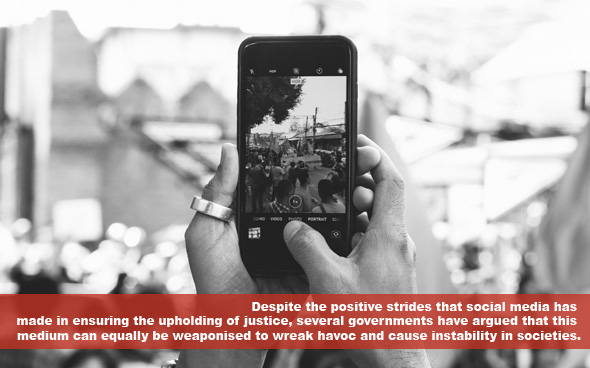
Despite the positive strides that social media has made in ensuring the upholding of justice, several governments have argued that this medium can equally be weaponised to wreak havoc and cause instability in societies. A recent example of such an instance is the unfortunate events surrounding the #ZUMAUNREST which occurred in the South African provinces of Gauteng and Kwa-Zulu Natal in July 2021. These protests were initially sparked by the imprisonment of former South African President Jacob Zuma because he failed to appear before the Constitutional Court in proceedings regarding a corruption inquiry. This protest spilled on to social media platforms such as Facebook and Twitter. Fake images, videos, and text messages were shared on these platforms to mobilise the public to participate in the looting of shops. Additionally, social media was used to incite violent attacks and cause fear and panic across the country. This unrest led to the loss of over 117 lives and billions of Rands in addition to the destruction of property and loss of means of livelihood of small and middle-income earning families.
A notable feature of most social media movements is that they often materialise into in person movements and protests. The increased surge in such movements over the recent years has seen several African States imposing policies in a bid to regulate the digital space and activities of individuals within their territories. Such action was witnessed as an aftermath of the #ENDSARS movement, where the Nigerian government publicly sought to regulate social media through the re-introduction of the Protection from Internet Falsehood and Manipulations Bill of 2019. This Bill sought to criminalise the use of social media in spreading false or malicious information such as statements deemed to diminish the public confidence in the Nigerian government. While this Bill is yet to become law in the country, the Nigerian government has succeeded in imposing a ban on Twitter, which played a key role in the #ENDSARS movement, on June 5, 2021. The government argued that the platform was being used to threaten and undermine the corporate existence of the country as its rationale for the Twitter Ban. The ban was eventually lifted in January 2022.
The move to restrict social media activities is not a novel phenomenon in Africa as countries such as Uganda have long sought to restrict the social media engagement of their citizens. In 2018, the Ugandan government introduced a social media tax that requires that citizens pay a daily levy to gain access to any social media platform. The imposition of such taxes restricts a significant portion of the Ugandan population by placing financial constraints on their access to social media thereby discouraging the use of such media. During the 2021 elections, the government of Uganda ordered an internet shutdown under the rubric of national security. A more egregious case of an internet shutdown is the experience of the Tigray region that has gone on for more than two years with blocked access to mobile internet. Over 15 African countries have reportedly restricted or completely switched off the internet or social media access over the past five years.
The imposition of these laws and policies has resulted in a battle between the digital rights of freedom of expression and access to information, and the obligation of a State to ensure national security and public order per the sovereign powers of a State. This is because while the regulation of social media may be necessary to prevent the misuse of this technology to threaten national security and public order, such regulation is likely to infringe on the digital rights of individuals.
It is thus important to question whether the regulation of social media by States at the expense of certain human rights is indeed legally permissible under international law. The simple answer to this is in the affirmative. The rights of freedom of expression and access to information, despite being fundamental human rights, are not absolute. This implies that these rights may be restricted under certain circumstances. Under the rules of international human rights law, such restrictions have to be prescribed by the law; serve a legitimate aim; and be necessary and proportionate in a democratic society. It is however crucial that such regulation must be executed under the domestic law of the State to protect national interests.
While the regulation of social media by States is legally permissible, it is not without shortcomings. The first shortfall of the regulation of social media is that the powers given to States to implement domestic laws regulating social media are overly broad. The absence of a concrete criteria to determine what would constitute a threat to national security or public safety makes it easy for States to violate digital rights under the guise of the protection of national security and public order. Despite the existence of legal instruments such as the Declaration of Principles on Freedom of Expression and Access to Information in Africa and the African Declaration on Internet Rights and Freedom, which call on African states to protect digital rights, there remains ongoing implementations of restrictive social media policies by African States. It is thus difficult to ensure a balance between the regulation of social media and the protection of human rights unless an independent body is established to oversee the regulation process.
Another shortfall is that the regulation of social media by State governments alone is inadequate to counter the negative effects of social media. Research has shown that the restriction and regulation of social media activities by State governments is sometimes futile as it does not necessarily reduce the harmful effects of social media. This is because technology is continuously evolving and therefore there are various means of bypassing the regulatory obstacles imposed by governments. A clear illustration of this is the use of Virtual Private Networks (VPNs) by many Nigerian citizens to circumvent the Twitter ban imposed by the Nigerian government to control the activities and access of its citizens to this social media platform.
In light of the above, it is sufficient to conclude that as the use of social media in mobilising movements and redesigning societies is at its early stages, it is essential to engage in discussions surrounding this technology as it is constantly evolving. It is essential to also note that the inclusion of ‘Big Tech’ companies, which create and own these social media platforms in these discussions will be beneficial in ensuring a holistic solution to the gaps regarding the regulation of social media.
About the Author:
Blessing Temitope Oguntuase is a lawyer with expertise in litigation and corporate law practice. Her interests span across the fields of Human Rights, technology and cyber law, telecommunications law and data privacy and protection. She holds a Bachelor of Laws (LLB) Degree and a Master of Laws specializing in International Air, Space and Telecommunications Law from the esteemed University of Pretoria. She is a member of the Golden Key International Honorary Society and obtained Academic Honorary Colors upon obtaining her LLB with distinction.
 AfricLaw